
All about Miniature Pinschers
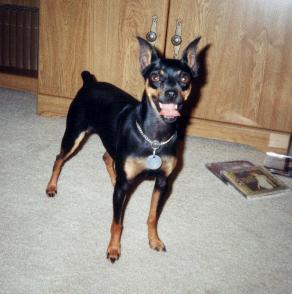
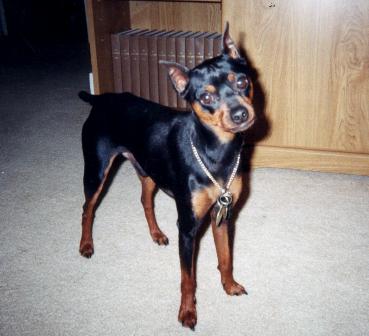
I would like to extend a large welcome to all who have entered. This will be a fantastic place to find out info on not only Min Pins and breeding, but info on other dogs as well. I am hoping that there will be many people who enjoy this site as well as share their thoughts and feelings, experiences, pictures, and advice on the message board (see link). Please feel free to post or e-mail me at any time. This is a family site and so all ages and backgrounds are invited. Please sit back, relax, and enjoy yourself and please do check back often, as this site is continuously under construction.

Introduction
The Miniature Pinscher, a breed of toy dog, has been around for over 300 years, originating from Germany, but have also been bred in the Scandinavian countries for a long time. The Pinscher-Schnauzer Klub, gave the breed it's initial standard.
The Miniature Pinscher is somewhat like the Doberman on a smaller scale. Although it resembles the Doberman, it is not a miniature variety of the Doberman. Despite their similar appearances, the two breeds share no direct genetic link. This breed is a crossing of a German Short-hair Pinscher with smaller breeds, possibly the Dachshund or Italian Greyhound. But it has a nature and a way about it that reminds you of a much larger dog, often keener than a dog twice it's size. They were bred to be ratters and good barking watchdogs.
The Miniature Pinscher also known as the Min Pin is a well-balanced, compact, well-groomed dog who is proud, vigorous, alert and high-spirited. They are also noted for their lively temperment, intelligence and pep. Although the Min Pin may look fragile, they are in fact a very sturdy dog and rugged in their size. A fun loving breed who is great in the show ring or makes a clever companion.
They have a flat head tapering toward the muzzle; dark, slightly oval eyes; upstanding ears; a gracefully curved neck; a compact muscular body; and a broad tail. It's short, flat, hard coat is either black with tan, red, or yellow markings; solid red; solid brown; or brown with yellow or red markings. As far as shedding, you can probably expect to see a few hairs on your white blouse or t-shirt. The breed stands 10 to 12 1/2 inches at that shoulder and weighs 8 to 11 pounds. Given their docile and friendly dispositions, Min Pins made a fortunate exodus across the globe. Their fondness for home and master is exceptional, and a Miniature Pinscher puppy is a good choice for the right family. There is minimal grooming needed and a short walk or two will give them the necessary amount of exercise.
Exercise is an essential element in your Min Pin's development, both physically and mentally. While it is important to monitor your dog's dietary habits and provide the proper medical attention, it is equally imperative to provide your dog with adequate exercise. This is expecially important if your dog is confined during the day, while you are at work or school. An alloted time should be set aside each day for exercise. A walk around the block or a game of fetch would be ideal; you can also jog or bicycle with your dog. Indoor dogs can be taken outdoors for exercise after meals; a housebroken dog will be accustomed to this arrangement and can gain some exercise time while taking care of it's "business."
Familiarize your dog with a collar and leash as soon as possible. You might even allow your Min Pin puppy to wear the collar a few days before attaching a leash. If you take your dog on a long walk through the park or playground, keep it on the leash; the leash should be long enough to allow your dog sufficient room to run and jump. Also, make sure that your dog is wearing a tag or collar which identifies it's name and address in case it were to become separated from you.
Always allow your dog some warm-up time before engaging in heavy play. Since most Min Pins are enthusiastic about exercise, you should provide ample time for activity and exertion. This enables a dog to look it's best by staying in shape, and is a great form of stress or tension release.
