Our American Parakeets
BACK
Pretty much everyone starts breeding birds with a pair of parakeets or
finches. For us, it was parakeets. Where else can you find
such a variety of color for such a small price? They are VERY
intelligent birds and make wonderful pets. They are easy to care
for and are able to learn a number of tricks. While we have
expanded our breeding into much more expensive birds, we still keep a
small collection of parakeets to breed. We only breed very odd
colors in hopes that we will produce odd-colored babies.
You will not find the average pet-store parakeet in our
collection!
Breeding? If they are fed a proper diet, and have a nest box
available, American Parakeets will readily breed. In fact, they
are one of the few caged birds that must be stopped from breeding for
their own health. Most birds regulate their breeding cycles
naturally so that they don't lay too many eggs in one year.
Parakeets will not naturally regulate. They will breed over and
over again until the hen dies or is too sick to breed. This
is the only real concern with breeding parakeets. The breeder
must intervene to interrupt the breeding cycle. They should
always be fed a good quality seed mix if they are breeding or not. We
recommend Kaytee Forty Diet.
Parakeets should be offered a variety of other foods on a regular
basis, especially if they are expected to breed.
crushed boiled egg (shell and all)
Fresh fruits and veggies (DO NOT FEED avacado or lettuce)
They love any kind of peppers, bell pepper hearts are great, but the
hotter the better!
Fresh corn on the cob.
They can eat pretty much anything we can, as long as you wash
everything really well and don't feed candy, salt, or any other overly
sweet or salty
foods.
Anyhow, all that info can be found on the web with a simple Google
search. I'll simply post some pictures of our birds.
Here are some pictures of our newest parents and their babies.
The first picture is the hen. She's a very pretty bird!

In the picture below, on the right is her mate. We hope their
babies look a lot like
them. However, with most parakeets, you can never tell what you
are
going to get until you breed them. Notice the size of the
box. This is actually a little smaller than what we normally use
for parakeets.
It's fine for a clutch of 3 or 4 babies, but anymore than that and the
smaller babies may get suffocated by the older babies as they get
bigger. We like to use a Prevue Hendryx Lovebird box. It's
a good bit bigger and we've never lost a baby due to suffocation.
We used this box because the hen refused to go into a larger box.
We are going to change boxes once this clutch is weened.
Hopefully she'll adjust to the new box in time.

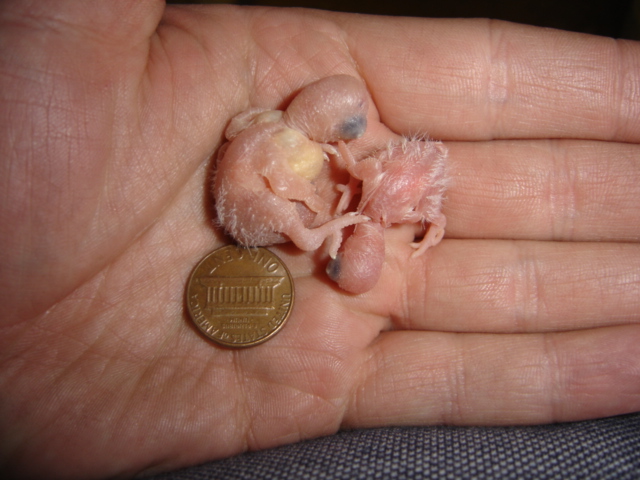
Below is a picture of their first two babies. The smallest one
has just hatched, the other is only two days old. Notice how tiny
they are! They hatch out with their eyes sealed shut, totally
dependent on their parents for food and warmth. Baby parakeets
must be kept warm or they will die. It usually requires
both
parents to successfully raise a clutch of babies. Often, a single
mother may
abondon her clutch if she loses her mate. Single parenthood is
very hard on a parakeet and can sometimes damage the health of the
bird.
The adults don't mind me holding the babies as long as I put them back
rather quickly. Babies are very fragile at this age and should
only be handled for short periods of time. They must be fed often
and kept warm. Parakeets will not abondon their babies simply
because they were held. They cannot "smell" the human on their
babies. In fact, most birds have a VERY poor sense of
smell. We do handle the babies on a regular basis to monitor the
health and development of each chick and to help prepare them to be
pets in the future. This is especially important once they have
opened their eyes so they can learn to trust humans.
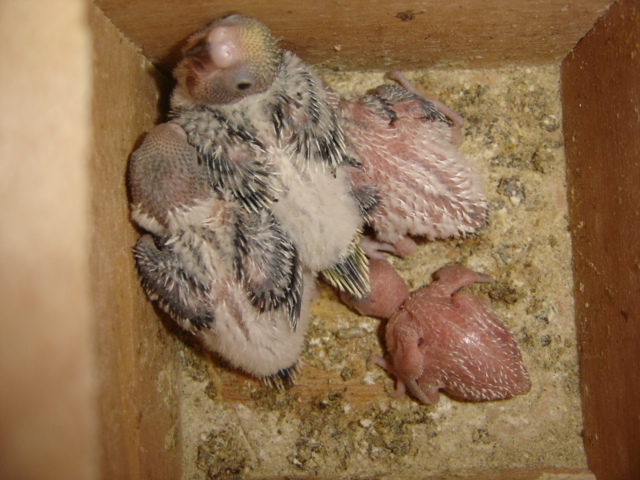
Baby birds grow REALLY fast so that they can be strong enough to leave
the nest within just a few weeks. Here are the same babies 12
days later. Their younger two siblings (who had not hatched
in the pictures above) can be seen in this picture as well. Notice the
blue pin feathers on the older chicks. Also notice the
yellow-face mutation already showing up on the oldest baby.
Parakeets usually lay an egg every other day until they are satisfied
with the size of their clutch. Sometimes the hen doesn't sit on
the first couple eggs until she has 3 or more. Our hen started
sitting as soon as she layed the first egg. Notice the difference
in size that just two days make between each baby. They grow
really fast!
Oh it looks like he's gonna have yellow tail feathers as well.
He's gonna look a lot like his mom!

In the above picture, you can see the oldest baby up close.
Notice how big
his crop is. It's almost as big as his belly!
In the next picture, the oldest baby is now 20 days old. Amazing
how much he's grown in such a short time. Notice the bright
yellow face and notice how much he's looking like his mom. This
is going to be a VERY pretty parakeet!

In the next picture, you can see all 4 babies. This pic was taken
at the same time as the picture above. The oldest baby is the
third baby from the left. Notice the second oldest is going to be
whiteface, like his dad. It looks like all 4 babies are going to
be very similar in color to their parents.

In a few weeks, when he
begins to wean, the crop will shrink down and the baby will lose a lot
of baby weight. The shape of the bird will change dramatically
over
the period of just one week as they begin to venture out into the cage
to climb and exercise. Within a couple weeks, the babies
will learn to fly and will soon learn to start eating seed on their
own.
We have a lot more breeder parakeets. However, they are all
taking a break at this time. I hope to add more pictures of the
babies seen above as they grow up. We will also have more
pictures of other breeders and their babies when they begin breeding
again.
Now, these parakeets are being raised by their parents. We will
eventually have hand-fed parakeets available. Hand-fed parakeets
make
the perfect pet bird from day one. They will often prefer to come
out
of their cage and spend time with their human companion. To be
honest,
they actually make better pets than most of the much more expensive
birds.
If you are interested in purchasing a parakeet,
please drop us an Email.
If we do not have what you want available, we will help you find
someone who does. Also, feel free to email us with any
questions about the care or breeding of parakeets.
Please do not use ANY of the pictures on this page
without written permission from the author.