Our Parrotlets:
Parrotlets are delightful little
birds!
As the worlds smallest true parrot, they are very intelligent and quite
comical. They are quickly becoming one of the most popular
parrots today. As the focus of our breeding program, they even
inspired the naming of our Aviary. They are small birds, about the size
of a
parakeet, but with a short tail. They are similar in shape to the
common lovebird, but
about half the size. In fact, they fit comfortably into the brest
pocket of most shirts! Our pet, Sprite, loves to ride around in my
pocket and has been in many stores without ANYONE knowing!
Occasionally, he'll stick his little head up to peak out and drop right
back down to hide. It seems that a warm, cozy, dark pocket makes
a perfect place for a quick nap for these guys. Although, don't
be fooled by his quick nap. Parrotlets are often very busy little
animals and consume quite a bit of energy for such a small bird.
They make wonderful pets for many reasons. Being
small, they don't make nearly as large of a mess as the big birds
do. Their calls, are not nearly as loud as that of the lovebirds
and larger parrots. And while they usually aren't quite as
talkative as the larger birds, they often do learn to talk. They
are sexually dimorphic, which means you can sex pacific parrotlets
simply by their coloration. Males usually have blue markings
around the eyes, on the flight feathers, and on the rump while femals
lack these additional markings. Albinos are the only exception to
this rule as they have no pigment anywhere on their body. They
must be sexed under a blacklight.
Since these birds have become so very popular,
there has been great interest in breeding these birds. Please do
not think it's an easy task, it isn't! As intelligent as
they are, they can be quite difficult to successfully breed.
However, for all those who are interested in breeding this interesting
little bird, please drop me an email for additional information.
Pacific parrotlets come in a wide variety of
colors today. The natural color of the pacific parrotlet is a
green color with blue markings on the males. Breeders have
expanded the colors to a wide variety including yellow, blue, lutino,
fallow, white, pastel and several others.
Please note, ALL
parrotlets bred by us are
International Parrotlet Society (IPS) banded! Bands will
have
IPS, MJR, SC, and a bird number on each band. We keep detailed history
on every parrotlet we breed and we go to great lengths to gather all
relevant
information on the parents. We pay attention to detail! We
study each mutation and try our best to breed them in the most
responsible way possible. We will send digital pictures of each
breeding pair that are responsible for each baby upon request.
This way you know what you are buying when you buy from us. We do
not like surprises, especially for our customers! If we say it's
split to a color, then there
is no doubt that the bird is
split to that color.
Below are a few pictures of our adult breeder parrotlets. As you can see, they are quite healthy and have begun breeding for us.
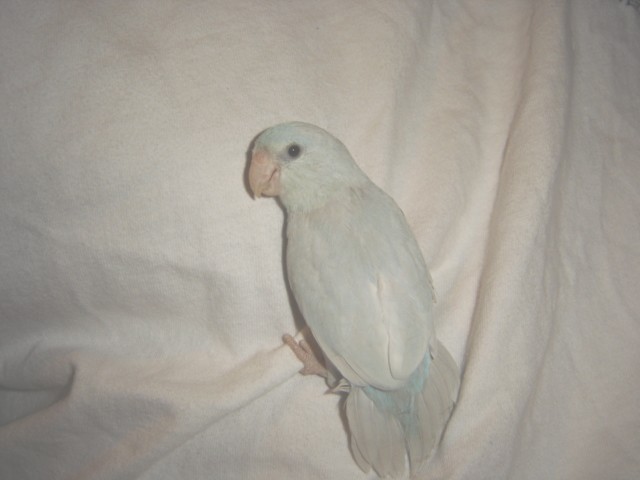
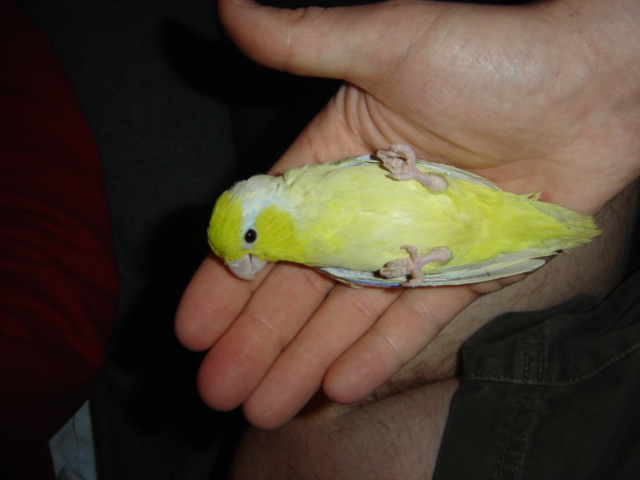
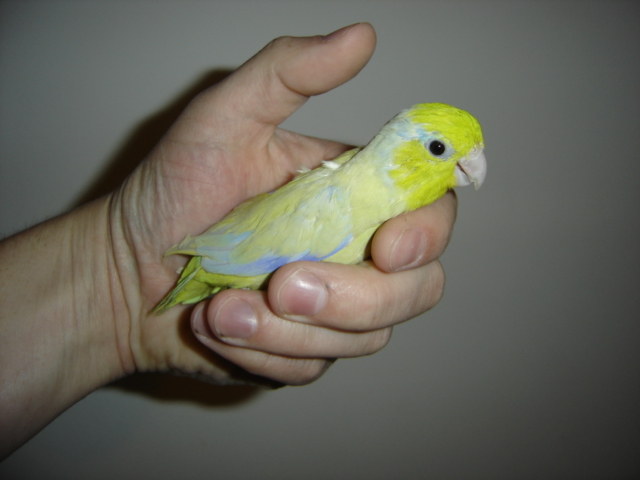
Here is a picture of our American White Hen.
She’s still a little too young to breed at this time, but
she should be breeding for us within 6 months. She’s sitting
on my chest wondering why we are taking so many pictures of her.
She's such a sweet bird! We expect to have white parrotlets
similar to her in the near
future. She
lives in a split breeder cage with a male double split on the other
side of the divider so that they can safely bond together until it's
time for them to breed.
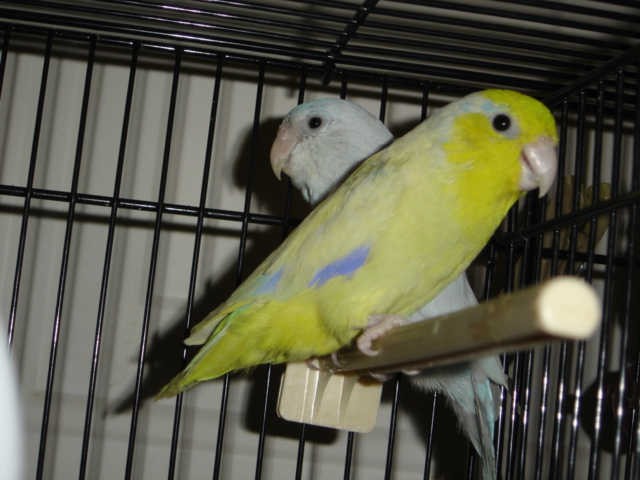
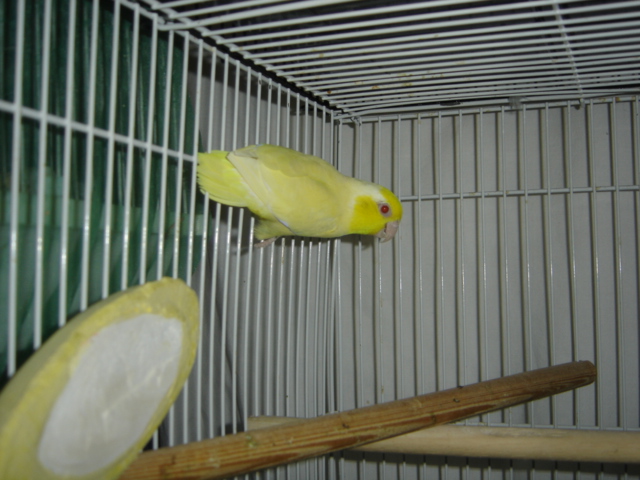
Below is a picture of the same male with his
mate. She has rubbed the feathers off her chest in preparation
for
sitting eggs. Hens sometimes do this to better incubate the
eggs. They are currently on 3 eggs and still laying. This
pair should produce albino, lutino split to blue, blue split to lutino,
and green double split to lutino and blue.
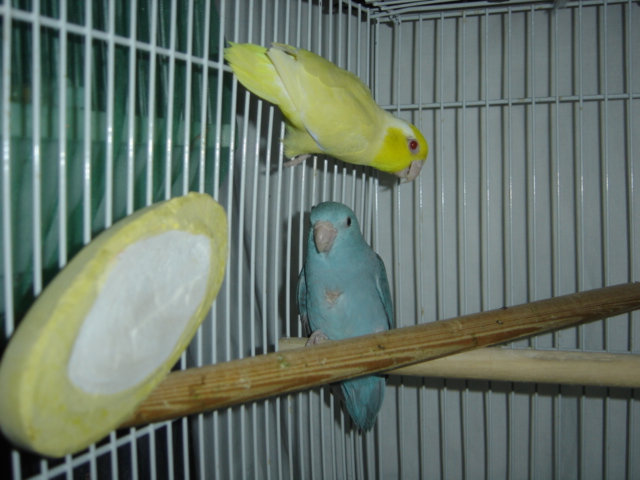
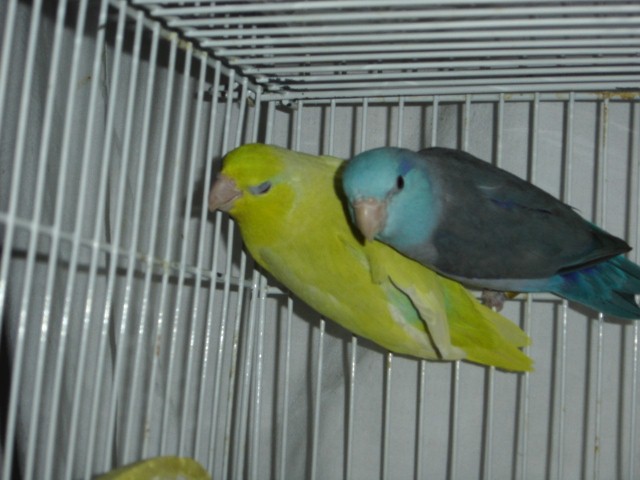
Below is a Yellow split blue female with a Blue split yellow
male. They have laid 7 eggs and those eggs should start
hatching soon. They should have a combination of White, yellow
split blue, blue split yellow, and green double splits. Once
again, being breeders, they are a bit shy and we avoid handling them or
bothering them very much. Breeders are best left alone.
Here is our Blue male parrotlet. He's about
a year old. He and his mate
are going through a molt right now, so they are taking a break.
He is paired with a green split to blue
hen. They will just have blue and green split blue babies.
Notice the tell tell darker blue around his eyes and on his flight
feathers. This is the best way to sex a parrotlet. Males
have the darker blue on their flight feathers, rump, and around their
eyes (except on lutinos and albinos).
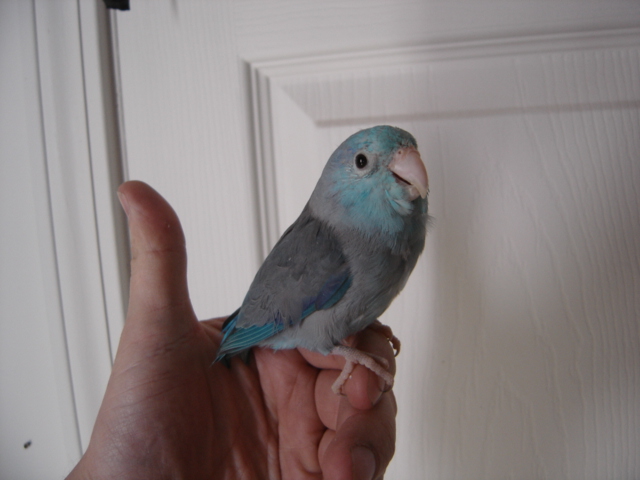
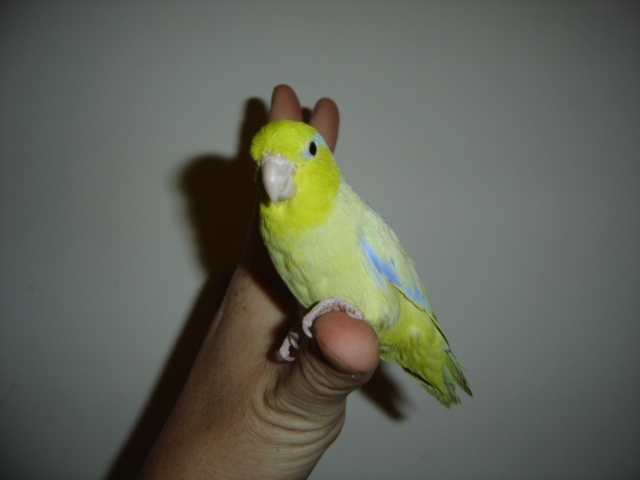
Here is our most recent addition to our breeding program. This is
a blue split yellow hen. She's only 4 months old, so it'll be a
while before she's ready for breeding. She's a sweetie. She
is very curious. Notice she does not have the darker blue color
on
her wings or eyes.
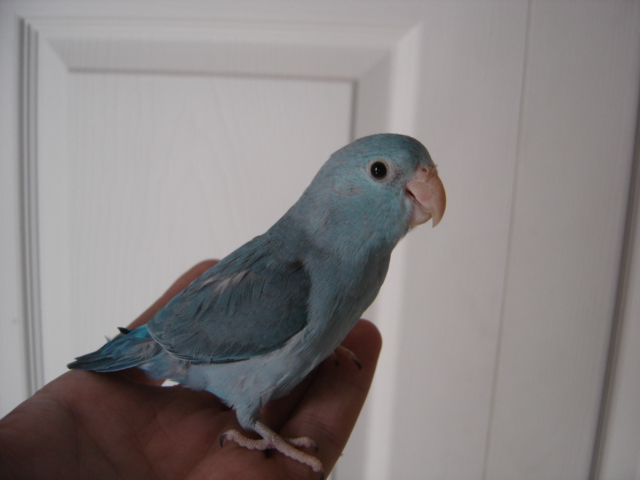
This is our double-split male. Notice he's
just taken a bath! He's such a mess! This green is the
typical color of a parrotlet. They are the most common
color. Therefore, they are the least expensive of all the
parrotlets. If they are split to a color, then they may be a
little more expensive than a "clean green", even though you can't see
any difference in the bird's natural color. Remember, you can't
tell by looking at a parrotlet if it's split to a color, you MUST know
the
genetic background of the bird. You MUST know what colors the
parents were and their genetic background as well. The green
color is a combination of both blue and
yellow. The yellow bird is the result of a genetic mutation that
does not allow the bird to produce the blue pigment. The blue is
a genetic mutation that does not allow the bird to produce the yellow
pigment.
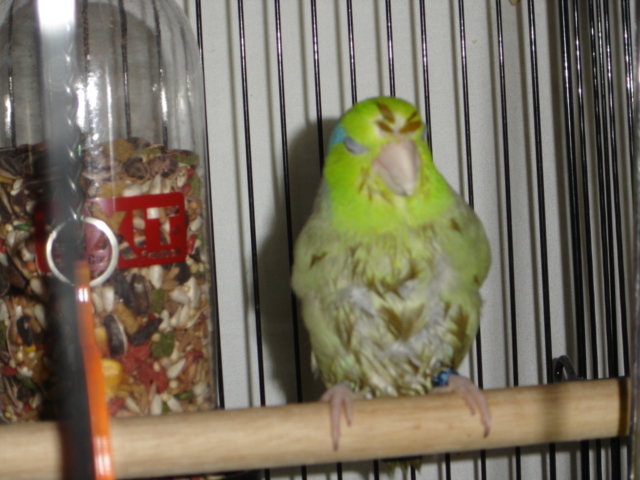
Below you will find our newest addition to our
breeding program, a Pastel Blue male. His mate is a green double split
to pastel and blue female. Now, they are both very young and so
will not be breeding for some time. He has just finished weening
onto parakeet food and millet and she is about 3 months old. They
should give us 25% pastel split to blue, 25% blue split to pastel, 25%
green double split, and 25% pastel blue. He is a VERY sweet
bird. Also note, Pastel Blue birds are a little more
difficult to sex. The males may only have a small amount of blue
on his rump.
If you are interested in purchasing a parrotlet,
please drop us an Email.
If we do not have what you want available, we will help you find
someone who does. Also, feel free to email us with any
questions about care or about the genetics of parrotlets.