The Triangle Shirtwaist Factory Fire, 1911
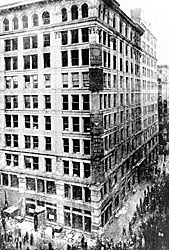
I saw a documentary on the history channel last night that was as horrifying as it was the most tragic event I have ever heard about. During 1909 and 1910 in New York, 20,000 Shirtwaist workers (mostly women) went on strike, to make strides in Unionizing the industry. Working conditions were very dirty, and the amount of stray cloth on the floor was a terrible fire hazard. What was worse, they were paid like sweatshop workers of the nineties: working seven days a week, ten hours a day, and barely making any money. These workers were mainly immigrants, and very young. However, wealthy women and poor women alike showed up for their strikes, to rally better conditions in factories. Women like Anne Morgan (J.P. Morgan's Daughter, member of the Women's Trade Union League) and Alva Belmont (member of one of the richest families in New York, president of the Political Equality League) raised money to support the striking factory workers. The end of the strike was less than satisfactory, in that 150 factories rejected Unionization. However, the Women's needs would be met, at a great cost of human life.
Saturday, March 25, 1911 at 4:45 p.m., girls began gathering their things to leave for the day at the Triangle Shirtwaist Factory. The eighth, ninth and tenth floors of the Triangle Shirtwaist Factory housed 500 workers. Their working conditions were less than satisfactory: sewing machines were placed so close together there was little room to move in the aisles; bits of flimsy fabric and paper for sewing patterns were littered everywhere. The owners of the Triangle Shirtwaist Factory Max Blanck and Isaac Harris, had locked most of the doors to keep Union activists out; the doors that weren't locked opened inwardly, effectively blocking stampeding workers.
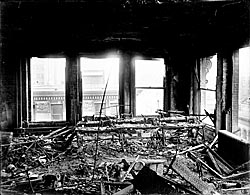
"A dropped cigarette on the eighth floor had the girls crying "Fire!" Some workers were able to escape by running down the the stairs and rushing into the two narrow passenger elevators. The entire floor was soon engulfed in flames, as the stairs were blocked by fire and the elevator ceased to work."
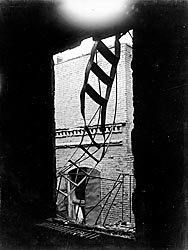
Workers on the tenth floor were telephoned a warning, and climbed onto the roof, where they were able to escape. The ninth floor, however, was the last to learn of the fire, where it simply appeared, lighting the entire floor in minutes. This was the most crowded floor; some workers were found slumped over their sewing machines, dead. Fifty eight girls died in the cloak room, while more were found crowded at the doors, which were locked to prevent stealing cloth. Some dove down the elevator shaft, to die on top of the elevator, rather than to be burned to death. The fire escape was rusted, and soon collapsed, preventing escape. Most lept out of the windows to their death eighty feet below. Hundreds of factory workers watched, horrified, as teenage girls lept sometimes five at a time, some unrecognizable, to die on the sidewalk, as only a few survived with injuries. Some lept praying, with rags over their eyes, and "Sophie Salami and Della Costello leapt, arms around each other(www.about.com)." The fire trucks had ladders that reached only the sixth floor; their hoses could only reach the seventh floor. The crowd, commotion and women jumping, made the firemen's job nearly impossible. Firemen tried to catch the girls with nets and blankets, but they ripped apart from the speed of the girls' flight.
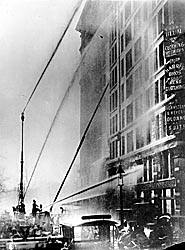
146 girls, from 13 to 23, died in the fire. Most of them were Jewish and Italian immigrant girls, with bright futures: 12 engagement rings were found in the aftermath. These women should never be forgotten, they were just at the beginning of life, and it would take their deaths to change factory regulations forever. Legislature soon was put into action for santitary conditions, fueled by the Factory Investigating Commission, who in their first year alone toured 1,836 factories in New York and talked to 222 witnesses. Eventually legislation was passed in that factories must have more sanitary conditions; there must be 2 exits per floor, one a staircase and another an interior or exterior fire escape; taller and bigger buildings required more exits. Stairways and fire escapes had to be fireproof. The number of workers to a floor was regulated by how many exits were on that floor. Regulation sprinklers were installed on the seventh floor and higher in 1912 (though it would of cost $5,000, everyone of the Triangle workers would have survived). Buildings with two stories or more were required to exercise fire drills every three months, and have fire alarms, both of which the Triangle factory did not have. Scraps of material were now required to be deposited in fireproof receptacles, and elevators were required to be enclosed (thirty workers lept to their death in the elevator shaft at the Triangle factory). Children under 16 were not allowed to work with dangerous machinery; all industrial accidents and lead poisoning were reported to the state. The fire not only changed the garment industry factories, but factories of every kind in the state of New York and nationwide. The Triangle Factory workers are women to be remembered, as their sacrifice helped men, women and children everywhere.
Links: