Bais City covers a land area of 31,690 hectares or 4.86% of the provincial area of Negros Oriental. It is bounded on the north by the Municipality of Mabinay; northeast by the municipality of Manjuyod; south by the City of Tanjay; east by the Taňon Strait and west by the City of Bayawan. Bais City has 35 barangays, 12 of which are coastal and the rest are interior barangays. Basically, it has an agricultural economy with sugar as the dominant crop.
Number of families:
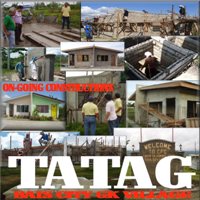
So far, there are 17 family beneficiaries residing in this GK village. 20 more housing units are undergoing construction. Site development has been completed, and the area is ready for construction of 363 more units, pending entry of new partners.
Total size of the land:
The LGU of Bais City has allocated 5 hectares for the GK site.
Status of the Land:
The lot is intended for Socialized Housing Project acquired by the city in 1999. The total land area is 6 has. For which the city paid P12,661,643.64 with counterpart for land development by National Housing Authority (NHA) of P7,640,608.91. There is an existing memorandum of agreement between the Local Government of Bais City and the Gawad Kalinga Community Development Foundation, Inc. of the Couples for Christ. The beneficiaries will pay a minimal monthly amortization for the lot for a period of 25 years. After they have fully completed the payments, they will own the land.
Lot size per family:
70 square meters per family
House design:
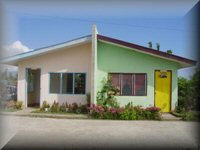
Duplex housing design
Kind of development:
Bais City GK Village is a new relocation site.
Description:
- Background of the families (history)
There are about 600 families to be relocated in Bais City. They are living in danger zone beside the riverbanks, affected by government projects, threatened with ejection by court order and landless squatters of private lands. The unavailability of land for socialized and low-income housing in the poblacion and low-land areas, most of which are owned and dominated by sugar haciendas, is a major problem that needed to be addressed.
At this period, 65% of the Baisanons live below poverty line. Majority of them are dependent on hacienda farm work as their source of livelihood. However, work opportunities are good only during the 6 months milling season per year. The remaining percentage of the population is engaged in fishing and upland farming. The average family size is 5.16. Hence, GK Bais seeks to strengthen socialized and economic housing program and to make Bais a slum-free city by 2010.
The beneficiaries of GK Bais are the poorest of the poor who are evicted from privately-owned lands through court order, affected by government projects, living in danger zones like river banks, coastal flats, creeks, etc., and who are landless and squatters of government land.
- Partnership
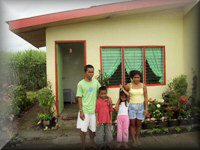
GK’s major partner is the LGU of Bais City under the leadership of Mayor Hector C. Villanueva. The LGU provided the land and its development. There are 6 duplex houses that are now being turned-over to 12 beneficiary-families. They were built as the “padugo” from the LGU employees who gave part of their additional Christmas bonuses of Php 2,000 each, amounting to a total of Php 624,000. There is also an on-going construction of one duplex which is a “padugo” from the Couples for Christ Bais City Cluster. Individual flush-type toilet bowls were donated by the United Architects of the Philippines, Dumaguete City Chapter.
New Partner: International
SOUTH CALIFORNIA THRU ANCOP
-CFC South California South Bay 4- sponsors 20 more houses and the construction of signage.
-Little Town, New Hampshire, USA donated 2 water wells
- Status of GK
The memorandum of agreement with the LGU was signed last December 16, 2004. After the ground breaking and launching ceremony last April 16, 2005, the building of the first duplex started. Members of the CFC, SFC, and the beneficiaries participated in the construction of the houses. On October 5, 2005, the six duplex housing units were finished and were given to 12 family beneficiaries. One duplex unit, sponsored by the Couples for Christ is still in the process of construction. Three housing units are still proposed for funding and will be constructed later. Out of the 17 identified beneficiaries, there are 5 families who are not yet awarded with their housing units.
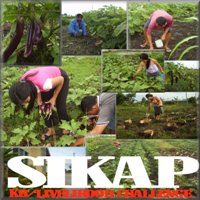
The Couples for Christ, Bais City Chapter has organized the Kapitbahayan Program. “Kapitbahayan” is the name of the Neighborhood Association of those who will be living in the GK site. Out of this Kapitbahayan program, the beneficiaries were able to generate income from their backyard gardening amounting to Php 23, 567, which is now deposited in the bank. Preparations for implementation of programs like the Sibol, Siga, and Sagip are underway, and they will be implemented in due time.
- Strategic Value
The area is fully developed with complete electricity, water supply, concrete road pavement and open-type and covered-type canals. The site is located near the three haciendas - Haciendas Lapaz, Hangyad and Consolacion -- which give opportunities for the beneficiaries to sell dry goods and household commodities, especially during the peak milling season.
Moreover, the soil in the vicinity is very fertile since the site was formerly an agricultural land planted with sugarcane. The fertility of the soil makes it conducive to the cultivation of vegetables. At present, as part of their Kapitbahayan Program, the beneficiaries are planting eggplants, onions, peppers and other kinds of vegetables which they can sell at the market.
In the Comprehensive Land Use Plan of the City of Bais, the area is classified as residential. Hence, the beneficiaries can be assured of a quiet and peaceful place where they can raise their families well.
- Possible Challenges
One possible challenge that the beneficiaries is facing is the lack of regular transportation from the GK Village to the poblacion, although, the distance is not really that quite far (only about 2 kms. from the city). In cases of emergency, especially during night time, it might be difficult for them to go to the hospital immediately.
The road leading directly to the site is also not yet fully concreted which makes it difficult to pass during the rainy season. At present, the beneficiaries have a common potable source of water from an artesian pump which is about 30 meters away. They still have to fetch water from the pump to their own houses since they do not have individual water supply. Although electric supply is ready for tapping, the residents were not able to have electrical installation in their own houses due to lack of budget.
The beneficiaries tried their best to augment their low income. Most of them are just pedicab and pot-pot (trisikad) drivers. Few are semi-skilled carpenters and hacienda workers. But all of them have shown that, despite these hard times and the difficult economic situation, they doing their best in making their village a place united by a sense of community where peace, brotherhood and love abound.
BAIS CITY GK PROGRAMS
Child & Youth Development/Headed by Tita Susan & Tito Rusue Remolano
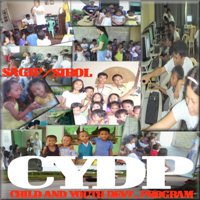
GK provides value based education for pre-school children, aged 3 to 6 years old through its program called SIBOL, which means “to grow” in the Filipino language.
GK provides a support program for street children of elementary age, from 7 to 13 years old. They are provided with academic tutorials, sports and creative workshops as well as a very solid values formation program through a program called SAGIP, which means “to save a life” in the Filipino language.
Health/Headed by Tito Joel & Tita Heideliza Llera
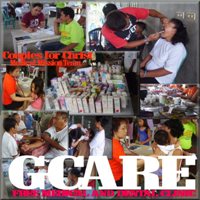
LUSOG, meaning “healthy” in Filipino, is GK’s program for community health care. The health profile of every family in a GK community is carefully monitored by a volunteer team of doctors and paramedical practitioners; most GK areas now have a clinic. Malnutrition especially among children is addressed and arrested not just through feeding programs but also through parent education regarding proper nutrition and hygiene
Productivity/Headed by Tito Bruno & Tita Mita Tamayo
Through GAWAD KABUHAYAN (translated to “to give livelihood” in Filipino), GK conducts livelihood and skills training, provides start up capital and materials for microfinance and micro-enterprise, and assists in the marketing of the GK communities’ products. Food self sufficiency is highly encouraged by teaching technology for backyard farming, urban agriculture and poultry raising.
Values Formation/Community Empowerment/Kapitbahay Coordinator/Tito Jun & Tita Cecil Ambos
Every GK community is organized into a KAPITBAHAYAN Neighborhood Association, which is established to inculcate stewardship and ensure accountability, cooperation and unity. Guidelines for community living are decided upon by the members, and new leaders who espouse the values of the association start to emerge. Peace is achieved not by force, but by mutual adherence to an agreed set of values. This new culture is the key to the community’s sustainability, and sets the community on the road to self reliance.
for more info email us @
or contact:
Bro. Joseph C. Ceriales/09187632043/4023665
Bro. Roy Sibala/09284240946
Bro. Botchoy Japin/09262542824
Bro: Tata Valencia/ 09173143634/4023200
Sis: Tim'2x Valencia/09173140634/4023200
BAWAT PILIPINO BAYANI!!!!