
Common Name: Alfalfa
Family: Legumesae
Scientific Name: Medicago sativa

Origin: Iran and central Asia.
Longevity:
Perennial.
Season: Cool Season Legumes.
Major Uses Hay and haylage, but has potential for expanded pasture use. Good alfalfah hay has high nutritive value and is in high demand, particularly for horses and dairy cattle.
Season Growth: March-November and its has the longest productive season of any southern- adapted legume
The "Queen of Forages", alfalfa is not
only the oldest cultivated forage crop in the US, but it is one of the most
palatable and nutritious. Alfalfa is rich in protein, vitamins, and minerals.
And, when cut prior to bloom, it is low in fiber and high in energy. Thus, it
is prized as a primary component in dairy cattle rations and is an important
feed for horses, beef cattle, sheep, and milk goats
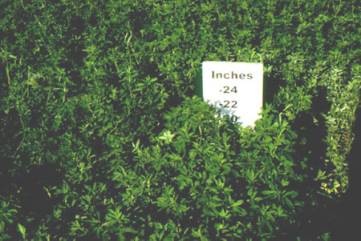
Description:
Erect growing with many
leafy stems arising from large crowns at the soil surface. Grown 24 to 36 inches tall. Compound leaves with three leaflets. Flowers of the varieties
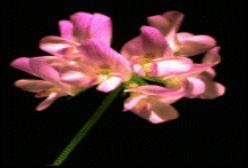
grown in the south are normally some shade of purple

Nodules are the result of rhizobium bacteria
and particular
legume
roots. Atmospheric nitrogen is converted into a form usable to plants
inside the nodule 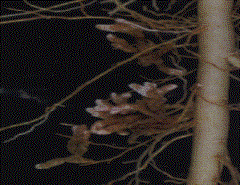
Planting
Alfalfa: Seeding
of alfalfa can be done in the fall or late summer. Approximately 8 to 12 lbs of
seed per acre will usually be needed.
Varieties:
There are many different varieties of alfalfa

Pests:
Alfalfa, like
most plants, is vulnerable to be attacked by insects. One insect problem is the
alfalfa weevil, which is a leaf-feeding pest. Much has been studied about the
pest, so management can be effective. When present, the use of insecticide is
often required to keep it from dramatically lowering yield of the crop. In
exceptional cases, where the pest is not controlled, alfalfa can die as a
result of alfalfa weevil feeding - for they "continuously graze"
until root reserves are depleted and the plant dies.
List
Legally labeled Forage Herbicide:
·
Benefin at 1.1 to 1.5 Ib/a (Preplant)
·
Bromoxynile
at 0.25 To 0.37 Ib/a(Postemergence)
·
2,4-DB
- Metribuzin at 0.38 to 0.75 Ib/a
Links:
http://www.cas.psu.edu/docs/casdept/agronomy/forage/docs/species/alfalfa.html
http://www.forages.css.orst.edu/Topics/Species/Legumes/Alfalfa/Images/index.html
http://www.naaic.org/Gallery/index.html
http://www.pickseed.ca/english/forage/info/alfalfa.html
http://agri.atu.edu/people/Hodgson/FieldCrops/StudentWork/Vicki_Shaw.html
REF:
Goicoechea N; Antolin MC;
Sanchez-Diaz M. 2000. The role of plant size and nutrient concentrations in
associations between Medicago, and Rhizobium and/or Glomus. BIOLOGIA PLANTARUM.
43(2):221-226
Bolsen,KK, JL Curtis, CJ Lin,
and JT Dickerson. 1990 Silage inoculants and indigenous mircroflora: With
emphasis on alfalfa. In TP Lyons(ed.), Biotechnology in the Feed Industry
Nicholasville, Ky.: Alltech Tech Publishing