 |
|
 |
 |
 |
| The Mystical Amazon River and Rainforest |
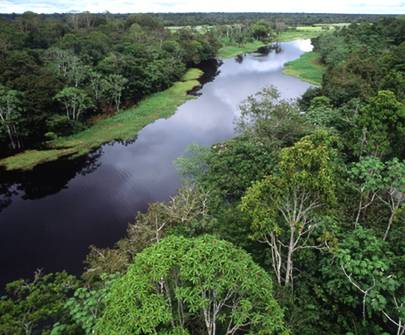
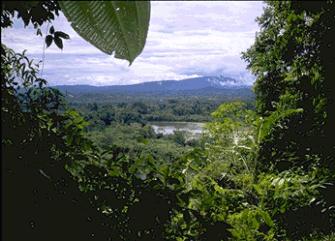
| Amazon (river) (Portuguese and Spanish Amazonas), river in northern South America, largely in Brazil, ranked as the largest in the world in terms of watershed area, number of tributaries, and volume of water discharged. Measuring 6,400 km (4,000 mi) from source to mouth, it is second in length only to the Nile among the rivers of the world. With its hundreds of tributaries, the Amazon drains a territory of more than 6 million sq km (2.3 million sq mi), roughly half of which is in Brazil; the rest is in Peru, Ecuador, Bolivia, and Venezuela. It is estimated that the Amazon discharges between 34 million and 121 million liters (9 million and 32 million gallons) of water per second and deposits a daily average of 3 million tons of sediment near its mouth. The annual outflow from the river accounts for one-fifth of all the fresh water that drains into the oceans of the world. The outpouring of water and sediment is so vast that the salt content and color of the Atlantic Ocean are altered for a distance of about 320 km (about 200 mi) from the mouth of the river. |
| The major headstreams of the Amazon are the Ucayali and Mara��n rivers, both of which rise in the permanent snows and glaciers of the high Andes Mountains. Feeding the Ucayali is the Apurimac River, the Amazon's most distant source. The headwaters of the Apurimac are located at a glacial meltwater of Nevado Mismi, an Andean peak in southern Peru. The Ucayali and Mara��n follow parallel courses north before joining near Nauta, Peru. From this confluence the main trunk of the Amazon flows in a generally eastern direction to the Atlantic Ocean. The Amazon enters the Atlantic through a broad estuary, roughly estimated at 240 km (about 150 mi) in width. Here delta deposits have formed a maze of |
| Rain forests are typically hot and steamy�the average annual temperature is 25� C (77� F). Temperature near the equator varies little over the course of a year, so rain forest temperatures are about the same year round�the average minimum monthly temperature in a rain forest is a balmy 18� C (64� F). Rain forests are not found where the temperature drops close to 0� C (32� F) because their resident plants and animals are not well adapted to withstand frost. Temperature in a rain forest depends not only on distance from the equator but also on altitude. As elevation increases, nighttime temperatures go down significantly. This daily temperature variation affects forest ecology, and true rain forests typically are not found above 1,000 m (3,280 ft). |
| Rain forest ecosystems contain more plant and animal species than virtually any other habitat in the world. Although their range has contracted and expanded with climate changes over the last several million years, in general, rain forests are some of the oldest ecosystems on Earth. As a result of this continuity, rain forests boast millions of different species, many of which are endemic, or unique, to rain forest habitats. |
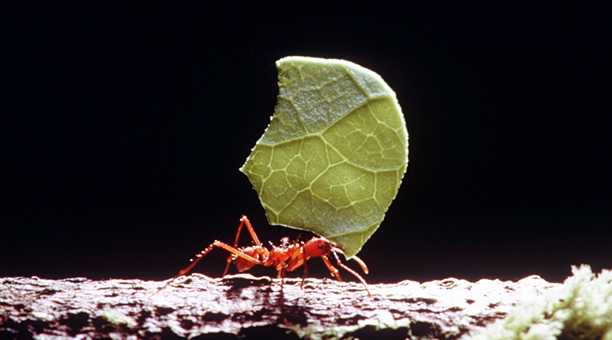
| Almost 90 percent of the rain forest animal species are insects, and of these, most are beetles. A single rain forest tree can host more than 150 species of beetles. Living high in the forest canopy, most of these beetles and other insect species have eluded scientists until recently, when technology has improved access to the upper stratum. To this day, scientists are unsure how many animal species exist in the world, largely because they have identified just a small fraction of the millions�some estimate as many as 30 million�of insects that live in the rain forest. |
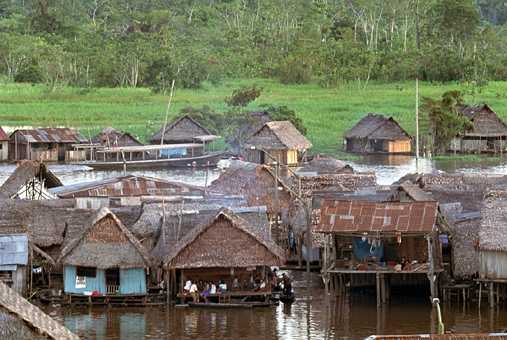
| Most of the world's tropical rain forests are inhabited, and have been for thousands of years, by indigenous peoples who depend on the forests for their livelihoods. Many indigenous peoples live deep within the rain forest in areas that, to this day, are accessible only by river. Anthropologists believe that as many as 1,000 different cultures of indigenous peoples may be living in rain forests worldwide. Among the many small groups are the Yanomamo, the Ashaninka, and the Cayap� of South America; the Baka Pygmies of Cameroon; and the Penan and Bentian Dayak of Borneo. Although each indigenous group has a different culture and customs, they all share a dependence on the rain forest habitat in which they live. |
| The Fern Background found throughout the SOTN IV website is courtesy of http://www.nps.gov/olym/home.htm "Rain Forest," Microsoft� Encarta� Online Encyclopedia 2001 http://encarta.msn.com � 1997-2000 Microsoft Corporation. All Rights Reserved. "Brazil," Microsoft� Encarta� Online Encyclopedia 2001 http://encarta.msn.com � 1997-2000 Microsoft Corporation. All Rights Reserved. "Amazon (river)," Microsoft� Encarta� Online Encyclopedia 2001 http://encarta.msn.com � 1997-2000 Microsoft Corporation. All Rights Reserved. "Amazon River," Microsoft� Encarta� 2001 Encyclopedia. http://encarta.msn.com � 1993-2001 Microsoft Corporation. All rights reserved. "PHOTOS" Microsoft� Encarta� 2001 Encyclopedia. http://encarta.msn.com � 1993-2001 Microsoft Corporation. All rights reserved. |
| The Amazon watershed includes the largest and wettest tropical plain in the world. Heavy rains drench much of the densely forested lowland region throughout the year but especially between January and June. Seasonal variation in rainfall is reflected by the width, rate of flow, and discharge volume of the river. During the months of maximum precipitation, broad areas traversed by the Amazon are subject to severe floods. In Brazil the width of the river ranges between 1.6 and 10 km (1 and 6 mi) at low stage but expands to 48 km (30 mi) or more during the annual floods; the rate of flow ranges between 2.4 and 8 km/h (1.5 and 5 mph); and the crest of the water at flood time often rises 15 m (50 ft) above the norm. To drain the vast mass of water, the Amazon has carved a deep bed in the plain through which it flows. In one sector near �bidos, Brazil, the bed is more than 91 m (300 ft) below the average surface level of its water. |
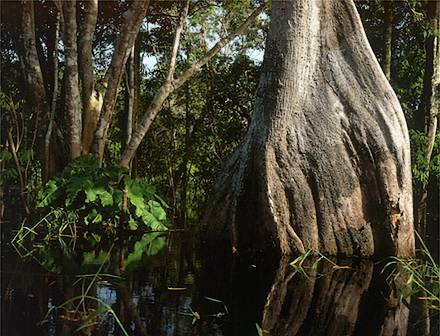
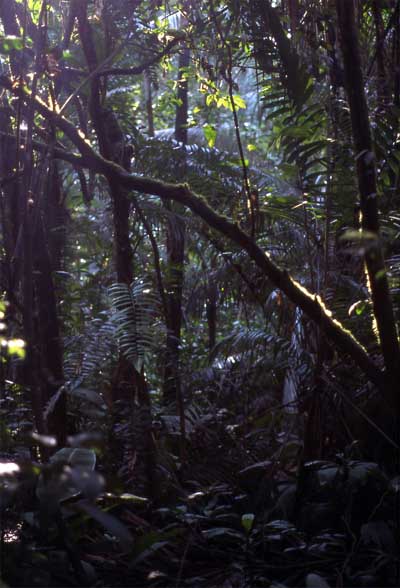
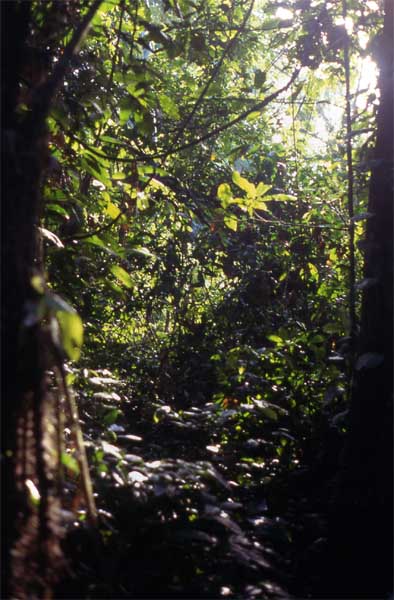
| Rain Forest, woodland characterized by lush vegetation and comparatively high temperature and rainfall throughout the year. Rain forests are the world's most biologically diverse ecosystems. Although they account for less than 7 percent of the land surface on Earth, they contain more than 50 percent�some scientists estimate as high as 90 percent�of its plant and animal species. One hectare (about 2.5 acres) of tropical rain forest may contain more than 600 species of trees. By comparison, the forests of the United States and Canada combined contain only around 700 tree species. Even more impressive are the number and diversity of animal species that call rain forests their home. One study found more species of ants living on a single rain forest stump than exist in all of the British Isles. To be classified as a rain forest, a forest must have a closed canopy, in which the treetops, or crowns, touch each other, creating a shaded forest interior. In addition, temperature and rainfall must be high and relatively even throughout the year. Forests that meet these criteria are found flanking the equator in South and Central America, Asia, Africa, and Australia. In South America, a vast, forested area of the Amazon River basin in Brazil and neighboring countries is by far the largest rain forest in the world. It encompasses more than 3.5 million sq km (about 1.4 million sq mi)�about half of the total global rain forest cover. |
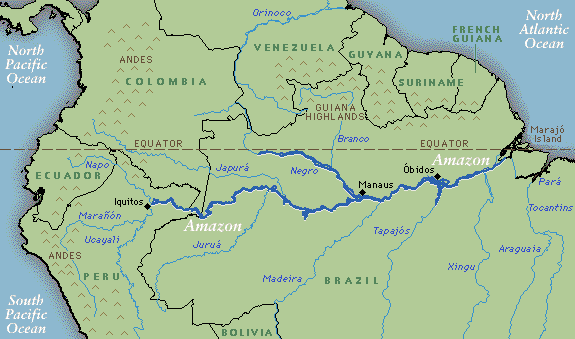 |
| islands that separate the river into branches. The mouth of the main stream is 80 km (50 mi) wide. This branch, known as the Par�, is separated from a smaller branch by Maraj� Island, which has an area of more than 36,000 sq km (14,000 sq mi). During new and full moon a tidal bore, or wave front from the ocean, sweeps some 650 km (more than 400 mi) upstream at speeds in excess of 65 km/h (40 mph). This phenomenon can cause waves 5 m (16 ft) or more in height along the banks of the river. |
 |
 |
 |
 |
 |
 |