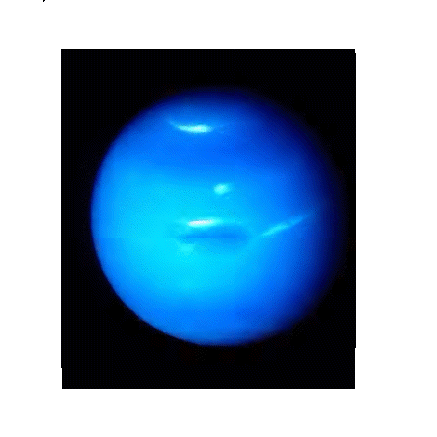
Neptune is the eighth planet from the Sun and the most remote of the gas giants of the outer solar system. During 1845 and 1846 the Englishman John Couch Adams and the Frenchman Urbain Jean Joseph Leverrier, unknown to each other, independently calculated where an eighth planet would have to be in order to explain slight perturbations in the orbit of Uranus. In Berlin on the night of Sept. 23, 1846, Johann Gottfried Galle and Heinrich Louis d'Arrest found a new planet within one degree of the position sent them by Leverrier. The equally good prediction of Adams, made a year earlier, met with unfounded skepticism in England and was not published until after the planet had been discovered.
During the months following the announcement of the discovery, an international controversy developed between English and French astronomers as to whom credit belonged and what the planet should be named. (Leverrier wanted to name it after himself.) Eventually the new planet was named Neptune, for the Roman sea god, and credit was given to both Adams and Leverrier for their calculations. Galileo Galilei actually may have spotted Neptune more than two centuries earlier, but he did not recognize it as a planet.
The orbit of Neptune around the Sun is even more nearly circular than the Earth's orbit. The planet's average distance from the Sun is 4,497,000,000 km (2,794,000,000 mi), with an eccentricity of only 0.0086. The orbit is inclined 1� 46� to the ecliptic, or plane of the solar system, and the planet takes 164.793 years to make one trip around the Sun. Neptune's axis of rotation is tipped only 29� 34�, which is not greatly different from Earth's 23� 30�.
The rotation period of Neptune's magnetic field, which had been presumed to trace the rotation of the planet's core, was found by Voyager 2 to be 16.11 hours. Most of the clouds on Neptune have longer periods of rotation, however, ranging from 12 hours deep in the southern hemisphere to more than 18 hours near the equator. This means that the jet-stream wind speeds on Neptune reach 2,400 km (1,500 mi) per hour, moving in a retrograde direction�that is, opposite to the direction of rotation. These are the strongest retrograde winds seen on any planet in the solar system.
The presence of rings around Neptune had been a subject of debate prior to the Voyager encounter. Several ground-based observations had suggested that irregular arcs, or strands of partial rings, orbited the planet. Studies of the probe's photographs, however, eventually revealed that five rings surround Neptune: two bright, narrow rings and three fainter, fuzzier sheets of orbiting materials. Some sections of the bright rings have significantly higher densities than others, and it was these "arcs" of higher density that had first been detected by Earth telescopes. The bright rings are located roughly at distances of 53,000 km (33,000 mi) and 63,000 km (39,000 mi). One broad ring is located at 42,000 km (25,000 mi), and another in a zone between the bright rings, while a third extended sheet perhaps fills the system between the planet and the inner broad ring.
Neptune has a diameter of 49,500 km (30,750 mi) and a mass 17.22 times that of the Earth. This means that the planet is slightly smaller and heavier than Uranus. It has an average density of 1.76 g/cm7, compared to Uranus's density of 1.1 g/cm7.
Neptune's atmosphere consists mainly of hydrogen and helium, but about 2.5-3% of the atmosphere is methane (CHP). The cirrus clouds seen in the atmosphere probably consist of crystals of methane rather than of water ice, as seen in cirrus clouds on Earth. Methane's strong absorption features dominate the spectrum of the planet, giving Neptune its deep blue color. Also in Neptune's spectrum are features due to molecular hydrogen (HM) and stratospheric ethane (CMHR). Observations in the microwave region of the spectrum suggest the probable presence of ammonia (NHO) and indicate that temperatures on Neptune rise with increasing depth, as on Uranus. Scientists had expected the effective temperature of Neptune to be about -228� C (-378� F), but infrared measurements made by Voyager 2 indicated a temperature of at least -218� C (-360� F). Thus Neptune, like Jupiter and Saturn but unlike Uranus, appears to have an internal energy source.