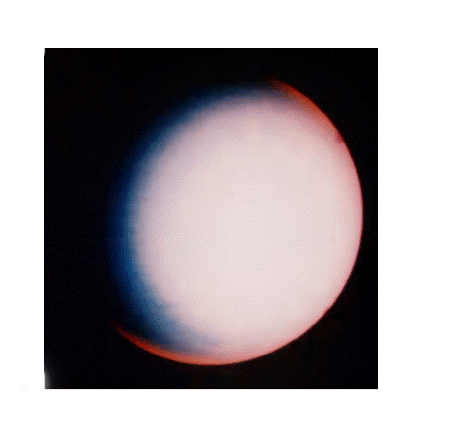
Uranus is the seventh planet from the Sun and was the first to be discovered since ancient times. Sir William Herschel first observed the planet through a telescope on Mar. 13, 1781, seeing a featureless bluish green disk that he nevertheless recognized as a highly unusual object. Although Herschel wished to call the newly discovered planet Georgium Sidus (Georgian Star) for King George III of England, and although many French astronomers referred to it as Herschel, Johann Bode's proposal of the name Uranus�the mythological father of Saturn�was over the years accepted more and more widely and finally became universal in the mid-19th century.
Uranus has an equatorial diameter of 51,100 km (31,750 mi), almost precisely four times that of the Earth, and a mass 14.58 times that of the Earth. The dark absorption bands discovered in 1869 in the red part of the spectrum of Uranus were identified in 1932 as being caused by methane gas in Uranus's atmosphere. This red absorption is the major cause of the blue green color of the planet. The methane absorbs much of the red light from the impinging white sunlight, leaving a bluish green color in the reflected sunlight. Measurements by Voyager 2 verified that hydrogen is the main constituent of the visible atmosphere. Helium is the other major constituent, about 15% (+ or � 5%) in terms of molecular weight, which is a larger percentage than in the atmospheres of either Jupiter or Saturn. Together hydrogen and helium make up more than 99% of Uranus's atmosphere, which extends to a depth of about 8,000 km (5,000 mi). A layer of methane ice clouds was detected by Voyager 2 near a pressure level of about one atmosphere. Deep within Uranus exists a superheated water ocean, perhaps 10,000 km (6,000 mi) deep, which contains large concentrations of ionized chemicals (see ion and ionization). It is in this ocean that Uranus's magnetic field may originate (see magnetism). Beneath this ionic ocean an Earth-size core of molten rocky materials has been thought to exist. Further analysis of data has suggested that the core may instead be a highly compressed liquid.
The discovery on Mar. 10, 1977, that Uranus has rings was one of the most unexpected and exciting events of modern planetary astronomy. Subsequent observations have indicated the presence of ten narrow rings of dark particles and one broad, diffuse ring, in addition to 100 or more possibly transient ringlets of dust-size particles seen only in Voyager 2 images of the backlighted rings.
The outermost ring (called the epsilon ring), in marked contrast to the rings of Saturn, has almost no particles smaller than about 20 cm (8 in). The other rings also seem to be deficient in small particles. Possibly the extended hydrogen corona exerts a drag on the orbiting ring particles. The drag would preferentially remove smaller particles, causing them to fall into the planet. Because collisions between larger particles create smaller particles, atmospheric-drag forces could virtually destroy the rings in geologically short time periods. The rings are therefore relatively young or else are replenished by the breakup of small satellites.