 Six in Hand
Six in Hand
Grasp the cluster. You will notice you have one more finger than you need. You can place it either between bells 1 and 2, or between bells 2 and 3. In other words, either group your index and middle fingers, or middle and ring fingers. (see Figure 10, for the latter option)
To ring the middle bell, use the standard motion, more or less. To ring the bell closest to you (the top bell), use the same "inward" or "pushing" motion as you use for the Campanile style top bell (see Figure 11). To ring the bottom bell (the one farthest from you), use the "knock" motion (see Figure 12). To ring the top and bottom bell at the same time, rotate your hand out a little bit (palm away from you) and push, much like ringing both bells of a Shelley. To ring all three bells at once, use basically the same motion as that used to get a 4iH cluster to ring simultaneously. Other combinations are possible; the trick is to use the clapper of the unrung bell as the axis of rotation.

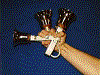


Figure 9 Figure 10 Figure 11 Figure 12 The Set-Up (RH) The Grip Ringing the top bell Ringing the bottom bell
The Claw
 This
is a technique to temporarily add a third bell to a 4iH. The third bell will
strike along with at least one of the other bells in the hand, so it is distinct
from the 6iH technique.
This
is a technique to temporarily add a third bell to a 4iH. The third bell will
strike along with at least one of the other bells in the hand, so it is distinct
from the 6iH technique.
Hold the cluster as usual. Now open up the pinky finger and grab the third bell off the table. Its clapper will be parallel to that of one of the other bells in hand; which one depends on how you grab the bell. The third bell can now be rung simultaneously with whichever bell it is parallel with. Ringing all three bells can be done by flicking the 4iH-cluster-plus-hooked-bell in the same way as described above in the six-in-hand section, although the motion might have to be exaggerated a little depending on the bells. Take care not to clink bells together.
