 Handbell
Notations
Handbell
NotationsHandbell
Notations
LV
This symbol can tell you otherwise. LV, in layman's terms, means Let Vibrate. In
other words, do not damp. Once a section of music has been noted LV (it often is
the entire score but may be just a part of it), it rings "forever" or
until canceled. There are three ways to cancel LV. (1) Another LV will cancel an
existing LV. This will often happen in measures with arpeggiated chords when the
chord changes (C chord may become G chord). A new LV will cancel an old one, and
any notes sounding when the new one occurs, should be damped at that time. (2)
The symbol R will cancel an existing LV (and any other special techniques that
are being used). Whenever R appears, it means you go back to ringing normally
with all notes ringing exactly as notated. A third way to cancel an LV is with a
damp sign. This sign resembles a double circle with a cross through it. Whenever
this sign occurs, all sounding bells are damped. It is often used at the end of
a song.
PL or Pluck
This technique is played by taking the clapper and flipping it down against the
side of the bell while it is laying on the table. In the smaller bells the bell
is rotated when it is put on the table and the clapper is pulled (flipped)
upward against the side of the bell. PL is usually notated with
(.) staccato dots over the note heads or stems in the music. A dot (.) will
apply to all notes on that stem. Usually at the beginning of a plucked passage
the sign PL will appear, followed by only dots afterward.
TPL or Tap Pluck
This is similar to PL and is notated the same way. It is used for soft or rapid
passages. It is played with the thumb by rotating the wrist and striking the
clapper of the bell, pushing it against the side of the bell. Care must be taken
to let the thumb "bounce back" quickly so as not to completely kill
the sound. Long extended passages played in this manner may require extra
padding for the thumb.
TD or Thumb Damp
This technique is played by placing your thumb on the bell and ringing it in the
normal manner. Small bells require "very little" pressure from the
thumb, barely on the bell. Larger bells may require one or two fingers around
the crown of the bell in addition to the thumb. Work for a uniform (top to
bottom) sound where some pitch is still heard and there is no after-ring. Many
times it is advisable to substitute a Thump Damp for a Pluck in the higher
bells. TD is also noted with staccato dots the same as PL.
Mallet/table
When the plus sign has a dot under it, it means that bells are laid on the table
and struck with the appropriate mallet. The bell should be struck, with the
mallet, on the outside at the same place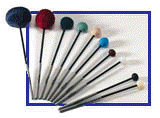 the clapper strikes it on the inside. This technique produces a similar sound to
PL or TD but has the advantage of being much easier to play. It is possible to
play much quicker passages with a greater variety of dynamics in this manner.
The use of mallets with bells on the table is often substituted for PL and TD.
Often passages may be marked with staccato dots (.) and a footnote indication to
play them with Mallets on Table.
the clapper strikes it on the inside. This technique produces a similar sound to
PL or TD but has the advantage of being much easier to play. It is possible to
play much quicker passages with a greater variety of dynamics in this manner.
The use of mallets with bells on the table is often substituted for PL and TD.
Often passages may be marked with staccato dots (.) and a footnote indication to
play them with Mallets on Table.
MT or Mart
Martellato is the effect of striking the pad with the bell. It is a more
percussive effect than the other stopped sounds. Experiment to achieve a uniform
sound. Be careful not to strike the pad too hard (this is where you really need
4 inch foam) and work to strike chords exactly together. Remember, it is
possible, and often desirable, to play Martellato softly. Mart signs are not
uniformly used by publishers. Some will always have them pointing toward the
stem which contains the notes being played MT; others always point the sign
downward (because you Mart downward -- did they think we would Mart upward?). A
director may have to spend some time determining which notes are to be played
MT.
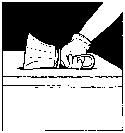
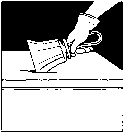
Correct Martellato Incorrect Martellato
Mart Lift
Martellato Lift is similar to MT. The bell strikes the pad and quickly lifts in
a full return. If the bell remains on the pad too long, the after-ring is damped
and you loose the effect of the lift. When this technique is used, the bell will
continue ringing as long as when it is rung in the usual manner.
