 Four
in Hand
Four
in HandFour
in Hand
 Four-in-Hand
(hereafter "4iH") is a method of holding four bells "in
hand" (hence the name) and having individual control over the ringing of
each bell. It is called "four"-in-hand even if you have two bells in
one hand and one in the other, because if we start allowing
"three-in-hand" and "five-in-hand" things just get a little,
well, out of hand.
Four-in-Hand
(hereafter "4iH") is a method of holding four bells "in
hand" (hence the name) and having individual control over the ringing of
each bell. It is called "four"-in-hand even if you have two bells in
one hand and one in the other, because if we start allowing
"three-in-hand" and "five-in-hand" things just get a little,
well, out of hand.
Why do we want to do 4iH at all? It allows fewer people to handle more bells, which is handy for smaller groups. It allows ringers in the 6s, for example, to pick up and play the 7s simultaneously when needed. Having additional ringers on the 7s, if they don't play throughout the entire piece, makes for bored ringers, and bored ringers cause trouble.
There are several different ways of doing 4iH. Each has its advantages and disadvantages. Different people choose different techniques depending on what they've learned and what they like. Some people even switch back and forth depending on the demands of the music. Learn them all, and choose which you like best.
The two major schools of thought on 4iH could be called the "Campanile" and the "Ring-and-Knock."
As in all 4iHs, there is a "top" bell and a "bottom" bell. To form this 4iH, hold one bell in the standard ringing grip. Rotate the wrist around until the bell is horizontal facing left or right (inward). Open up the index and middle finger and grasp the handle of the second bell as close to the collar as possible. The handles should be facing perpendicular to each other; ie, the "top" bell's handle should be facing front-back and the "bottom" bell's handle should be facing up-down. (see Figure 1; the C is the "top" bell and the E is the "bottom" bell)
Pick up the group. The "top" bell is rung with the standard ringing motion. (see Figure 2)
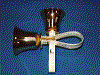


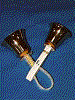
Figure 1 Figure 2 Figure 3 Figure 4 Crossed Handles (RH) Ringing the top bell Ringing the bottom bell Locked handles (RH)
To ring the "bottom" bell, rotate the wrist inward again and make a motion as if you were knocking lightly on a door. (see Figure3)
Note: Ring and Knock can also be done with locked handles. To do this, stick the "top" bell's handle through the handle of the "bottom" bell with the casting of the "top" bell pointing inward. (see Figure 4; the E is the "bottom" bell) Pick the cluster up in the same way as the unlocked cluster and ring as above.
This 4iH is easiest to compose on the table. Take one bell and set it on the table normally. This is the "top" bell. Take a second bell and slide the handle through the handle of the first bell. This second bell is the "bottom" bell. Again, ensure that the handles are perpendicular; the "top" bell should be facing up-down and the "bottom" bell should be facing front-back. (see figure 5; the E is the "top" bell)
To hold the cluster, stick your index and middle fingers between the bells and wrap your ring and little fingers around the locked handles. (see Figure 6)




Figure 5 Figure 6 Figure 7 Figure 8 Campanile-style (RH) Live Long and Prosper Ringing Inward Damping
