MCD and Computerisation
PKGUPTA
A. Background
Municipal
Corporation of
E-governance is the use of information technology to deliver public services in a much more convenient, people-oriented, cost-effective, and altogether different and better way. It affects an administrative body’s dealings with citizens, businesses, and other public agencies as well as it changes the way its internal business processes are conducted and even the dealings with the employees It enables more transparent, efficient and effective decision making. It strengthens the management/ administration by enabling them to become more efficient in resource management, tax collection and identifying local infrastructure needs Information on conventional files now available on computer system.
MCD is the biggest Corporation of
India, covering most of 1470 sq.kms. area of National
Capital. Municipal Corporation
of
Zonal Administratition is headed by a Deputy
CommissionerCity
1. Central
2. South
3. Karol Bagh
4. Sadar Paharganj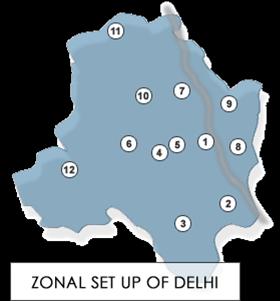
5. West
6. Civil Lines
7. Shadara(S)
8. Shadara(N)
9. Rohini
10. Narela
11. Najafgarh
B. Objectives
The strategies adopted by MCD for ushering in municipal E-governance were based on the belief that objectives of MCD’s E-governance programme are as follow:
a) To bring MCD closer to the people through Citizen Service Points, PCs’ kiosks, telephones and others.
b) When, where and how – users will decide when, where from and how to interact with MCD e.g. from home, at work or on the move.
c) Provide round the clock services—24 hours a day, 7 days a week through its proposed interactive and dynamic website.
d) Set up a modernized municipal services network through increasing use of Information and Communication Technologies in all departments and offices.
e) Create a digital community – A digital community can foster personal involvement in municipal governance by municipal government by providing people with easier access to information and other resources.
f) More transparent efficient, effective decision making in an integrated information network.
g) Strengthening of the management of municipalities by enabling them to become more efficient in resource management, tax collection and identifying local infrastructure needs especially for the poor in respect of health, education, shelter and basic services.
h) Preparation of work plan, maintenance of accounts, balance sheet, ward wise and neighborhood wise identification of deficiencies and preparation of bottom up annual plans.
i)
VISION STATEMENT
- To make E-Governance the central instrument for modernizing the functioning of MCD in providing the best quality of services to Delhi’ites
- Information Technology applications can overcome decades of established procedural opaqueness by forcing change and enforcing transparency
- Electronic media delivers services instantly without
fear or favour and without considerations of
caste, creed, status or gender
C. Project Approach
An I.T. Master Plan was got prepared having details regarding strategies, project components, time frame, implementation alternatives and indications of cost estimates. The master plan was prepared by Tata Consultancy Services in 2003. Further in keeping with the developments that are taking place the world over, MCD encouraged public-private partnership (PPP) for implementing its e-governance initiatives MCD adopted innovative model of implementing its IT plans on Build, Own and Operate revenue model in order to ensure that neither absence of IT skills in municipal employees nor MCD’s non-existent IT infrastructure come in the way of successful implementation of these plans
MCD provides various essential services to its citizens. All these activities were earlier carried out manually but it was difficult to monitor and control these activities centrally. Therefore this project was conceived. But computerization needs fund and skill and therefore private sector participation was sought in setting up infrastructure for providing these delivery channels Open Tenders were invited in 2002 on the basic of estimated 22 lacs transaction per year MCD was not to invest any money. A consortium of ECIL –Sark Systems was selected.
It was to
provide electronically enabled services to the citizens of
Changes in procedure from Manual to Electronic delivery system were approved by Standing Committee vide resolution no 604 dated 10/3/2003.
• First CSB at Lajpat Nagar along with MCD’s website wasb started on 19/2/2003.All the 13 CSBs were operationalized by 13 Aug,2003. Presently 38 CSBs are working. These CSBs charge to citizen on the basis of value of transaction which are as follows:
Value of transaction Transaction fee
Rs 1-500 Rs 5
Rs 501-1,00,000 Rs 10
Over 1,00,000 Rs 100
Each CSB has normally 5-6 computers but sometimes there are even upto10 computers to accommodate large number of the transactions. Timing is between 8.30 am to 5.30 pm on all 6 days. CSBs are managed by One supervisor and 5-6 operators. Operators and supervisors to wear distinct dress and I-Cards, Security Guards are by SARK.Each CSB has Diesel Generator for stand by Power Supply. Other responsibilities of PPT partner are as follows:
• Recruit necessary skilled and experienced manpower .
• Setting up Computer systems, Printers, UPS, Furniture, Fire Alarm etc. Set up email system for MCD. To set up Internet payment gateway facility.
•
Setting up
• Develop, host and Maintain MCD website (www.mcdonling.gov.in )
• Protect the system from malicious hacking and from spread of computer viruses
• To appoint a Supervisor at each of the CSB
• To provide security to the Centers during working hours and to pay electricity dues for the electricity consumed .
• To provide 15 hrs training on the basics of computers to MCD employees to bring computer awareness @ Rs 350 / per head.
• Presently these training centers are conducting trainings in hospitals and science centers
CSBs are connected to Central data base at Lajpat Nagar through Internet or R/F network which has been set up by ECIL-Sark Systems. The following services are offered:
• Issue of Birth & Death Certificate.
• Registration of Birth & Death Certificate.
• Booking of Parks and Community Halls for Various functions
• Issue/renewal of various types of licenses.
• Acceptance of all Municipal dues. (Property tax etc).
• Acceptance of e-tender fees through Internet.
• Dissemination of various MCD information through mcdonline web site.
• ECIL/Sark Systems is allowed to Charge transaction fee from Citizen which is based on the value of the transaction Details given below
:
D. Project Components
- To prepare MCD’s Master Plan for IT
- Launching of an interactive and dynamic website under PPP
- Setting up of Citizen Service Bureaus under PPP
- Digitization of records of important functions/departments.
- Training of municipal staff
- Capacity building in the areas of
· IT infrastructure
· Health
· Engineering
· Sanitation
· Education
· Employee Information System
· Financial Management and Property Tax Collection System
· Electronic Mailing & Wok flow system for the MCD.
·
Transparency which include projects:
E-tendering, computerized Public Grievances and Redresses System and online
monitoring of Ward Action Plan
E. Actions Taken.
Projects were initiated by MCD through funds made available either from
its own resources or through Urban Development Funds from GNCTD or through
Councilors Development Fund. Training or up gradation of skill of its
employees was the first priority. Computerisation and efficient delivery of its
services to citizen was next priority.
Provision of basic IT infrastructure and identification of
computerization needs at various departments was next prioritized. E-mailing and LANs were planned initially on
a limited scale
1. Master IT Plan: MCD got prepared an IT Master Plan 2003 for 5 years by TCS and prioritized its needs.
2.
Projects
initiated on PPP (Public Private
Partnership) Basis.
i) MCD started its IT journey on 19th February 2003, by launching its Website www.mcdonline.gov.in
ii) Citizen Service Bureaus to provide Municipal services on PPT basis have been set up. Expansion of Citizen Service Bureaus (CSBs) has been approved By GNCTD to act as single point e-governance window for whole of Delhi Government Services. Present number of 38 CSBs shall be expanded to 134 numbers which is one for each Ward of MCD. Each of official posted at 134 Wards in two shifts shall be provided a basic training by MCD in public relation (by a professional PR agency) besides jobs related training
3. Records of the following departments have been digitized.
a) Birth & Death records pertaining to years 1998, 1999-2003 has been digitized so that Citizens can take Birth & Death Certificates immediately for the said period.
b) Factory licenses records have been digitized.
c) Following record digitalization though started but still need to be fully digitized.
o Property Tax System legacy records as well as self assessment forms.
o Building Lay out Plans.
o Employee Details.
o Hospital legacy records
o GIS records for property
o MCD asset records like roads, buildings, schools, hospitals for Urban Planning, Solid waste management, etc.
·
4.:. Training&
Education
Training is a
continuous exercise. MCD has no resource
of its own in the area of computer training.
Training provided so far has been more through external resources both
in terms of facilities and faculty.
a)Training of Municipal Staff.
i)
More than 20% of municipal employees have been
trained in basic computer training.
Additionally, two training centers have been set up to provide computer
training to the Doctors, Nurses, in
ii) Training centres have been set up in
16 places including in each of 6 hospitals and10 computers at each of 6
Science Centers in Schools have been set up to provide basic computer training
to school teacher These centres are also providing application specific
trainings.
b) Computer Aided Learning has been established in 1800 primary schools under the project ‘SHARDA’. 5 to 6 computers with one computer teaching faculty have been provided at each school.
It is estimated that MCD have to provide basic computer training to a very large number of its employees including school teachers, hospital staff etc. on repetitive basis. Besides, special training in computer systems and networking shall also be needed to be provided to a core group of officials dealing in IT related activities in MCD.So far a small percentage of its employees has been provided training in basic computer awareness either in after office hours at CSBs or at School Science Centers through Microsoft learning scheme.
It is therefore recommended to set up an independent computer training
institute for which resources like land, building shall have to be provided
either by MCD or GNCTD and funds by GOI
for equipments, facilities etc. It is assesed that apart from a few administrative staff on
deputation from GNCTD/MCD , all faculties and supporting staff shall have to be
hired on contract basis. Such a training institute shall not only strengthen IT
infrastructure in MCD, but many be focal
point of training in future for municipalities/ULBs
all over
5. IT - Infrastructure
•
MCD
has initiated strengthening its IT infrastructure,
•
It
has got set up citizen centric services through private public participation.
•
Servers
for these services have been set up at Lajpat Nagar and to secure “DATA” a mirror server has been set up
at
•
Most
of engineers, officers have been provided with internet connected PC.
• Training centers have been set up in each zone and also in each hospital
• Servers have been set up in each hospital to run local Hospital Computerisation
• A pilot data centre has been set up at Lajpat Nagar to support testing and stabilization of internal computerised applications .Internal users are accessing it through mcdonline which is a secured system.
• Scheme has been finalised to use NIC/CDAC facilities to co host Data Center of MCD
• e- tendering server is working at Wipro Bangalore
•
13
work stations, one each in Zonal office comprising 5 computers, one line
printer, one DMP, all connected in LAN environment with broadband connectivity
have been already set up.
•
1200
computers have been provided and work is
in progress to set up LANs in various MCD buildings.
•
•
2
MB line going to be provided by Delhi Govt under SWAN project to connect MCD’s office at Lajpat Nagar to NIC’s Data Centre.
•
Base
map of
6. Software Application
Following applications which have identified under Master IT Plan are being developed by various reputed software houses in the country and project monitoring of each of the application development/project component is monitored through a Project Monitoring and Implementation Committee (PIC) set up by MCD.PIC consist not only very senior officers of each functional department but also IT specialist. Finally IT systems set up under this mission mode project are inspected through STQC of Govt. of India and system auditing by 3rd party at regular intervals.
(i) Engineering Department Information System: To automate operations and functions of Engineering Department efficiently and monitor all relevant activities of construction, development, electrical and other works.
a) Objective
• To efficiently track and monitor all relevant activities of construction, development, electrical and maintenance works undertaken by Engineering Department MCD
• To handle public complaints expeditiously
• To prepare estimates for different works
• To make the tendering online on MCD’s web site
• To have an effective inventory management system
• To perform financial planning and budgeting efficiently
• To track the sanctioning of building plans efficiently
• To have an interface between various sub departments of the Engineering department
• To maintain the organizational structure and make the reporting system smooth and fast
• To host on MCD’s Website a list of projects requirement-wise and to post updated information about them on real time basis.
• To interface the system with other MCD departmental systems
b) Problem Areas which
were necessitated the computerization were as:
- Construction and Maintenance
- Non-uniformity in estimation
format
- Repetition of entries
- Tedious and time consuming
estimation/ Justification
- No connectivity with DAR and
DSR
- Inclusion of non-approved and
non-schedule items
- Insecurity while tendering
- Technical Laboratory
- Sampling not in proportion to material procured
- No verification of statistics on tests and machines
- No direct link with billing
- Quality Control
- Unavailability of online
monitoring
- Difficult to maintain
inventory of assets
- Planning and Monitoring
- Difficult monitoring of all the work in the entire department
- Tedious and time consuming reporting process
- Store
- No direct link with billing of
constructional work
- Time consuming process of
indenting and raising demand
- Buildings
- Delay in processing of cases due to postal communication
- Unavailability of online
tracking of applications
- Cases not linked property wise
- Establishment
- Enlistment/ blacklisting/ de-listing
information not properly circulated
- Chances of forgery by
contractors rule high in getting work certificates.
- No identification of labour
- No employee number for employees
- Exact posting location of
JE not known
- List of streets in all over
(ii)Employees Information System: To achieve standardization in the administration and assured functioning at the zones, departments and headquarters.
(iii)Solid Waste Transportation System.
• The primary objective is to maximize the efficiency of the Solid Waste Management System (SWMS) and improve the quality of services to the citizens
• MCD has implemented this project in PPT mode. The private operator uses his trucks and manpower. MCD has deployed efficient and low cost GPS based Surveillance System, that caters to the following requirements
– Ensuring regular and timely collection of solid waste from the scheduled points
– Calculating the amount payable to the private concessionaire based on tonnage
– Providing complete audit trial on the movement of trucks vis-à-vis position and speed with time stamp
– Collecting data that would provide detailed and exception reports in order to analyze and improve the system
– Eliminating human factor from entire cycle of solid waste management starting from collection till disposal
– Enabling appraisal of driver’s performance in terms of punctuality, safety and adherence to predetermined routes, timing and stoppage
•
The
system has the following five
components:
1.
Offline GPS Device: An offline GPS device is mounted on
each Refuse Removal Truck (RRT) for logging the vehicle movements.
2.
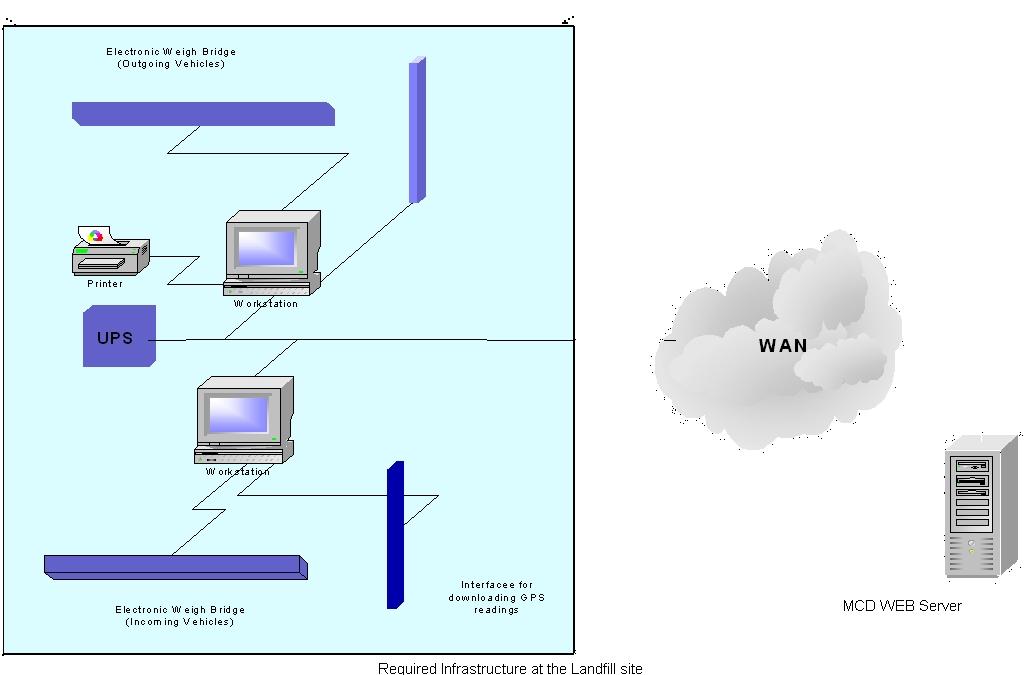
Electronic Weighbridge: A pair of electronic weighbridges at landfill
sites for measuring the weight of the solid waste transported.
3.
Base Station: A Base
Station at each landfill site for collecting the data from vehicle mounted
Offline GPS device, Smart Card and Electronic Weighbridges and transferring to
Central Control Station.

Required Infrastructure at landfill site
4.
Application Software: Computer
application software for processing the data viz. calculation of transportation
charges payable to the private concessionaire, generation of detailed and
exception reports and provision of audit trial.
5. Central Control Station: A central control station for hosting the central server from which the clients at various MCD offices shall be able to access the information over the web.

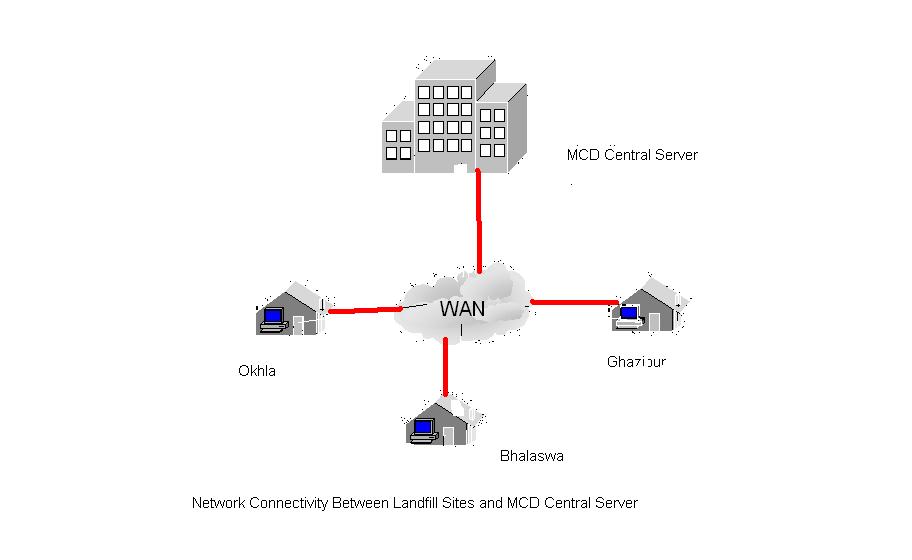
Network connectivity between landfill site and Server
Working:
- Geographical Position of each Waste Bin / Dhalao and landfill site is identified through survey using a precision GPS device and the corresponding latitude and longitude data is mapped in spatial DATABASE.
- The route to be taken by each Refuse Removal Truck (RRT) is predefined along the group of Waste Bins / Dhalaos located in particular locality on the route.
- An Offline GPS device shall be mounted on each Refuse Removal Truck (RRT) for logging the vehicle movements together with time stamp. The data would be collected at 20 seconds interval and stored in the data logger of the GPS unit. The capacity of this device should be with at least 2 MB data storage
- A base station setup at each of the landfill sites collects the weight measurements from Electronic Weighbridge using an RS 232 interface and also gets downloaded DATA from GPS devices fitted on trucks through infrared devices.
- The data collected by the base station from GPS device and Electronic Weighbridge is transmitted to Central Server hosting the Application Software located at Central Control Station through internet.
- The distance between the group of Waste Bins / Dhalaos located in particular locality and the designated landfill site can be calculated through survey using a precision Offline GPS device.
- The Application Software at the Central Server
• Calculates the amount payable to the concessionaire as tipping fee. The tipping fee is the amount paid to the private operators for collection, segregation, and transportation of solid waste from designated municipal zones and its disposal at sanitary landfill sites. The tipping fee is fixed on the basis of garbage transported from within a designated zone to particular sanitary landfill site.
• It calculates the distance traveled and also trip time from bin to landfill site per trip
• .It provides information about over speed the stoppage time at each Waste Bin / Dhalao and the route taken by the RRT.
• It shall generate all the detailed and exception reports required for analysis
• All detailed reports are available on internet where MCD officials and even if access provided to citizen can also view the status of quantity of garbage collection from a colony at a fixed time.
• It also provides information whether a particular bin/ dhalloa has been attended on a particular day,
•
It also provides GIS based route diagram for a
particular trip.
(iv) Computerised Public
Grievances Redressal & Monitoring.& Ward
Action Plan Monitoring.
Citizen can lodge a complaint through Internet,
e-mail, phone, postal mail. or personal visit. All modes of inputs integrated
for computerized registration and each complaint is identified by a token
number. Citizen can online track status of his/her complaint. MIS status of
complaints, department wise are available to Commissioner and Head of
Departments. System is in use since
February 2005
(v)e-tendering
MCD has introduced e-tendering system for all the procurements w.e.f 1-4-2005.First stage is preparation of tender on line using templates, issue of e tenders to those all authorised contactors, on line receipt of the tenders and opening of tenders on line.All participative vendors are required to have digital signature and are provided free of training by MCD. Next stage is preparation of comparative statement, negotiations and financial concurrence The system enables on line processing of tenders from indent requisition to placement of order. Vendors do not visit offices of MCD and participate in the tendering through digital signatures. MCD officials also participate through digital signatures and by accessing system through Internet. Public viewing of progress of tenders is possible
vii) Health Information System (HIS)
Computerization of all MCD hospitals has been planned to build efficiency and productivity with better workflow management to monitor allocated funds and expenditure utilization analysis, and to develop a common clinical database and also it has been planned for Faster and Easy access to information ,Improved quality of patient care, Increased nursing productivity, Improved quality of documentation, Development of a common clinical database, Enhanced ability to track patient’s record, Improved communications, Transparency in all hospital activities, Improved hospital image. ,Improved patient’s perception of care, Reduced hospital maintenance costs, Increased job satisfaction to hospital staff.
Major Hospitals are :
- Hindu Rao
Hospital, S.D.N. Hospital, RBTB Hospital ,MVID Hospital , Kasturba
Hospital ,GLM Hospital 06
- Colony Hospitals 06
- P.H.C 05
- Maternity Homes 28
- Ayurvedic Hospitals 02
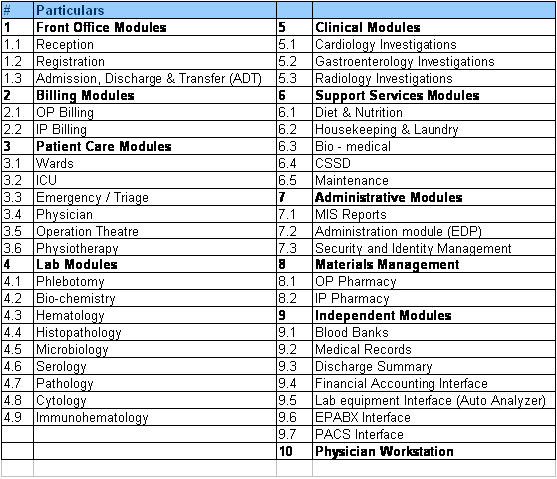
Important
Modules being Computerised are :
Other Modules
ü Blood Bank
ü Requisitions
are received from OT, Donors details are maintained, Screening, Cross matching
is done ,One bag can be issued to more than one patient, Blood stock details
and Inventory are maintained
ü CSSD
ü Receives
soiled material from wards/ departments,Sterilized
material is issued back to respective wards/ departments
ü Medical Records
ü Out-patient
records are collected from OPD’s ,In-patient record
case sheets are collected from Wards once the patient is discharged.Case
sheet diagnosis is classified using their own classification,Medico
legal cases are maintained in a separate format,Medical
certificate and Medical examination certificates are issued by collecting some
amount at OPD.
Status in major MCD Hospitals in 2002
|
2002 |
Beds |
OPD |
Emerg. |
Admn. |
BOR |
LOS |
|
|||||
|
HRH |
980 |
563381 |
67325 |
55094 |
65.36 |
5.89 |
|
|||||
|
SDNH |
230 |
508646 |
51606 |
17262 |
94 |
401 |
|
|||||
|
KH |
450 |
199007 |
36064 |
63064 |
94 |
9 |
|
|||||
|
RBTBH |
1155 |
|
|
8585 |
98 |
0 |
|
|||||
|
IDH |
227 |
|
|
4828 |
27 |
5 |
|
|||||
|
GLMH |
97 |
37833 |
2863 |
5845 |
28 |
6 |
|
|||||
|
2002 |
X-Ray |
Lab. |
Delivery |
Opera. |
Los |
|||||||
|
HRH |
95606 |
534279 |
4170 |
21090 |
5.89 |
|||||||
|
SDNH |
31284 |
268290 |
4054 |
11841 |
4.1 |
|||||||
|
KH |
9679 |
266844 |
11304 |
13477 |
9 |
|||||||
|
RBTBH |
16799 |
|
|
|
|
|||||||
|
IDH |
|
10284 |
|
|
5 |
|||||||
|
GLMH |
724 |
41068 |
730 |
4194 |
6 |
|||||||
vii)
Role of MCD in Education
“To improve the
standard of Nursery and Primary education, qualitative as well as quantitative
for the harmonious development of children.”
Presently
MCD runs 1833 Primary Schools, 44
Sharda project was
conceived under IT plan through Computer Aided Learning along with Computer
Awareness to improve the standard of primary education at MCD run schools.
- Each school has been provided 5
computers and a faculty by MCD selected vendors.
- Computer Aided Learning
material for class 3to 5 has been prepared on a set of 22 CDs.
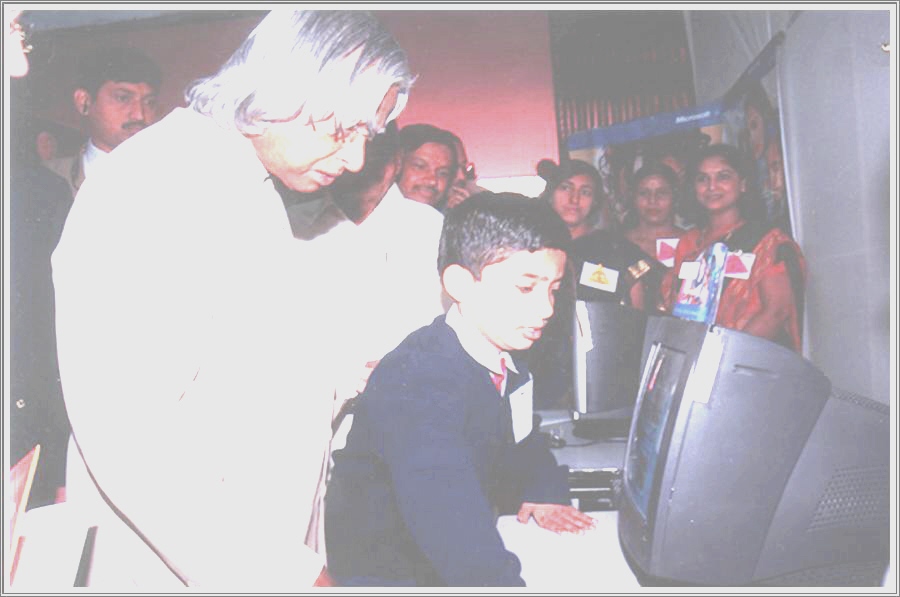
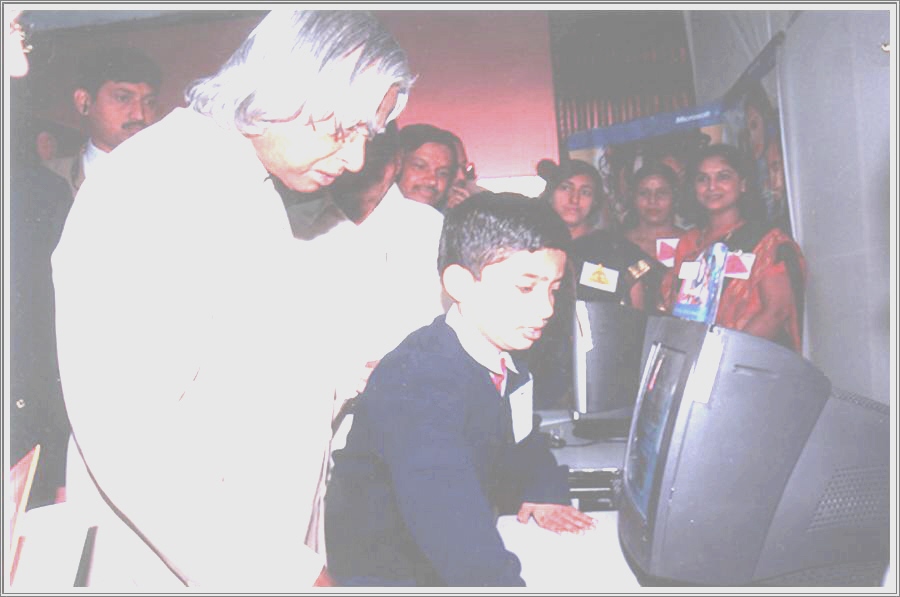 President
of India in MCD
President
of India in MCD
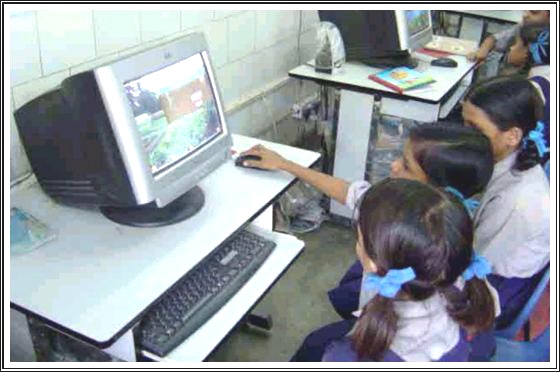
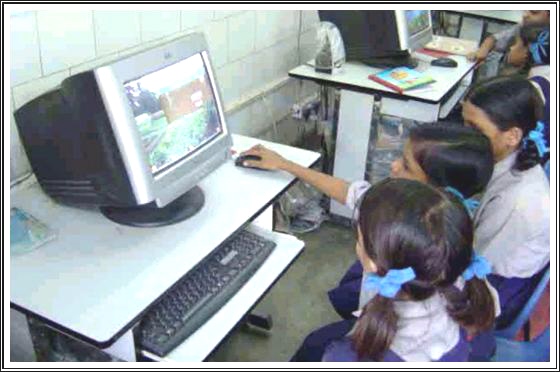 MCD School Children
learning computers
MCD School Children
learning computers
F) E governance Project has following 3Phaes,
Phase-I
· Preparation of Master IT Plan
· Setting up dynamic Website and Citizen Service Bureaus
· Trailing to initial batch of staff
· Digitisation of licenses data, birth & death records, parks, community halls
· Identification of Core applications and arrange its software development.
· Limited IT infrastructure.
Phase-II
- Expansion of CSBs to 134
wards.
- Digitisation of employees
records, property tax legacy records, hospital legacy records.
- Training on e-procurement, basic computers awareness
and use of various MCD software applications.
- Setting up of Data Center & WAN
- Provision of 2500 computers
- LAN in 22 buildings
- Broadband connectivity in all MCD offices
- Implementation of computerization in 6 Hospitals
- Processing of tenders of value more than 10 lakhs
through e-procurement
- Implementation of SWTS, EIS,EDIS applications
Phase-III
- Setting up Municipal Computer Institute of Training (MCIT)
- Digitisation of remaining tax records and GIS mapping
- Smooth implementation of e-procurement, Engineering Information System, PTIS, FMS, GIS.
- Implementation of messaging and work flow system.
- Implementation of MCD’s other applications like Vigilance, Legal etc.
- Implementation of ‘SAP’ in slaughter house.
G)
Constraints which were faced
during Computerisation in MCD
1. Complete absence of automation of any kind except in Property Tax Dept. – everything was done manually
2. Lack of IT skills among its 1.5 lakh employees
3. No IT Department
4. Lack of clear IT policy and direction
5. Complete absence of any procedure for management of knowledge assets
6. Lack of transparency in dealings with public
7. Lack of funds
H) Strategies to deal with these Constraints
• Identify projects that did not depend for their success on
– IT Skills of MCD employees
– MCD’s IT infrastructure
– Financial support by MCD
• Take up citizen-centric first by
– Outsourcing of delivery of municipal services by inviting private sector participation
• This strategy involved handing over of our knowledge assets to the private company
– By selecting the company on the basis of transparent open bidding procedures
• Digitizing records of departments
• Selection of IT consultants to
– Prepare a long term IT road map for MCD
– To assist key departments in conceptualizing development of their back-end applications
– To assist IT Department in all matters
• Identifying Pro IT Change agents in all departments and nominating them as nodal officersensitizing senior officers and political leaders about IT Initiatives
• Drawing up training schedules
• Providing E-mail connectivity
I) Problems,difficulties,suggestions
for improvement
• Lack of clean and complete records.
– By creating database on the fly as we went along conducting transactions
• Opposition from Counsellors and a section of officers
– By taking them into confidence and sensitizing them
– Managed to raise fee in many transactions and thereby revenue
– Identifying pro-IT Change elements within the officers and isolating the anti-IT Change officers
– By following transparent procedures in selection of IT vendors and consultants – raised their confidence levels
• Procedures not clear in many cases and not amenable to electronic transactions
– By constituting a Procedure Review Committee and standardizing procedures
• Lack on in-house IT expertise:
· By hiring IT consultants
- With the initiation of setting up Citizen Services
Bureaus (CSB) under Public Private Partnership mode (PPT),Computerisation
in MCD begun in 2002 In all 13 CSBs were opened
in next one year to provide various municipal services under one roof. In
spite of initial teething problems these CSBs
have become integral part of MCD functioning. It is hearting to see
politicians of various hues demanding to open one such CSB each in their
wards. Such a support resulted in MCD decision in 2004 to extend these CSBs in each of 134 wards .
MCD has spent about 1.5 crores to provide
air-conditioned space and Private Partner spent about 3.0 crores in setting up hardware, network, software, etc.
Delhi Government also decided through its cabinet decision in Oct 2005 to
join these CSBs. These centers like e-sewa of other states would be providing all state Govt
services and collection of bills of various Utilities and also traffic challans of police under one roof. It is unfortunate
that MCD has not been able to set up more than 40 such centers till date
and also not taken any decision to go ahead with
- The other important case where MCD has messed up is Computerisation of Property Tax System (PTS).But present mess is only due to wrong decisions taken my MCD in the past. This is the most important aspect of strengthening financial resources of MCD as it was required to take up digitlisation of its legacy records (information available before unit area method was introduced) through professional agencies under the charge of a Champion officer. The information provided by citizen under self assessment was to be added or modified to this legacy Database. What was done by MCD was the other way resulting in total mess... The sooner the correction is made better it is for MCD as under the present system, time limit, to review the cases, has been reduced from earlier 3 years to one year. Two years old self assessed cases are already out of MCD preview. The use of GIS comes next when MCD wishes to identify un-taxed properties. It is estimated that with the present set up MCD would not be able to computerize its PTS in next 5 years. MCD needs immediately to discipline software developers and appoint a professional to look exclusively It is needless to say that it shall be too naïve to assume that this task can be manually accomplished through meager strength of MCD inspectors.
- MCD is setting up a modern Slaughter house at Gazipur. The operation and management of the complex is as important as setting up to derive long term sustainability. MCD has already got prepared a detailed Computerisation plan which is based on latest ERP solution for manufacturing like activities. It is important that MCD gets the Computerisation of operation of slaughter house completed along with the commissioning of the project. It is feared that in absence of computerised operation the ultimate goal of setting up operational slaughter house may not be fully achieved.
- MCD has set up a Public Grievance and Redressed
System (PGR) available on line through its web site. The purpose is to
enable citizen to record complaints through internet also. PGR was
introduced with much fan and fare in Feb 2005 by Chief Minister,
- Much talked e tendering system of MCD has no doubt brought some discipline in tendering system of MCD. But the system being currently used by MCD is akin to one being developed by its service provider for many PWDs. It needs to be customized for other procurements like ones in Horticulture, Hospitals and Schools. Moreover inconsistent decisions taken sometimes by MCD may be due to pressure from politicians need to be avoided.
- Computerised systems planned to strengthen the internal systems of MCD were started in most honest way but due to lack of foresightness currently most of them either have been lagging behind their schedule or even abandoned. Computerisation of Pay roll and personnel system is one in example Except for some isolated and that too partial Pay roll Computerisation in 2 zones nothing more has been achieved for last 2 years. The digitlisation of personnel records has been handled in most shoddy manner. Full implantation across MCD is unlikely to happen.
· System planned to computerise engineering system is finding that engineers are not ready to part the vital information like assets information, master records information, building layouts, etc to be digitalized. Software developer claims that development is ready but there is no data for testing and deployment. However after spending/committing about Rs 1 crores on software development alone, it is not certain if this system could be implemented for all the planned modules and also for all the Zones.
· MCD has been able to implement Computerised Sold Waste Management System. Beside many other MIS reports the system has linked GIS information with non spatial database to give pictorial description of the route a truck has taken to dump the garbage from the bins to the dumping site. The usage by MCD officials is however is slow but likely to pick up in due course of time.
· MCD has spent/committed lot of money to computerise its Hospitals. Except for Swami Dayanand Hospital, the much talked ”portability of OPD cards along with medical records across MCD hospitals and ultimately to all Govt hospitals in Delhi” is likely to remain a pipe dream as MCD has not been able to finalize Data Centre facilities where this common information is likely to be kept. . The software used by MCD is also different than used by Delhi Govt. MCD has spent a lot more money to acquire software as compared to Delhi Govt though its spending on hardware and networking comparatively has been much less. However due to lack of coordination, MCD could not spent the money in two successive years which was allocated by Delhi Govt for this purpose
· The Sharda project under which MCD is providing computer awareness to its primary school children thought laudable again is full of mismanagement. The system on which training is provided to children by hired faculty of service provider is different than that on which MCD teachers get trained. It is likely that MCD teachers would never be able to substitute hired faculty.
· MCD has however been able to provide reasonably IT infrastructure. All the 12 zones and town hall have been provide work canters equipped with 5-6 Pcs, DMPs. Line printer and Broadband Inter net connectivity. All 134 councilors being provided with lap tops. Most of the officers, engineers and doctors are being provided with PCs. A pilot data centre has been set up. All hospitals, Town Hall and most of important building are being Locally Area Networked. Now it is the only usage of these facilities which need to be ensured
· Though 4 out of 10 would suffice presently but it is going to fall below pass percentage very fast than expected.
The author was till recently Advisor (IT) with MCD and can be
contacted through e-mial at [email protected]