Undeciphered document (2)
There exist many unexplained documents and
engravings, the VMs is not unique in that respect. For example
the following two remain a mystery. Even the highly schooled
iconographers haven’t been able to crack them. It’s
interesting to read their speculations. It illustrates the
difficulty of interpreting VMs iconography. This one is from the
"Illustrated Bartsch" - Early Italian Engravings.
| .053 FRONTISPIECE OF AVLVS
ANTONIVS OROBIVS, ARCHETYPI SIMILITVDO DE RATIONE
PVNCTORVM
110 x 150 (approx.). Hind 1948, vol. 5, p. 296, no.l4.
lnscribed as follows:
- in the margin below the image: Autor Aulus
schimatis artifex Brix. ;
- on a tablet near the lower center: AV;
- around the outer border of the circle, clockwise
from the top: METAPHYSICA RATIONALIS SPECVLATIVA
ARS SAPIENTIA;
- around the inner border of the circle, clockwise
from the upper right: PHYSICA PRACTICA SCIENTM
VERA VIRTVS;
- on the blank background to the right of the
author: MINIMV MMIMO/ COMPOSITUM/ HAC FIGURA
/PER. . . FECTIS/SIMVM EE DIX/ERIS;
- on the scroll held by the author: SCRIBENS/ MTE
CO[N]-/CIPIAS/Q[VI]D/ PRO/BE/V ... ELIM;
- on the pages of the open book: QVV/ LEGE/DO
AV-/TORI/S (continued on the right-hand side)
PER-/SONA INDV/AS;
- above the book: W.LOB.R.M. (It may be noted that
several of the letters in inscrs. 5-8 are
accompanied by lines indicating abbreviations;
these are not, however transcribed here.)
|
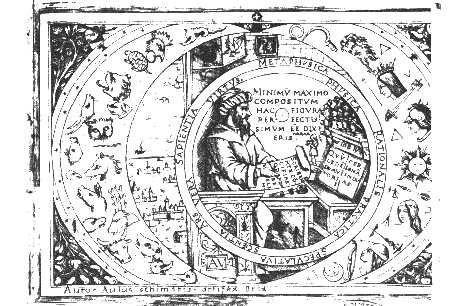 |
This enigmatic engraving serves as the frontispiece of a
"little volume'' (Libellus) by Aulus Antonius Orobius, whose
highly erudite text amounts to a philosophical essay on
punctuation. Entitled Archetypi Similitudo de Ratione Punctorum,
the book was published in Bologna in 1518, as we learn from its
colophon, which reads "Impressum Bononiae per Benedictum
Hectoris. Anno Dni.M.D.XVIII. Quarto Kal, Augusti.''
Unfortunately, the present writer has discovered nothing about
the author, presumably represented by the bearded and turbaned
sage who sits at a desk in the center of the print and points to
a book on his lectern, behind which is clustered a group of
miniature auditors. According to the inscription in the lower
margin, Orobius was Brescian, but his name appears to be an
esoteric pseudonym. One is struck by its similarity, which can
hardly be coincidental, to that of Paulus Orosius (ca. 385-420)
an associate of St. Augustine and author of the Seven Books of
History Against the Pagans (Historiarum adversus paganos Iibri
VII), famous for being the first history of the world by a
Christian writer.
Without doubt the plate must have been engraved in or shortly
before the year of its publication, 1518, and the artist may have
left us a clue to his identity in the monogram AV appearing on a
tablet near the lower center of the image. Here one naturally
thinks of Agostino Veneziano, the well-known engraver who often
signed his prints with the initial letters of his name (a variety
of his monograms is conveniently illustrated by Nagler, vol. 1 ,
p. 590)., but Agostino's manner is altogether different from that
of the present item. In view of Orobius's birthplace, the name of
Giovanni Antonio da Brescia also comes to mind, and, according to
Hind, the frontispiece is "not unlike G. A. da Brescia in
style of engraving''; but the present writer sees nothing more
than a superficial resemblance to Giovanni Antonio's work of ca.
15 15-20, during which time he was residing in Rome.
For its date of 1518, the technique of the engraving is
conservative witness its fine, delicate, regular shading with
rectilinear parallels and crosshatching, a technique reminiscent
of the early Venetian school. Specifically, the writer is
reminded of the various engravings of ships herein ascribed to
Venice (TIB 2409.0 1 1-.014)., and of the related Lion, Dragon,
and Fox Quarreling (2409.015), where the water with minuscule
ships and the landscape with small buildings are comparable to
the corresponding features of the frontispiece. Even the tiny
silhouetted figures appearing here and there in the frontispiece
have counterparts in several of the works just mentioned.
Accordingly, the print may be tentatively ascribed to a
northeastern ltalian engraver, possibly a Venetian or, since the
book was printed in Bologna, an Emilian.
No coherent explanation of the curious imagery of the
frontispiece suggests itself to the writer, nor does the
engraving appear to illustrate the contents of the book, with its
arcane speculations concerning periods, commas, semicolons,
parentheses, and other marks of punctuation. The overall
composition has something in common with conventional diagrams of
the cosmos. In fact, there is an obvious reference to the
firmament in the bands of stars that frame the image on both
sides; and the signs for Pisces and Aries, respectively the last
and the first of the twelve constellations of the zodiac, appear
below a cross at the upper center of the print and perhaps stand
for the zodiac as a whole.
The writer is unable to account for the assemblage of creatures,
surely symbolical, whose heads are depicted in the broad
crescent-shaped segment at the left of the engraving. But the
heads and objects in the corresponding area on the right-hand
side of the sheet (if not the geometrical forms that fill the
interstices) symbolize the seven planets, which appear in their
normal sequence from the bottom up: the Moon, with Diana's bow;
Mercury, with his caduceus; Venus, adjacent to an archer
(representing Cupid?) on a tripod; the Sun, with Apollo's arrow
(unless the arrow should linked with Cupid and hence with the
emblem of Venus below it; Mars, the helmeted warrior, with a
sword; Jupiter with a crown, a scepter beside him; and Saturn, a
bearded old man accompanied by his sickle.
The remaining images in the engraving still await interpretation,
as does the precise meaning, assuming that it has one, of the
complete ensemble.
It may be noted that a loose impression of the frontispiece
(present whereabouts unknown) appeared as lot no. 615 in a sale
at Sotheby's, London, on 21 May 1832.
Berlin; Rome VE (bound with two other volumes sub no. coll.
69.2B.17. 3R 2 ).