Undeciphered document (1)
There exist many unexplained documents and
engravings, the VMs is not unique in that respect. For example
the following two remain a mystery. Even the highly schooled
iconographers haven’t been able to crack them. It’s
interesting to read their speculations. It illustrates the
difficulty of interpreting VMs iconography. This one is from the
"Illustrated Bartsch" - Early Italian Engravings.
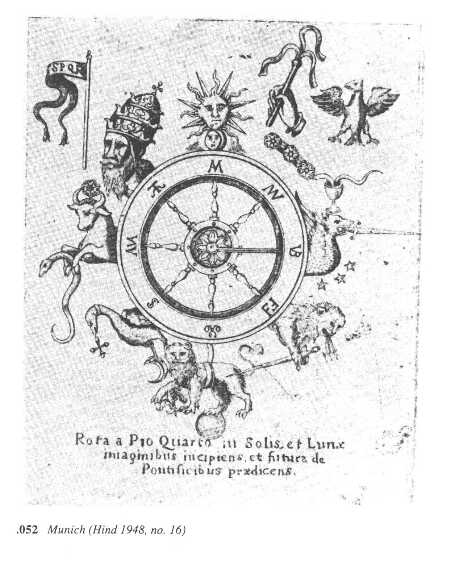
.052 THE WHEEL OF POPE PIUS IV
140 x 1 12 (approx., sheet).
Passavant 1860-64, vol. 5, p, 191, no. 108;
Hind 1948, vol. 5, p. 296, no. 16.Below the
image: Rota a Pio Quarto in Solis et Lunae / imaginibus
incipiens, et futura de/ Pont/cibus prœdicens ;
around the wheel: eight unidentified characters or
combinations of letters; on the pennant at the upper
left: SPQR
The present item is a puzzle in more than one respect
perhaps even literally so. Its inscription referring to
Pope Pius IV apparently dates the image to the years of
his pontificate, 1559-65. Although this circumstance
should have placed it beyond the scope of the present
study, it is included here because Passavant and Hind
treated it in their catalogues, and also because, despite
the inscription, it has a legitimate claim to being
considered an "early'' Italian engraving.
|
 |
Following Passavant, Hind compared the print to the Prognostic
of 1510 (TIB 2409.033), judging it to be "very near'' the
latter "in style of design and engraving'' and speculating
that it "might have been produced at the same period, the
original inscription having been altered to suit a later
occasion.'' The inscription in its current form is clearly
datable to the mid-sixteenth century, not only on the basis of
its content but on the style of its lettering as well; there can
be no doubt that it was cut onto the plate at the time of Pius's
pontificate. As far as the image is concerned. the writer sees no
marked resemblance to the Prognostic of 1510, except, of course,
for its general nature. Like the Prognostic (if the inscription
be given any credence), the print also serves as a symbolical
forecast, a pictorial prophecy of events to come during the reign
of Pius IV. Like the Prognostic, moreover, the technique of fine
rectilinear crosshatching has the character of early
sixteenth-century workmanship, suggesting that Hind may have been
on the right track after all. In this context, it may be noted
that the initials SPQR on the pennant are slightly different in
style from the letters of the principal inscription; to the
present writer's eyes, they seem to betray an earlier hand.
Granting that the pictorial elements of the engraving may
predate its inscription by a generation or more, one also notes
that the head of the pontiff emerging from the wheel is bearded.
As such, it bears a vague resemblance to Julius 11, who grew his
celebrated appendage in 1510 and thus became the first pope of
the Renaissance to go unshaven (Zucker 1977). After 1527, when
Clement VII elected not to shave following the Sack of Rome,
papal beards became the norm: all of his successors, including
Pius IV, wore them down to the end of the seventeenth century
(see ills. in Haidacher). At any rate, the head in the engraving
resembles Pius no more than Julius; its features are somewhat
more in keeping with those of Paul III ( 1534-49), Julius III (
1550-55), or Paul IV (1555-59), but there is no reason to suppose
that any of these mid-sixteenth century pontiffs was intended.
Clearly, the dilemma posed by the engraving will only be resolved
by explaining the significance of the unusual group of images
arrayed about the wheel, as well as the cryptic lettering on the
rim of the wheel itself. The present writer is unable to
accomplish this task and unaware of any other attempt to do so.
(Munich.)