Rota paschalis
There is a long tradition of rosette-like diagrams with
characters around their perimeter, the so called “rota
paschalis” used to determine the exact dates of Easter.
Again a demonstration that our VMS-contemporaries might be able
to perform rather complex symbol manipulations. - I have found
many more interesting rosette-like diagrams but haven’t had
the time to scan them yet. I was surprised that old tarock-card
sets had no VMs like features (except a cosmological card
describing the “primum mobile” sphere of the heavens).
This one is from the "Illustrated Bartsch" - Early
Italian Engravings.
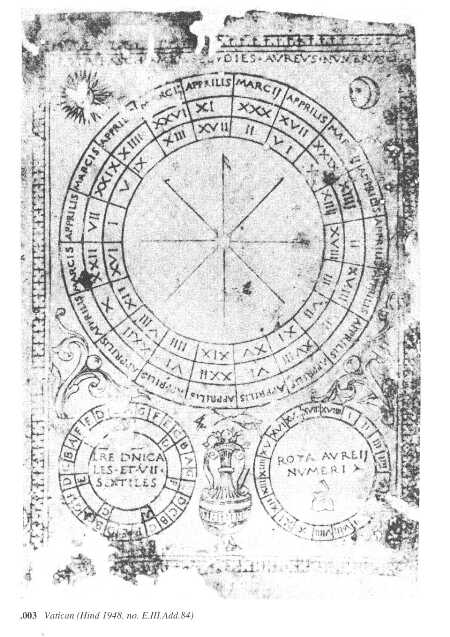
| 003 EASTER TABLE (ROTA
PASCHALIS) 204/06 x
147/50 (sheet).
Goldschmidt, p. 358., "Incunabuli . . .,'' p. l 54.,
Donati 1946., Hind 1948, vol . 5, p. xv, no.
E.III.Add.84.
Across the top: .ROTA.PASCHE.MEMSIS
[sic].DIES.AVREVS.NVMERVS. Inscriptions also fill three
circular tables or wheels as follows:
1) The large wheel is surrounded by three circular
bands divided equally into nineteen boxes. The outer
boxes are labeled APPRILIS (April) fourteen times. MARCIJ
(March) three times, and MARCIS (March) two times. The
boxes in the middle band are inscribed, nonconsecutively,
with Roman numerals from II to XXX representing days of
the months to which they are adjacent. The innermost
boxes are inscribed, nonconsecutively, with Roman
numerals from I to XIX each one representing a ''golden
number'' (the number of a particular calendar year within
a so-called Metonic cycle, a nineteen-year period after
which the phases of the moon return to a particular date
within the calendar year). Golden numbers are
traditionally used to fix the date of Easter, and here
they are aligned with the days in the middle band and the
months in the outer band so that II coincides with 30
March, VI with 17 April, etc.
2) The small wheel at the lower right, inscribed ROTA
AVREIJ/ NVMERI ("wheel of golden numbers''), is
surrounded by a circular band divided equally into
nineteen boxes; the latter are numbered consecutively
from I to XVIIII, counting clockwise from the upper
right.
3) The small wheel at the lower left, inscribed
L[ETTE]RE D[OME]NICA/LES. ET. VII.SEXTILES
("dominical letters'' the first seven letters of the
alphabet, used in church calendars to determine the date
of Easter ''and seven sextiles''), is surrounded by two
circular bands. The outer one is divided equally into
twenty-eight boxes containing the seven dominical letters
A through G. There is one inner box for every four outer
boxes; thus the inner boxes are used for leap years,
although the central inscription mistakenly calls them
sextiles instead of bisextiles.
|
 |
The engraving is known in two impressions. One of them,
colored red, green, and yellow, is pasted onto the binding of a
copy of Nicolaus de Ausmo's Supplementum Summae Pisanellae
published in Venice 30 November 1473 (Hain, no. 2151). The book
belongs to the Franciscan convent of Campora on the island of
Arbe (Rab), located off the Dalmatian coast of Croatia. It has
been in the convent since the fifteenth century, having belonged
to a friar named Bernardino, who was probably responsible for
inscribing a date of 1480 inside the lower left wheel. The other
impression (herein reproduced) is also from the binding of an
incunabulum (Biblioteca Vaticana, no. 1V.654), the Confessionale
of St. Antonino of Florence published 15 April 1472 (Hain, 130.
12.12).
Donati analyzes these works in detail, gives further
bibliography, explains how they work, and observes how the minor
wheels (but not the major ones) are valid for a period extending
indefinitely beyond 1484. For the most part, all four of the
German versions contain identical features: one large wheel and
two smaller wheels with comparable inscriptions in gothic
lettering; branches, leaves, or flowers in the three empty spaces
at the bottom; a pair of hands with fingers pointing to the pair
of smaller wheels and indicating the direction of movement around
them; and images of the sun and the moon in the upper comers the
sun on the side corresponding to the wheel of dominical
("Sunday'') letters at the lower left, the moon on the side
corresponding to the wheel with the golden numbers (representing
the lunar cycle) at the lower right. An interesting feature of
these Easter tables, still extant in two of the versions (but not
the present one), is an extra piece of paper in the form of a
circle precisely the same size as the blank area in the middle of
the larger wheel. Printed with the image of an angel and fastened
to the center of the wheel, this disk is meant to revolve on its
axis so that the angel points to specific alignments of boxes as
described above (sub no. 1).
Donati demonstrates that all of these prints are direct or
indirect copies of a lost original, which must have been a German
woodcut issued in (or immediately before) the year 1466. The
theory also holds true for the present item, with its principal
wheel inscribed with nineteen dates from 6 April 1466 (APPRILIS
VI IIII) to 18 April 1484 (APPRILIS XVIII III). That it is
ltalian rather than German there can be no doubt, seeing that the
lettering is Roman instead of gothic, that the vase at the bottom
is classical in character, and that both known impressions are
pasted into Italian incunables. The publication dates of these
volumes, 1472 and 1473, are consistent with the supposition that
the engraving was produced in the mid- to late 1460s, and so too
is the handwritten date of 1480 on the Arbe impression. In view
of the latter's location in a Venetian book belonging to a member
of a convent on what was then a Venetian island, one may further
surmise that the engraving is itself Venetian. To be sure, it
contains few stylistic or technical elements that might serve to
establish an attribution, but the very delicate shading of the
moon-face is in keeping with the notion of Venetian authorship.
Accordingly, the present writer follows Donati in assigning
the Easter Table to the early Venetian school and dating it to
ca. 1466. Also acceptable is Donati's attribution of the
preceding item, the Fountain of Love (.002), to the same
anonymous craftsman, an attribution based on comparison of such
details as the vases, the scroll-like plants, the ivy leaves, and
the hands. Even the ornament of the present item's rectangular
frame is identical to that which appears on two decorative bands
on the upper section of the fountain in .002. The writer is not,
however convinced that Donati is correct in ascribing the Madonna
and Child with Saints (.001) and the Allegoty of Envy (.005) to
the same hand. (Arbe; Vatican.)