The alarm went off way before dawn. I woke up in strange surroundings, with a faint coastal breeze coming in the window. The day before, I had driven 400 miles from my home in Oregon to get to this part of Northern California where the tallest trees in the world grow. Now it was time to drive another hour in the pre-dawn darkness to the old growth grove of redwoods where we were to climb. I wanted a scenic spot to have lunch--a place with a nice view, and this trek with fellow Tree Climbers International member Jerry Beranek was just the ticket.
It's not that I had never climbed a big tree--cone collection contracts in Oregon had included 200 foot Sugar Pine--but the challenge of the biggest of them all was somehow compelling and mysteriously unresistable. Jerry's reputation as a consummate master of the redwood empire was comforting enough to allay the fear of attempting something that most people regard as foolhardy. Leaving the perfectly safe ground to ascend over 300 feet in the canopy is, admittedly, very hazardous. By using the most modern climbing techniques, safety procedures, and proper equipment, we turned a lark into an expedition.
Upon arrival at the site, we had to pack our gear in. This meant we couldn't bring much gear, period. The tree was about a quarter mile up a moderatly steep trail. (Another quarter mile farther is the 357' tree that was climbed by Jerry and TCI founder Peter Jenkins and detailed in the winter '87 issue of TREE CLIMBER magazine).
Weather conditions were perfect--the day had dawned bright and clear--but as we entered the grove, the light level dropped to a deep twilight shade under the multi-level forest cover. No sky was visible to us down here on the forest floor, and the tops of the trees couldn't be seen either. We felt like mere ants in the land of the giants. My mouth gaped open in awe as the first few monstrous trees came into view. Only a couple hundred feet of their trunks were visible, giving the ominous impression that the trees were a staircase to Jack-in-the-Beanstalkville. We had entered another world--where time had stopped twenty centuries earlier. We scrambled over enormous rotten logs that had lain there, undisturbed, for 500 years (They must have been several thousand years old when they fell, soundlessly). We made the transition in our minds, as well. We were now with nature, not in it.
It was quite obvious when we reached the tree. It was significantly larger than the others, fifteen feet in diameter, and very tubular. The sides of the tree trunk were parallel--there was no apparent taper as my eye travelled up the massive trunk. I craned my neck back and looked up and up, the limbless trunk vanishing overhead into the competing vegetation. Oh yes! This was indeed what I had come after.
Jerry didn't waste any time preparing for the ascent--he knew what to do because he had been up this particular tree before, so he acted as the lead climber. The plan was to go up a smaller tree, swing over into a larger, twin-spired one, then transfer on over into Big Daddy. I put on my Euc Man buttstrap saddle and was starting to flake out the 175 foot Safety Blue climbing line, when he stopped me, saying that it should be carried coiled because it wouldn't be used until quite a bit later. I suddenly envied his lightweight 200 foot, three-eights inch Gold Line and hand braided saddle.
Our philosophies varied widely in the gear department. Jerry is very minimalist, preferring to make his own, or adapt existing equipment to his specialized uses. Ascenders and line guns are some of the rigging tools he likes to use. As for me, I like to carry a truckload of conventional arborist equipment of the kind typically found in a Sierra Moreno Mercantile catalog. All aerialists have their own preferences--from professionals like Window Washers; Silo Painters; Ironworkers; Electrical Linemen or Tree Surgeons, to amateurs such as Spelunkers; some Search & Rescue people and Rock Climbers. Recreational tree climbing takes from all these disciplines and uses whatever works. The night before, Jerry had cut and spliced a special, 30 foot flip line for me. Now it was plain enough to see why. Also, we used climbing spurs, (not recommended by TCI), so we could confine the climb to a one-day event. Jerry cautioned me about nicking the top of the limbs, where breaking a small amount of tension wood can cause large limbs to fail. We put on our backpacks filled with camera gear, lunch, and other climbing stuff. Jerry ajusted his flipline around the smaller redwood (a seven-footer!) and started walking up the tree. I followed.
What a workout! My anticipation turned quickly
to perspiration as I tried to keep up with Jerry, who moved
smoothly upward, above me. It was important to take big steps, so
the large diameter portion of the trunk didn't consume too much
of a limited ration of energy. I felt like a fly climbing a flat
glass wall. The bark was surprisingly firm, not like the spongy
bark of the puny backyard redwoods I periodically climb as an
arborist. The spurs barely penetrated. As we went up, I made sure
to keep at least one limb between us as a safety precaution, lest
he slip and come down against my flip line. A second flip line
was used for security as we unhooked to vertically pass by limbs.
My usual flip line is an eight foot length of proof coil chain,
secured by Klein harness swivel snaps at a side dee ring. This
arrangement makes for excellent adjustment of length, although
somewhat heavy and noisy (Some people accuse me of having
offended the Gods, and of being condemned to chain myself to the
top of a tree every night, where an eagle tears out and consumes
my liver!).
As we approached the two-foot diameter level, over a hundred and
fifty feet
in the air, we were at a bare spot in the canopy of the
neighboring tree.
This was the location where the first transfer would take place.
Jerry
paused and told me to wait while he went up about 50 more feet to
get a good
tie-in. He went on up, got tied in with a taught-line hitch, then
slid back
down to where I waited. There was plenty of pendulum in his line.
He swung
over to the next tree, whose limbs were about 15 feet away. He
attached
himself to the trunk with his flip line, then unclipped his
climbing line
and sent it back to me, where I repeated the procedure, and
joined him.
This twin-trunked tree was hollowed out and bare of limbs in the
space
between its two spires, like a big, outdoor room. Actually it was
more like
stepping into a huge empty cathedral, majestic with sparkling
dust floating
in long beams of filtered sunlight streaming down through the
stained-glass
foliage. The trunks were like massive pillars, and branches
radiated out
from the center. This ancient cathedral was more than twice as
old as any
built by man. We climbed another hundred feet in reverent
silence.
We bridged to the opposite side of the tree, where the next
transfer was to
take place. This time it was my turn to go up to set the line.
Since the
distance to be traversed was greater this time, I went up a
little higher,
sixty to seventy feet, then came back down on the taught-line
hitch. Jerry
took the tail of my climbing line and tied a special 'Jam Knot',
which he
expertly tossed over to a spot on the big tree where two
interfering limbs
crossed each other. It wedged itself firmly between them,
allowing me to
hoist myself sideways, hand over hand, until gaining a good
enough hold to
flip my safety chain around a limb on the big tree and slack off
the
climbing line. Working my way sideways over to the trunk on some
foot-in-diameter sized limbs, I went up the trunk a ways and got
tied in
with the tail of the rope. Going back down to Jerry's elevation,
he threw me
the tail of his rope, which I tied to the climbing line set in
the big tree.
He pulled it over to himself, and, suspended between the two
trees, made his
transfer.
We were now all set to make the final leg of the climb. At this
point, about
250 feet above the ground, the trunk was still six feet thick. It
made the
tree we had just come out of look like a scrawny sapling. There
was a lot of
limb-over activity, using two flip lines for safety as we climbed
up. Jerry
went to the top, pulled up my climbing line and got me tied off,
so I could
make the last part of the climb without having to keep stopping
to flip in.
Such a team effort saves a lot of energy, and is much safer than
each
climber replicating the movements of the other. Swapping gear as
the
situation demands results in a synergy unattainable by a single
climber.
When we finally reached the top, Jerry said,
"Congratulations on breaking
the 300 foot barrier!". We didn't know exactly how high we
were at the time,
but I felt overjoyed and relieved. We had a chance to talk and
relax after
the grueling effort. There was plenty of room for us both in this
flat-topped tree. The treetop was pancake shaped, with limbs the
same
diameter as the trunk fanning out at the top. Maybe gravity had
decided that
sap couldn't rise any higher than this. By standing on the top
branch, my
head was higher than any part of the tree, and I could see in all
directions. Farther up the valley was a whole hillside of 300
plus footers.
Old growth has the striking characteristic of showing large
portions of
individual tree trunks, as they extend well above the understory
in a
magnificent panorama. The ground was invisible, forgotten under a
carpet of
velvet green, far below. Besides, we had worked up a big
appetite, so it was
time for lunch. And what a view!
All good things must end, and it was finally time to come down to
earth. We
had one thing to do on the way back down, which made the descent
more
exciting, and less of a chore. Jerry wanted to measure the exact
height and
diameter of the trunk. So, with one end of a fifty foot tape, he
started
lowering himself off the edge of this flat world into the abyss.
I held the
other end of the tape at the highest point of the tree. After he
reached the
fifty foot level, I decended to his level, where we measured the
circumference. The tree was fifteen feet around, or five feet in
diameter.
Another fifty feet down, it was seven feet thick. Fifty feet
below that it
was nine feet thick. It started to become quite an operation for
two
climbers to maneuver the tape around this massive girth. With all
the limbs,
there was a lot of clambering around.
When we reached the lowest limb on the tree, (which was about a
hundred and
sixty feet above the ground) we switched to single rope
technique. Doubled,
our ropes would not reach the ground. Jerry tied a running
bowline around
this limb with my half inch climbing line. He tied his climbing
line through
the bight of my bowline for later retrieval of the two ropes. We
then
continued our descent on figure-eight rappeling devices. We
continued to
measure girth every fifty feet. After the sixth measurement, or
300 feet, we
were almost at ground level, and Jerry went down, leaving me up
in the tree,
holding the tape. He made the last measurement at ground level
and announced
that the tree was 336' 3" tall (There may be a little room
for slop in this
measurement).
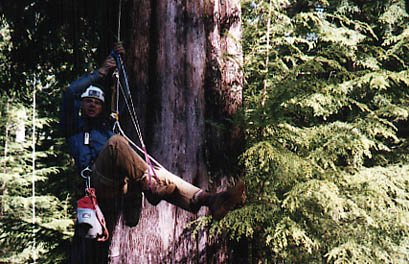
Here I am hanging on a hundred and forty feet of my rope with it
footlocked
off below the figure-eight decender. (Ever footlock with spurs?).
(Note:
Footlocking is a very fast rope-climbing method where the rope is
wrapped
around one foot, then clamped down by stepping on it with the
other.) Jerry
decides to set up a tripod to take some pictures, since the light
is so low.
To keep my mind occupied, he takes the tail of my rope, and walks
me all the
way around the tree trunk about three times, says "Hang
on!", then throws me
out into space. What a wild ride! I coiled around that maypole a
half dozen
times--with all the strech in the line it was a wide, springy
arc, like a
ride at Disneyland. When I came in for a soft landing, I pushed
back off
again and wrapped around three or four more times, until it was
time to pose
for the last picture, thirty-six feet off the ground.
When I rappeled to the ground, it was definitly time to relieve
my bladder,
so I stepped over to a convenient bush. I heard a challenging
voice say to
Jerry, "Where's your commercial photography permit?".
Well, Jerry had
mentioned that he had told some friends where we would be
climbing that day,
so I assumed it was them. Wrong! It was a resident park aide, who
was
apparently out of things to do at the moment. Since there is no
procedure
for dealing with errant tree-climbers in his guidebook, I guess
he figured
that he better invent one. At the time, I felt like turning
around from the
shrubbery and answering, "I've got your permit right
here!". But I finished
up, and let him say his piece. He was concerned that falling
limbs that we
had dislodged could possibly injure hikers, since we were on
state parkland.
A valid issue, since we had no support from a ground party to
secure the
area (a major fault). After checking our ID, and some more
posturing to
demonstrate his authority, he went away.
After some figuring on the calculator, Jerry computed the cubic
volume of
wood from our measurements of the tree. At the going market rate
for
clearheart redwood lumber, this tree would have brought more than
a quarter
of a million dollars at retail price. It's a good thing it's
located in a
park reserve, and is protected by law. I hope it stays that way.
--------------------------------------------------------------------------
I'm still looking for my next fun climb up a monster tree, in
Oregon,
California, or anywhere. I've got my eye on the Big Pine (the
worlds tallest
Ponderosa Pine at 250 feet) near my home in Southwest Oregon. Or,
maybe
it'll be a tree in your neighborhood!
Back to: Urban Adventure Archive
© 2001 Petr Kazil - 6 February 2001 - Have you more of these stories ? Mail me!