Kleinpolderplein
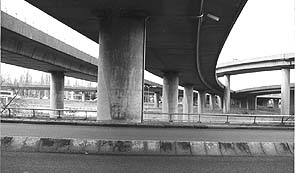
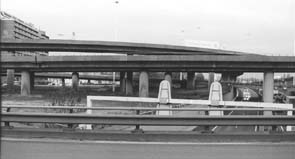
Impressive spaghetti - The second most complex roundabout of the Rotterdam Ring. It has four vertical levels. Traffic coming from the south (from the van Brienenoordbrug) and traffic from the east (Utrecht - Arnhem) is routed west (towards the harbour), north (Delft and Den Haag) and south (towards the city center).
Unfortunately the upper levels are inaccessible. They're the domain of the cars. But the pedestrian level gives a nice view of the overhead spaghetti and the tunnels under your feet. You can walk around the whole circuit and you will see some interesting bridges and underpasses along the Schie-Schiekanaal (Kleinpolderpad). The best time to visit is on a clear winter's evening with it's romantic sunlight. It combines well with the headlights and taillights of the traffic jams.
There's a narrow path between the highway and the fence of the ROTEB (the municipal waste disposal company). At the end of this path you get a nice view of the old "Van Nelle" factory and the modern jail (Penitentiaire Inrichting De Schie - a slick building covered with blue and orange tiles).
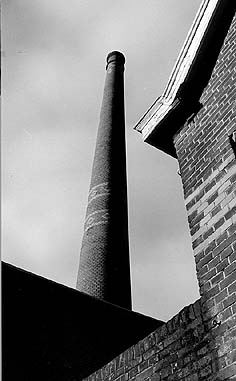
Brick chimneys - Another interesting feature of the Kleinpolderplein are the two gigantic chimneys. They date from the time that Overschie was the outer edge of Rotterdam and these varnish-factories were modern. The chimneys are visible from the train and the car. Neither of these is in use anymore.
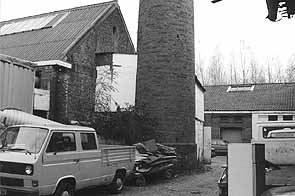
Van Wijk factory - The first chimney belonged to the varnish factory of the Van Wijk family. I have a picture from 1943 showing this same spot. It still looks the same. Only the first building on the left is modern. In 1943 there was a ferry instead of the pedestrian bridge that I took this picture from.
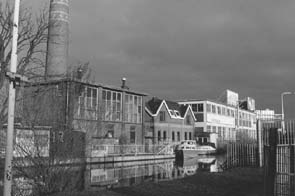
The factory (first picure on the right) looks deserted with some broken windows and decaying paint. But it's still in use and is tightly locked. Walter has worked there for a few days, just for fun. They make "VERTIGO" climbing-walls and climbing-holds. Walter got a new rope, a Grigri and 10 quickdraws form this temporary job. And he got a lot of experience to build a private climbing wall in his home.
Both chimneys are now part of illegal-looking car painter's shops. But the inhabitants / owners were very kind. When I asked if I could take a picture the owner said: "Come in, at the back there are some big dogs, but as long as you don't put your hand in their cage they won't do anything." After talking a while I asked him if one day I could climb the chimney. And he gave me permission "... as long as you do it on your own responsibility ..."
Missed opportunity - Next weekend I returned and I again got permission to climb the chimney. I inspected the base of the chimney and measured the steps. You had to climb a wooden ladder and stand on a corrugated-iron roof to reach the step-irons leading to the top. In the following week I called the local Building Inspector and the Fire Brigade and tried to find out if the structure was solid. I didn't trust the rusted, wrought iron steps - but no one could give me a clue. Then I had other things to keep me busy and I haven't realized my plans to climb this chimney.
This happened in December 1998. Recently I noticed that this beautiful structure has been defaced and spoiled by large GSM-antenna's that have been attached halfway up the chimney. This makes further climbing impossible, because the mimimal safe horizontal distance is 3m. So I can't get past the antenna!
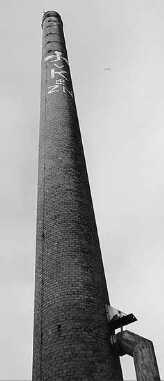
Van Klaveren en Zonen - The inhabitants of the car shops around the other chimney also didn't mind me taking pictures. They even told me that someone already had climbed the chimney. They assured me that it wouldn't be torn down, because it's a monument. It's owned by the Van-der-Valk family who intend to build a hotel there in the future.
The logo on the chimney is authentic - it belongs to J. van Klaveren & Sons, the original owners of the varnish factory. The "J" has been distorted to resemble clubs (klaver = clubs). Around 1930 this factory - NV Vernis en Japanlakfabriek - was famous for it's white "Ostara" japanese lacquer that was used for painting exteriors.
Go to: Home
© 2000 Petr Kazil