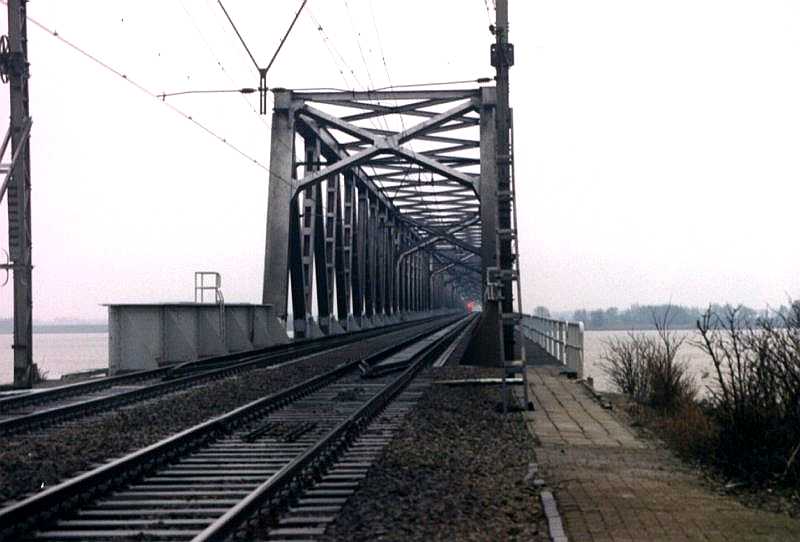
On the 18th of January 1999 I got an unexpected e-mail from Erik van Geene offering me a picture of the railway-bridge at the Moerdijk. Ofcourse I was quick to accept it. It's a nice big one with a lot of atmosphere. Some data:
I asked Eric to describe the circumstances surrounding this picture. You can find them lower on the page. His original text and my translation and notes.
| Het was op een zondag. Een regenachtige dag, waarin wij als researchteam voor een filmproject op zoek waren naar locaties. Met de auto kom je er haast niet, want je moet een terrein oprijden van de NS en zo'n 750 meter verderop ligt deze brug. De zenuwen gieren wel door je keel, wetende dat elk moment via een seintje van de machinisten in voorbij razende intercity's, de spoorwegpolitie op bezoek kan komen. Eén man constant op de uitkijk voor treinen, de fotograaf neemt zijn tijd om een juist standpunt te zoeken. Ook zijn er op dit terrein nog foto's genomen van een gevechtskazemat (bunker) welke kennelijk een treffer heeft gehad in de meidagen van 40. |
It was on a Sunday. A rainy day
and we (a research team for a film project) were looking
for suitable locations. You can't reach the place by car
because you have to drive onto the site of the NS (the
Dutch national railway company) and the bridge is 750
meters from there. It's a very nervous situation. The
intercity trains race past you and you know that the
drivers can call the railway police to remove you (note
1). One person was continually on the lookout for trains. In the meantime the photographer took his time to find a good spot. We also took pictures of a bunker that seems to have suffered an impact during the May-time of 1940 (note 2). My notes:
|
Go to: Home
© 1999 Erik van Geene - 13 February 1999