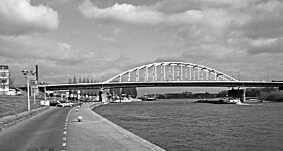
The "John Frost Bridge" was built between 1932 and 1935 to carry road traffic from Arnhem to Nijmegen. In the picture you can see the Northern bridgehead (on the left), the first pylon and the arch that spans the river Rhine. The distance between the bridgehead an the pylon is 49m and the span of the arch is 120m. The arch is 17,5m high. The distance between the road and the water is approximately 20m.
The bridge was damaged twice during WW II (in 1940 and 1945) and was rebuilt in it's original shape. The name was given in honor of an army commander (but I'll have to do more research to find out why and which nationality he had).
From England I received a nice e-mail with more historic facts. I reproduce it below.
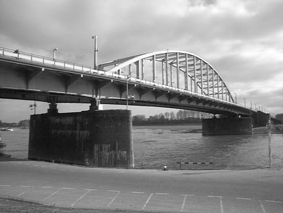
Mr. Green and Mr. Orange climbed the under-side of the bridge starting at the bridge-head and finishing under the arch. They used standard alpine techniques for two-member rope-teams. The whole stretch was done in free-climbing style.
Few people noticed them while they were under the bridge. One little child looked up but they put their finger to their lips ("shh") and the child got the message. The climb to the surface of the bridge and their appearance on the surface drew more attention. It even caused a minor traffic jam.

The following pictures are a reconstruction of the climb. On the original occasion Mr. Green and Mr. Orange did not have a camera with them. So some moves are not drawn in the original places, but you'll get the picture.
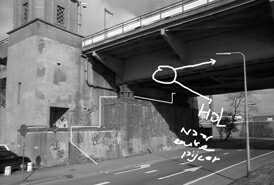
Climb up the concrete and go under the bridge. You will find that the steel girder is hollow and that you can climb through. Expect lots of pigeon shit and take a (head-)lamp because it's dark inside.
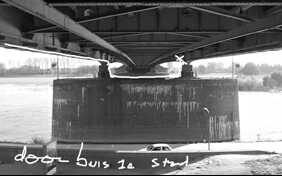
Once you've climbed trough you are at the first pylon. You can make a first belay at the place marked by the "x".
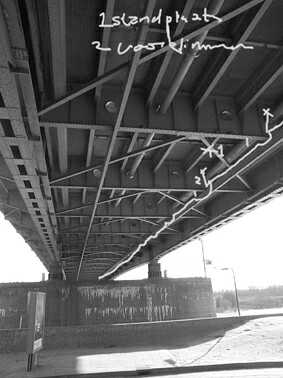
From there you can walk over one of the rails that carries the cart/gondola that the pinters use. The spots where you can place protection are indicated by "x". You need a lot of slings and carabiners. Quickdraws ("setjes") are not really necessary.
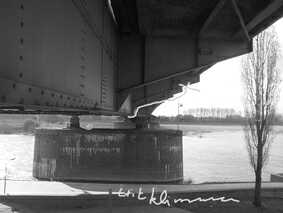
You climb out over one of the side girders. This is the trickiest part of the whole climb. It's probably grade 6a-6b.
In their own words Mr. Green and Mr. Orange say the following:
1999 will be the year in which Mr. Green (green climbing trousers) and Mr. Orange (orange climbing trousers) will try to climb as much of the classic bridges as possible in the Dutch Lowlands.
You might have seen the famous film "A bridge too far", wich is about the John Frost Bridge in Arnhem. We've climbed this bridge as a test, wich took us five and a half hours to conquer (we expected it would take us about 2 hours so when we reached the other side of the river "the Rijn" we were very thirsty).
Many of these old briges are taken care of by the Monument Trust and are being seen as our Dutch heritage; lots of old fashioned bolts, lead paint and pigeon shit. So extra caushion is necessary. We will try to climb them as "clean" as possible, so without fixed hooks or ladders, in Alpine style.
Possible candidates are the railway bridge near Zwolle and the Waalbrug in Nijmegen.
Historic facts about the bridge
From: King's College London - Liddell Hart Centre for Military Archives
Hi, Just found your site while looking for details of the John
Frost
Bridge at Arnhem and noticed you didn't know why it had been thus
named.
Col Frost led the troops that held the northern end of the bridge
for
4 days in the 'Bridge too far' operation - Operation Market
Garden,
in September 1944
The following two bits may be of interest (then again maybe they
won't !)
| Survey of the Papers of Senior UK
Defence Personnel, 1900-1975 FROST, John Dutton (1912-1993), Major General Service biography |
| Arnhem. John Frost bridge. The
majority of the 2nd Parachute Battalion under command of On the bridge one can find a plaque which commemorates
the actions of It contains the following description: This is the bridge for which JOHN D. FROST fought |
Until a few days ago I didn't know of our local connection
with Col. Frost.
I was looking in the first place because a member of our local
Royal
British Legion asked me if I had a photo of the plaque while I
was
photographing their annual Canada Sunday ceremony but didn't say
why
he was interested.
Last Wednesday I was in the Peak Centre in the village, it's a
hall
for local organisations to use, and noticed the plaque on the
wall
saying the centre was opened in 1982 (?) by Colonel Frost.
When I asked, I was told that he lived near here (Liphook, in
Hampshire, Southern England) until he died.
Back to: Home
© 1998 Mr. Green, Mr. Orange, Petr Kazil - 14 May 1999