Of the four of us, not including the dog, you were the only one
            who couldn�t stop
   thinking about America, at least the state that mattered most,
                              and I used the time
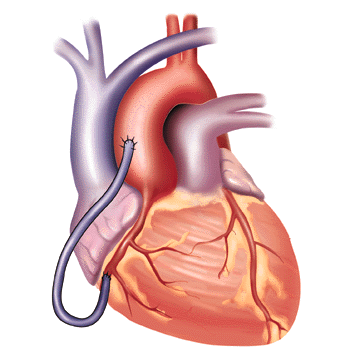
we weren�t on the road to read about the heart
            and understand what I was
   getting myself into.  In one diagram, the bottom half
                                  was red with an arrow
pointing from the right ventricle to the lungs:
              it could have been part of a map �
   if the arrow was another color, say gold,
                         it could have been the main road

to the city.  There were guides like this in every
              glove compartment, impossible
   to fold.  All angels and devils were identical in length
                      and shape when taken
in full scale of the route.  I spent a year ruined by rain
            and the next year doing my best
to recover.  I fell in and out of sleep, in and out, in and out,
                          remembering lines
from old poems, singing to myself, sometimes out loud.
           I saw men on all fours
   wearing stiff coats, roaming in what my father called progress.
                           I watched

two people press into one another on the platform,
              how their features disappeared
into one great open-jawed kiss that threatened never to end.
                            I took a count
of my lives, what the French called folie de doute,
             what David Hume believed to be
an utterly changing world: I was a fiddle, I was a watt,
                         I was a middle-class
conversationalist.  To keep a tumor from coming back,
               surgeons rebuilt the chambers
of a woman�s heart with cow tissue.  Call it a victory,
                           one way to return

home � what you called the patches of greensward in Kansas,
               where you spent hours
making elaborate plans, lifting your arms toward the sun
                             or folding them
across your chest, letting the past and its dirty hands pull you
              this way and that way,
the dull blades brushing against your white neck and mouth,
                            twisting
you like a poppy, touching you, touching you in a style
             that takes a lifetime
to understand: why the wind has its way,
                           how far an emotion can bend.
�2007 by Frank Matagrano
first published in Cimarron Review