


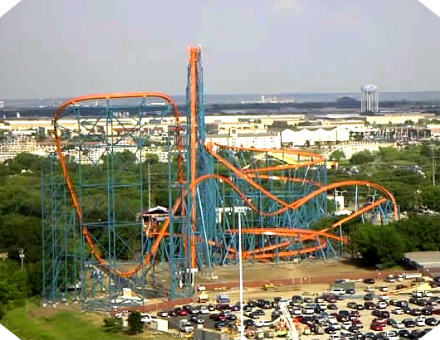
you well design roller coasters. You get to sit in front of a computer (like you are now) and think of what type of roller coasters people like some like loops and some others like speed. So the designer has to think of what there roller coaster will look like and then he/she puts it on the computer shows it to thier boss and then 5 months to a year later it starts to be made. Yeah I know what your thinking how much does it pay? Well it pays $600-$700 million a year. I reallylike this job because it sounds like fun you get to make something and then see a lot of people ride it over and over again. I would consider working at this job. To get it you have to have a University dagree to get it. To get this education you could go to Queens in Kingston or all most any University.
DID YOU KNOW??????
1-Objects that are changing their speed or their direction are said to be accelerating. The rate at which the speed or direction changes is referred to as acceleration. Some amusement park rides (such as roller coasters) are characterized by rapid changes in speed and or direction. These rides have large accelerations. Rides such as the carousel result in small accelerations; the speed and direction of the riders change gradually.
2-A balanced force results whenever two or more forces act upon an object in such a way as to exactly counteract each other. As you sit in your seat at this moment, the seat pushes upward with a force equal in strength and opposite in direction to the force of gravity. These two forces are said to balance each other, causing you to remain at rest. If the seat is suddenly pulled out from under you, then you experience an unbalanced force. There is no longer an upward seat force to balance the downward pull of gravity, so you accelerate to the ground.
3-Energy comes in many forms. The two most important forms for amusement park rides are kinetic energy and potential energy. In the absence of external forces such as air resistance and friction (two of many), the total amount of an object's energy remains constant. On a coaster ride, energy is rapidly transformed from potential energy to kinetic energy when falling and from kinetic energy to potential energy when rising. Yet the total amount of energy remains constant.
When you're riding in a roller coaster, do you ever stop to think that physics makes all this fun possible? Basic physics concepts such as centripetal forces and kinetic energy are related to the operation of many of our favorite amusement park rides. Learn about them here. Useful experiments and activities are offered to reinforce the concepts discussed, and the many links to other roller coaster sites are great fun.