

Paul's |
Update Page |
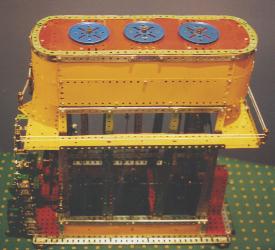
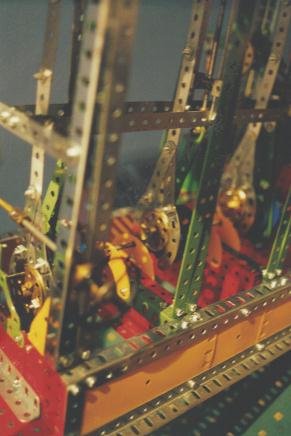
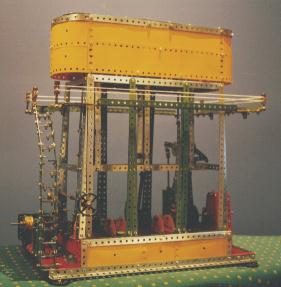
Marine Engine 9.18 from the 1959 manual. Side, top and interior views. I was inspired to build this
when I saw the "Titanic" film - remember the scene in the engine room with the
enormous cranks in full stride? This model has three cranks, three eccentrics and
a twin cylinder feed pump. The old E15R electric motor has to work hard! |
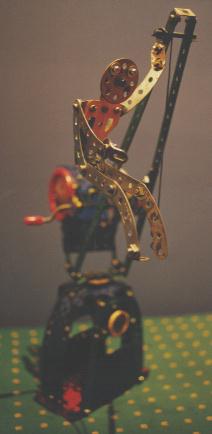
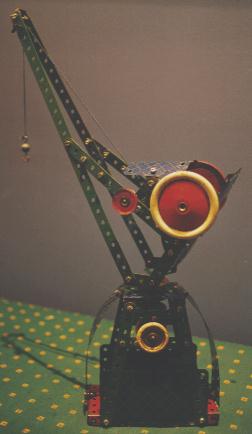
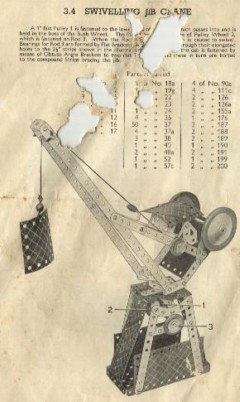
Swiveling jib crane 3.4 from 1937. A friend recently found an old shoebox of Meccano and instruction manuals
(an Aa Accessory outfit from 1936 and a 2a Accessory outfit - from 1937)
at, presumably, an Opportunity shop and gave it to me as a birthday present.
A friend indeed! By way of thanks, I built this crane for her son. Unlike the
instructions, shown above, the parts were not moth-eaten, although the white rubber
rings were in a delicate condition. Our intrepid guy from my other web pages
operates the crane from an unusual position, above left. For the UK market in this period, the strips were coloured gold. For the Australian market, however, they were green. Why? |
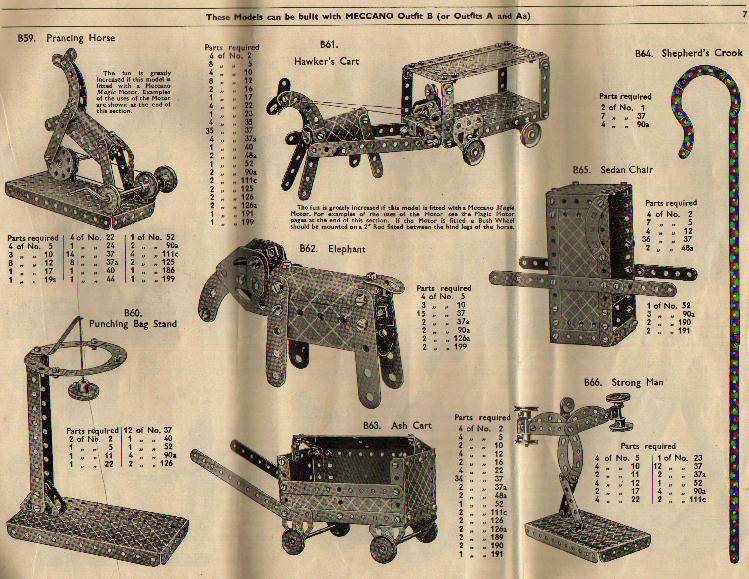
I love these simple models from the thirties. How about the biceps on Strong Man B66! Less can be more with Meccano, too - there is an active interest in "micro models", where the maximum effect is sought from the minimum number of parts. |
featuring the ironing board cover |

Click on the "Spanners" badge above to find out how to join. Graphics courtesy of Bob Thompson, Birmingham, UK. |
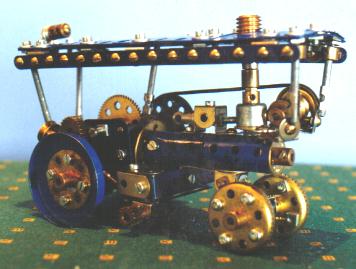
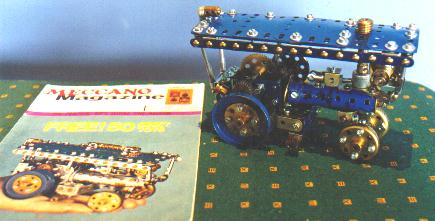
I liked the look of this mini Showman's Traction Engine from the Meccano Magazine,
December 1970. My version in 1970s blue and 1978 dark blue is pictured above. It weighs 850g. The original, pictured on the cover in the right
hand photo, won the Meccano Cup at that year's Model Engineer Exhibition. |
To be continued |
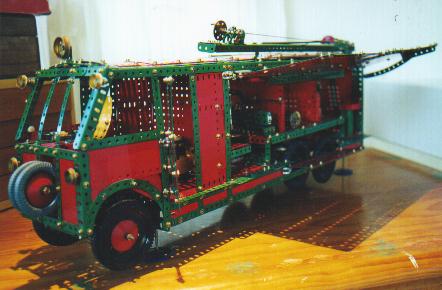
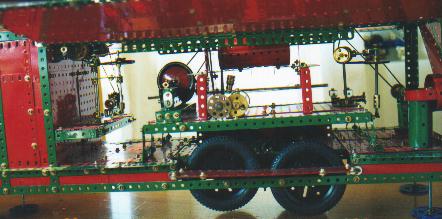
At left my completed version of a model I've always admired in the pre-war 10 set
manual - the 10.9 mobile workshop. I used a 1960s 6-speed meccano motor to power it. As well as front wheel steering,
there is rear wheel drive via a differential, front and rear suspension and
8 powered "machines", such as lathe, drill, grindstone etc. The sides fold up,
as shown. There is also a crane which, when not being used, is stored on the roof
as shown. When in use, the back of the workshop swings up and the crane attached.
Surprisingly big - more than 1200mm long with craneattached; 600 mm wide
with both sides open; 300mm high. Built mostly with Jack Parsisson's replica parts. |