

The late 1920s and through the 1930s are viewed by many as the finest hour of Meccano's
own published model designs. After that period the style moved to a simpler
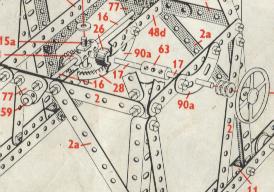
style with greater use of flexible plates to "fill in the spaces". The unique prose style of the instructions was replaced in the 1960s by schematic drawings (left) and model
design was further simplified. This has been addressed by contemporary modellers
whose designs often far surpass anything published by Meccano Limited. Similarly,
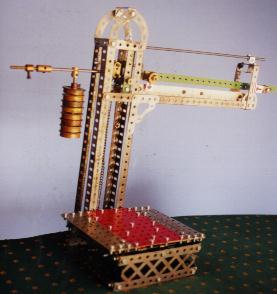
the prize-winners of the great (cash prize) 1920s/30s Meccano competitions
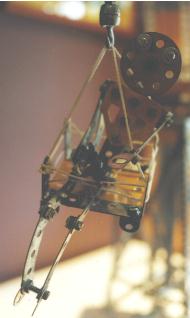
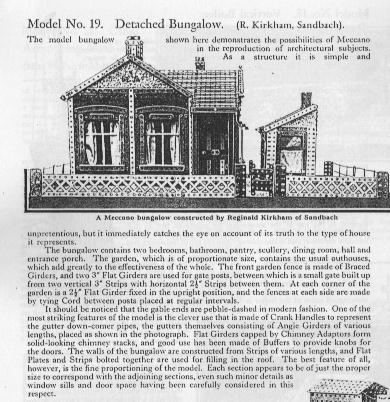
designed some impressive models, including unusual ones such as the one below, from 1932. |
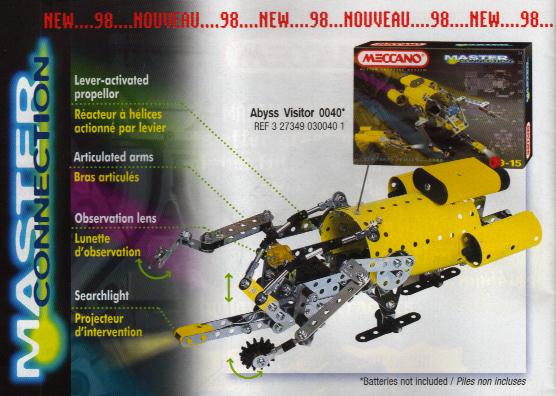
Under French ownership, a large variety of new parts and series of outfits were introduced, partly for added ease of assembly of models,
partly for cheapness of manufacture and partly to appear more relevant to modern tastes. At left is a 1998 outfit, the Abyss Visitor. It will be interesting what changes in technology, style and marketing the new owners will bring to Meccano. |
Paul's Meccano Pages continued |
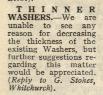
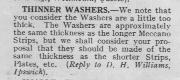
Nothing changes - the washers were too thick in 1928 and they're still too thick! As a result many model builders source them from specialist manufacturers. Meccano
paint is easily scratched and damaged - the little discs called washers (designed
for spacing purposes in models) also help protect the paintwork. The alternative
is laborious re-painting or powdercoating, or training oneself not to worry
about "pre-loved" look of one's collection. |
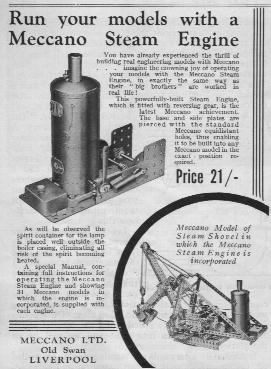
Released in 1929, the Meccano Steam Engine (left, from a Meccano Magazine advertisement) is rarely seen today. A reproduction
one is available these days at around 500 pounds sterling. |
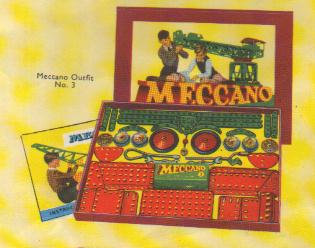
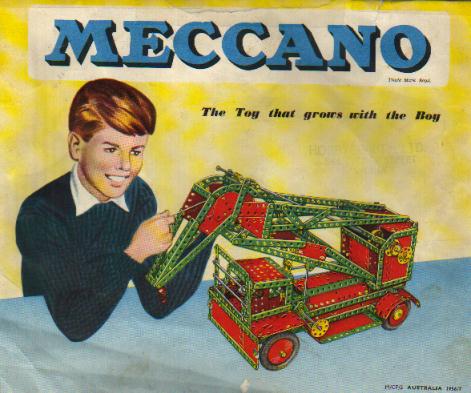
While red and green are the colours that many most readily associate with Meccano, there have been many, as there have been styles of packaging of outfits. Shown above
is a 1956 light red and green no.3. Originally all nickel-plated, variations
of red and green (first bright, then much darker) were introduced in the
late 1920s, then blue/gold cross-hatching and gold in the late 1930s (with variations
for the export market) , then red and green until 1964 (in lighter shades
from 1958), then silver (later zinc-plate), black and yellow until 1970, when
zinc-plate, blue and yellow took over. A year before the Binns Road factory
closed colours went to dark blue and a mustard yellow. When production resumed in France colours more or less returned to the early 1970s
scheme. All sorts of colours appeared - even day-glo - in the latter French days.
What will the new owners do? Consequently, together with the area of obsolete parts, literature, packaging and the Meccano Magazine, there are many avenues to explore for the collector. The enthusiast intent on building models often sees his creations in a patchwork of colours, depending on what parts are available in the collection! Of course, one can be both collector and builder |
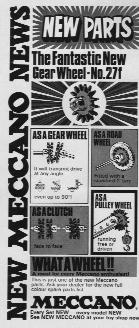
By the 1970s Meccano was having trouble keeping up with other toys, including other
construction systems. The new wheel (above) was lifted from the Marklin system.
Raw material, energy and UK labour costs all ballooned during that decade,
bringing about frightening and regular price increases in outfits. This was just when it could least afford to be more and more expensive
than Asian imported toys. |
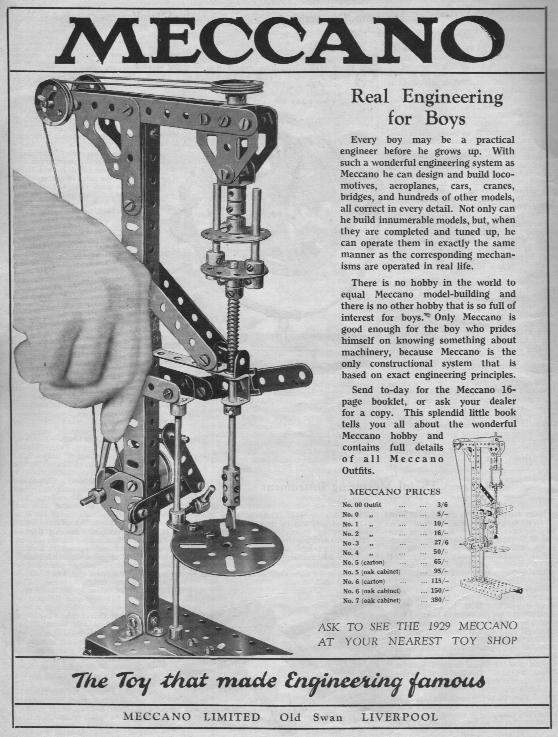
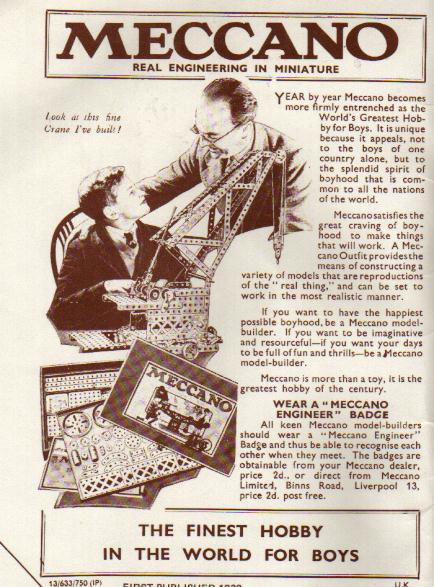
Meccano Limited was never reluctant to promote itself, as these advertisements (left
and below, left) indicate. However, Meccano had such an impact at its peak
that its claim of being "the greatest hobby of the century" is indeed arguable, not only in terms of longevity of production and popularity, but also in the durable culture it built around
itself in a way that Lego, for example, did not. (And stepping on Meccano in
bare feet was generally nowhere near as painful!) Also, Meccano taught boys patience and persistence and encouraged ingenuity in a way that many modern toys do not (although I continue to be amazed that youngsters were assumed to be able to easily build many of the outfit models that I find very tricky!) There is undeniably a strong nostalgic element in looking back to a seemingly blissful and wholesome Golden Age without today's television, mindless/ violent computer games and expectation of instant gratification. However, Meccano was never a cheap toy; larger outfits were out of reach of all but those lucky enough to have wealthy parents. Today, English "Binns Road" Meccano is still not cheap, with the rarer items and outfits in good condition being very expensive. Binns Road enthusiasts are not getting any younger and the long term prospects for the state of the market and values have to be uncertain. However, the internet has re-introduced many to Meccano and the new owners appear enthusiastic and cashed-up, so there is cause for optimism. |
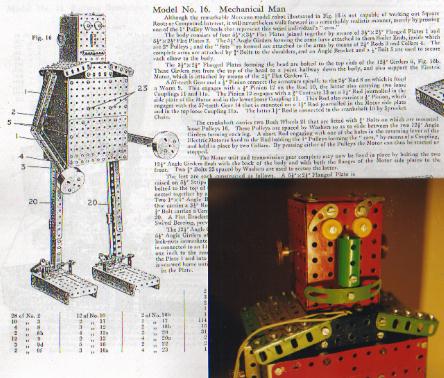
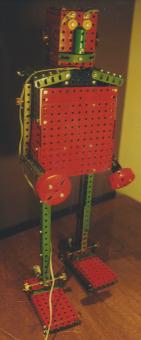
Here's a guy from 1931, with insert showing the wires leading to the 12 volt motor
inside his body. Pushing his right ear activated the motor. The quizzical
expression on my guy could be due to the fact that try as he might, he was unable
to walk without falling over. (Contrast this with the confident expression on the face of the instruction book
guy). Although I have read that this model has been successfully built by others,
many of the published models could never be made to work! |
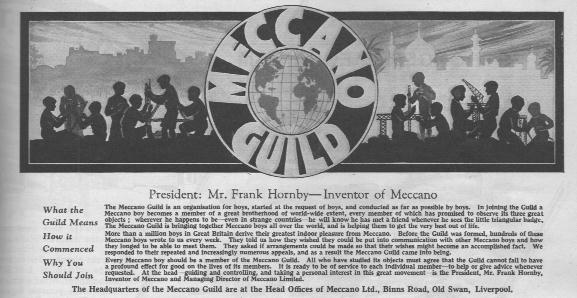
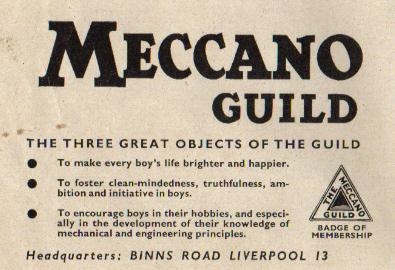
Promoted in the Meccano Magazine, the Guild was Frank Hornby's own creation after WW1, his plan to create an international fellowship.
Meccano clubs, encouraged to be closely linked with the Guild, flourished.
In recent times, with much of the interest in Meccano being adults
revisiting and expanding (or continuing) their childhood hobby, local clubs
and the internet bring the like-minded together. The International Society of Meccanomen (designed to be the modern successor to the Guild), the Spanner online discussion group and the Meccano Web Ring are all active and growing. The reader who wishes to learn more about any aspect
of the system will find he or she is well catered for! Pursue the Meccano Web Ring
link at the bottom of this page if you are interested in finding out more.
Any lapsed (or potential) Meccano boy (or girl) anywhere will find support closer
than they think to pick up where (s)he left off, (re?)build a collection and
rediscover that Meccano is "for boys (and girls) of all ages". My daughter Rose enjoys Meccano! |
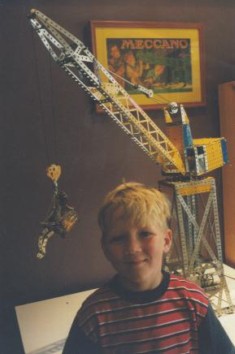
Here's a dockside crane (left, above) built from a 1970s set, but the design had been published by Meccano
since the early 1960s. (The schematic plan above the photo is part of the plan
I used). It carries the little guy (left) seen in the motor chassis on my other
page. Posing in front is my son Charles. On the wall behind is the companion image by Pinyon of the background to this page
- the two boys building the famous Giant Blocksetting Crane, watched by their pipe-smoking father; it appeared on outfit instructions from the
late 1940s. |
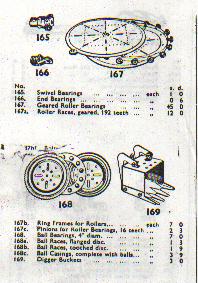
There is a fascination in exploring the historical development of the system. Parts
were introduced and then discontinued, to become highly collectible, such as
parts 167 Geared Roller Bearing and 169 Digger Buckets shown above in a 1938 price list. Replicas of such obsolete
parts are made today; originals in good condition are rare and valued accordingly.
|
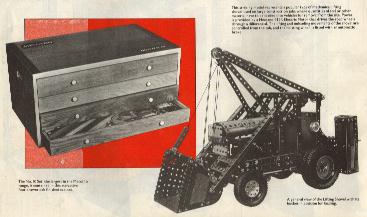
For many boys (the writer included - to this day!) the ultimate aspiration was the
no. 10 set, shown (at left) tantalisingly at the end of many outfit instruction manuals. Beautifully
presented in a 4 drawer oak cabinet, it followed the Binns Road tradition
of presenting the largest outfit in this way. |
Another Super Model, no.7 Platform Scales, from 1928. It's built mostly from nickel-plated parts from around the period. |
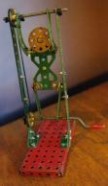
This little acrobat (above), operated by the crank handle at the bottom, flips
over the bar at the top. Instructions were from the very smallest outfit. The
largest outfit, the number 10 from 1937, cost over a hundred times that
of the smallest. Prior to that, the largest outfit ever released, the L set, was almost twice as large and was priced at 20 pounds sterling in the UK, this
at a time when many working men's pay packets contained only a few pounds. Rarely seen today, an L set was recently offered for sale by a UK dealer for 4,500
pounds. |

The comments in this web site are a mixture of my opinion and my understanding
of Meccano history. I welcome your comments or questions. Created 19th May 2000 Paul Johnstone, Melbourne, Victoria, Australia [email protected] |