Shell Shower
 Shell Shower
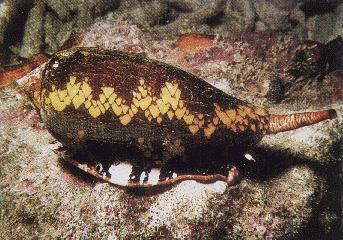
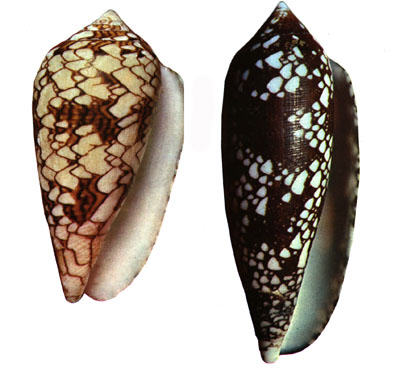
Usually found in warm, tropical waters, cone shells are carnivorous. They eat worms, mollusks, and small fish. A few species, from the Indo-Pacific region can inflict a serious, if not fatal sting to humans, including the textile cone, shown below.
Live Aulicus Cone Conus aulicus 4-6" Indo-Pacific, uncommon
Textile Cone on left Conus textile 3-4" Indo-Pacific, common.Aulicus Cone on right Conus aulicus 4-6" Indo-Pacific, uncommon
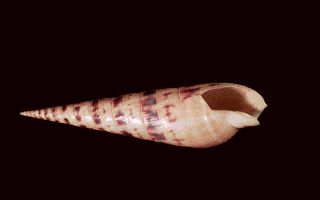
These are usually found under the sand in warm, tropical areas. Early in the morning and late in the evening, when the sun is closest to the horizon, these can be tracked from the markings they leave in the sand, looking for food.
Marlin Spike Terebra maculata 3-9" Indo-Pacific, common
These are all vegetarians, eating algae from the ocean floor. They use a muscular foot with a horny opercelum, to move around, hopping from place to place.
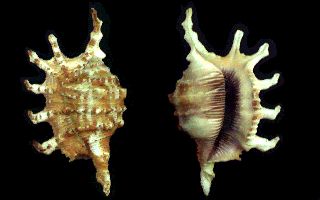
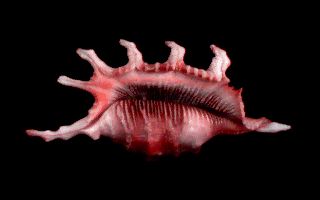
Scorpion Conch Lambis scorpius 4-6" Indo-Pacific, uncommon
Scorpion Conch Lambis scorpius 4-6" Indo-Pacific, uncommon
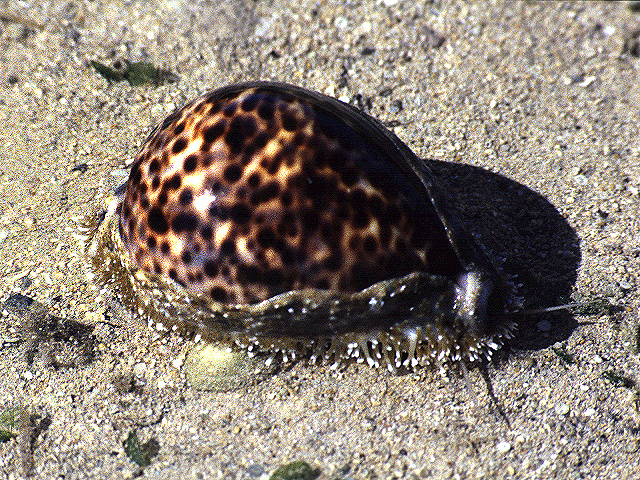
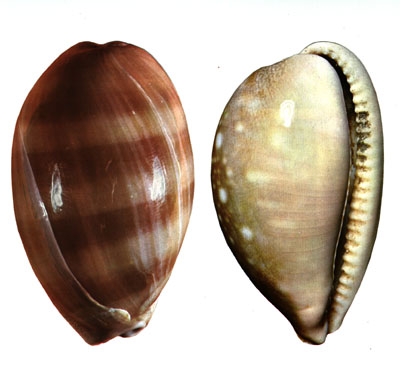
These are the most beautiful member of the mollusk family, with glossy, perfect shells. They have a fleshy mantle that covers the shell when undisturbed. When approached, the cowrie will retract the mantle, revealing the treasure inside. Used primitively as money and for religious symbols, this is a very popular shell.
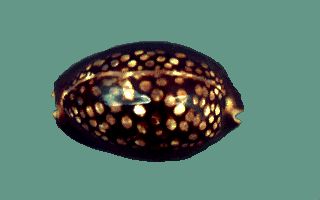
Tiger Cowrie Cyprea tigris 3"-4" Indo-Pacific, common
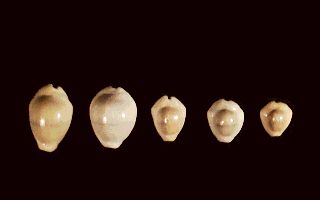
Deer Cowrie Cyprea vitellus 2" Indo-Pacific, common
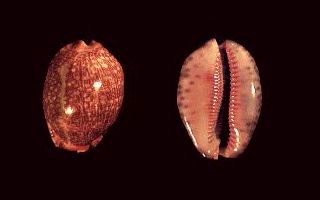
Mole Cowrie Cyprea talpa 3-5" Indo=Pacific, uncommon
Money Cowries Cyprea moneta 0.5-1" Indo-Pacific, very common
Arabian Cowrie Cyprea arabica 2" Indo-Pacific, common
Hump-backed Cowrie Cyprea mauritiana 3-4" Indo-Pacific, uncommon
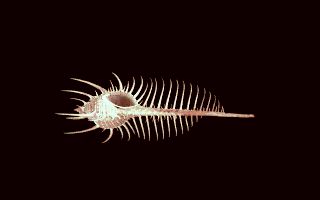
Greeks and Romans used these valuable shells to make the royal color, purple. When crushed and pressed, the snails let off a yellowish fluid, this was boiled and treated to create a permanent yellow die.
Venus Comb Murex Murex pecten 4-6" Indo-Pacific, uncommon
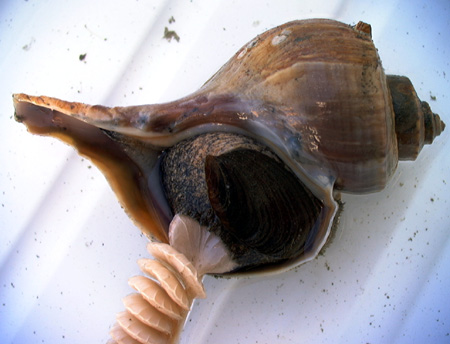
This particular whelk is laying egg cases, these are commonly found washed ashore on beaches. A close relative, the lightning whelk- is usually left-handed.
Channeled Whelk Busycon canaliculatum 3-7" Maryland to Florida, common
Primitive snails with two gill plumes. The slit is an opening for water and waste materials. Once thought to be extinct, there are now 18 species known.
Emporer's Slit shell Pleurotomaria hirasei 3-5" Japan, uncommon
Huge shell list! NTCS Grp_moll Conchologists of America Shells
Abbot, R., T., Seashells of the World, Golden Press, New York, 1985
Young, J.,D., Personal Experience, Air Force, Guam, 1993-1995