
|
Adam Maxwell Ferrell |




|
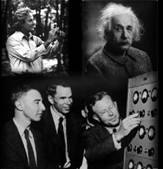
Richard Feynman, Albert Einstein and J. Robert Oppenheimer used visualization and metaphor to drive their scientific explorations. |
|
“This is the irony of modern physics. It seeks reality in its most fundamental form, and yet we are utterly incapable of comprehending these fundaments beyond the math we use to represent them. The only way to know the universe is through analogy.” Jonah Lehrer, January 2008 Seed Magazine The Future of Science...Is Art?
From “colors” in quarks to the “fabric” of the space-time continuum the use of metaphor and analogy to explain progress in increasingly rarified fields like particle physics and cosmology is pervasive and proper. Providing context for discoveries spanning 40 orders of magnitude (from, conservatively, the proton at 10-15 meters to the visible universe at 1.2826 meters) is critical for debate across fields, disseminating relevant findings and, not least, winning grants. Discoveries otherwise rendered opaque in dense mathematical equations can take on new life at the turn of a phrase; careers and cottage industries have been erected on the shifting sands of metaphorical language. Can metaphor also guide research from a teleological standpoint? It can, and it has. |

|
The Future of Science...Is Art? FERMI (formerly GLAST) Gamma Ray Telescope Large Hadron Collider Up and Running! Cern Courier — their magazine Has the LHC destroyed the Earth Yet? - Stay informed. |