




|
|
Home Beyond the Brass Ring Quotes Pictures Pete's Teams Movies Statistics & Records Reviews Tributes & Memories Links |
I have FINALLY completed my biography about "Pistol" Pete Maravich. This is, by no means, a complete biography of basketball's greatest showman. I suggest if you are truly interested in learning more about Pete Maravich you read his autobiography, Heir to a Dream. It's a truly amazing book. I would also recommend: Maravich Memories: the LSU Years, and The Pistol: the Birth of a Legend videos.
I would personally like to thank the fellow who signed the guestbook requesting that I finish my biography. If it hadn't been for that encouragement, I probably would've taken another six months to get around to doing this. (See what signing the guestbook gets you?!) Well, anyhow, enjoy the biography on the "Pistol" and be sure to sign that guestbook telling me what you think or e-mail me!
 Even when he was a skinny, five-foot-two, ninety-pound eighth grader struggling for acceptance on the team, he only wanted to play basketball to the best of his ability. Still, when the crowds called him a "hot dog" or cheered for him, he only wanted to fulfill his dream (and his father's) of basketball--acquiring a college scholarship to play basketball, earning a million-dollar contract to play pro basketball, and winning a world championship, in turn gaining a ring which would symbolize that he was one of the greatest basketball players ever. When he played basketball, people were on the edge of their seats, anxious and excited, waiting for what the master of the unexpected would unleash next. "Pistol" Pete Maravich brought a new and exciting light into the game of basketball, and forever etched his name in history through re-writing the record books. But still, when he broke Oscar Robertson's record and they stopped the game, all Pete could do was smile and plead with his teammates to let him get back to the game he loved. He spent his life becoming a legend while fulfilling his dreams, and along the way obtaining fame and money. But through it all, the only thing Pete Maravich really wanted to do was play that game that he loved immensely--basketball.
Peter Press Maravich emerged into this world on June 22, 1947, in the steel-mill town of Aliquippa, Pennsylvania. His parents, Helen and Press Maravich, had met and been married in 1946. Helen had a son, Ronnie, from her previous marriage. Pete's father, Press, was a retired naval officer, but had pursued a career as a basketball coach to go along with Helen's wishes. Her previous husband had died while flying in the air during World War II. Helen didn't want to lose another husband in the air. So, Press agreed to become a basketball coach. He had spent a life abundant with basketball. Press had loved the game since he was a young boy, and played the game in college and even played in the pros. One of Press's deepest wishes was for Pete to love the game just as much.
From a young age, Press endeavored to instill a love of the game deep into Pete's heart. Press would come home after work and flawlessly shoot free-throws. Pete watched Press, fascinated and intrigued. Pete became so mesmerized by the game that he finally asked Press if he, too, could take a shot. Press, delighted, agreed, and allowed Pete to shoot the ball. On his first try, there was no sweet swish of the net. Pete chased after the ball, and tried again and again, frustrated that he couldn't make it.
As time went on, Pete developed the basic fundamental skills of basketball through careful instruction and teaching from Press. Pretty soon, Pete began to challenge Press in games of one-on-one and "horse." Press defeated him simultaneously, and Pete soon became disinterested with the game and losing. One night, Helen suggested to Press that he let Pete beat him just one time. Press concurred, and the joy of winning was implanted in Pete.
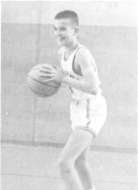 The years progressed, and Press continued to teach Pete new skills and drills, which later became known as "Homework Basketball." Basketball became Pete's life. He spent hours every day practicing, and he was continually striving to improve his game. He dribbled all over the place, including the movie theatre! He also would blindfold himself and dribble all over the house. He wanted to play basketball to the best of his ability, and he knew that hard work, dedication, discipline, and desire were the key to achieving his goal.
The Maravich family now lived in Clemson, South Carolina, and Press was basketball coach at Clemson College. Pete and Ronnie attended Daniel High School. Of course, Pete desperately wanted to play on the varsity basketball team. Ronnie, Pete's older brother and hero, was on the team, and Pete wished he could join him, but there was a problem: the starting lineup consisted of mainly seniors. When Pete would get into the game, they would avoid passing the ball to that goofy little eighth-grader. The crowd would also laugh at the sight of the ninety-pound, five-foot two-inch eighth grader on the court. Pete was devastated and spent many lonely nights crying himself to sleep, the only consolation coming from his dad's basketball drills.
One night, however, it was all changed by a single shot. The opposing team was ahead of Daniel High School by one meager point. The seniors, led by Ronnie, were searching for a play to win the game. There Pete stood wide open, with no one guarding him (the other teams found it pointless to guard him when he rarely got the ball), as usual. To Pete's astonishment, a sleek pass was thrown to him, and swish! Two points for Pete Maravich, and a win for Daniel High School! From that point on, Daniel High played as a team, and the young Maravich boy played a pivotal role.
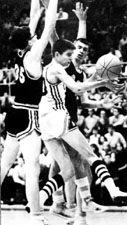 It was during this time at Daniel that Pete reaped the nickname "Pistol Pete." A newspaper reporter had seen Pete warming up before a game, and he commented that when Pete shot the ball, it looked like he was drawing a pistol. The nickname stuck, and "Pistol Pete" was born.
Maravich continued to play basketball at Daniel High School until 1963, when Press transferred the family to Raleigh, North Carolina. The Needham-Broughton High School Basketball Team welcomed the new player, who flabbergasted the crowds with his creative and instinctive style of basketball.
After finishing an extraordinary high school career, Pistol Pete and Press came to the decision that it would be best for Pete if he went to a prep school before advancing on to college. They both knew that Pete (at 6'3" and 130 pounds) would be physically beaten if he competed against some of the roughest and brutal players at the college level, and Pete's academics could use a little polishing, too. So, Pete was sent to Edwards Military Academy for a year, which turned out to bring tremendous benefits. He grew to 6'5" and 150 pounds by the end of the year, and his basketball game had furthermore enhanced. Vast progress in the classroom had also taken place.
Just as the year at Edwards Military Academy was drawing to a close, Press Maravich was being offered a job to coach basketball at Louisiana State University (LSU). But Press wasn't just being given the task of coaching basketball; he was also given the monstrous duty of reviving basketball in the south. Jim Corbett, LSU's athletic director, knew, however, that Press could fulfill the job. Press and Jim decided that bringing Pete Maravich to LSU to play basketball would be a smart move. When Press first approached Pete with this idea, Pete thought for sure he was joking. LSU was a football school, nobody even thought of basketball there! Pete knew that Press wanted him to play basketball for a West Virginia school, not a football school like LSU! Press made it clear to Pete that he was dead serious. First, Pete flatly refused. Then Press adamantly enforced his authority: either Pete accompanies him to LSU, or Pete could plan on never coming home again. The first part of Pete's dream was about to fulfilled--along with the man who had first infused the dream deep in his heart.
At LSU, Pete pulled on the number twenty-three jersey, in honor of his hero and older brother, Ronnie. In his first season at LSU (1966-1967), Pete Maravich was not yet able to play varsity basketball as a freshman. So, Pete led the "Baby Bengals" (the freshmen team) to have a great season, ending with a 17-1 record, in stark contrast to the varsity 3-23 record. Night after night, the Baby Bengals had the "Cow Palace" (the John M. Parker Coliseum) flooding with spectators, fascinated by the young hot-shot freshman Maravich. Press Maravich wished the freshman games were scheduled for after the varsity games, as the LSU security maneuvered more traffic in between games than after the varsity game. Pete concluded the astounding season with a forty-three point per game average.
1967 brought several changes in America, including that LSU's "hottest shot" Maravich could now play varsity basketball. During the first three games Pete played as a sophomore, he scored 141 points! He became a "hero" to many, and he was dedicated to lingering after every game until all the desired autographs were signed. Pete's floppy socks and mop top, combined with his superior basketball talents, made him LSU's "hottest shot." In his sophomore year, Pistol Pete averaged 43.8 points per game, and was named Most Valuable Player (MVP).
Despite the colossal success Pete experienced on the court, problems at home were taking shape. Helen Maravich's emotional health was in decline, and an alcohol addiction was increasing. Press was beginning to feel weighed down by the burdens and responsibilities he now had to fulfill at home.
The third year at LSU did not just bring more memorable basketball moments and records (he averaged 44.2 points per game that year), but it also brought a new love into Pete's life--a girl. Growing up, Pete had described himself as a "social misfit." His life had always been preoccupied with basketball, and if his friends weren't interested in a game of one-on-one or horse, then Pete was apathetic. However, Pete fell in love with a girl named Jackie, who was unaffected by Pete's fame and fell in love with Pete Maravich, the man, not "Pistol" Pete Maravich, the college basketball superstar. She became a much-needed stable influence in Pete's life.
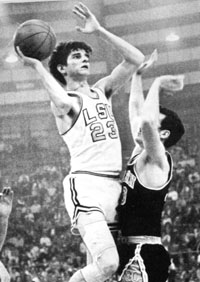 Perhaps the most exciting time of Pete's career at LSU came during his senior year. He continued to establish records (his senior average was 44.5 points per game) and dazzle the crowds with his innovative play, but one of the immense lustrous highlights flashed on January 31, 1970--when the shot heard 'round the world was fired. It was on that night that Pistol Pete surpassed Oscar Robertson's record as NCAA's all-time leading scorer. As the ball swished through the net, exceeding the record, the game was stopped, and Pete was huddled onto his teammates' shoulders. Pete was greatly honored, but he pleaded with his teammates to let him down so they could finish the game!
"Pete, how does it feel?" an interview interrogated.
"It feels great," answered Pete, "it feels great, it feels great."
"Pete, what was the shot that did it?" the interviewer fired another question.
"That last shot did it, it went through, didn't it?" quipped Pete.
"What kind?" the interviewer persisted.
"Jump shot. Jump shot did it."
"That's your favorite shot?"
"That's my favorite shot."
Pete led the LSU Tigers to the N.I.T. final four that year, but they did not win the championship. Pistol Pete finished out his college career with a 44.2 points per game average (considering the fact that he shot "three pointers" before the three-point line was developed, his average would be much higher calculating the three-pointers) and he was voted College Player of the Year in 1970. He also was NCAA's all-time leading scorer with 3,667 points resulting from 83 college games. Now, with the college scholarship under his wing, Pete longed for the millionaire-dollar contract and that world championship that seemed to slip from his fingers no matter what.
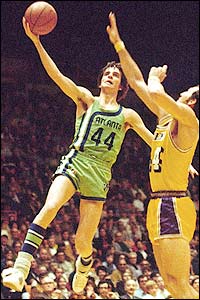 "If I play pro ball, it'll have to be in the south. I was raised there, I love the people, the fans, the environment and the prospects of a future life there," that's what Pistol Pete said back in 1970. It was announced later that year that Pete would play basketball for the Atlanta Hawks, and his dream of a millionaire-dollar contract was rewarded. Pete pulled on jersey number forty-four (his signature number twenty-three was already occupied by teammate Lou Hudson, so he chose his college scoring average instead) and learned several lessons in his rookie year. He learned how to adjust his play to become more team-oriented, and he truly improved as a player. There were problems at the beginning of his rookie year due to teammates' resentment and jealousy of Pete's money and style of play, and the problems never really ceased. However, Pete's era with the Atlanta Hawks brought several triumphs. He averaged 23.2 points his rookie year, and was selected to play on the All-Rookie team. His average for the next season slipped to 19.3, but then rose to 26.1 in the 1972-1973 season. Also during that year, Maravich was chosen to play on the NBA All-Star team. During his last year with Atlanta (1973-1974) Pete averaged 27.7 points per game, which was second only to Bob McAdoo's 30.6. The time with Atlanta brought several challenges, and an unspeakable tragedy. Helen Maravich's growing mental illness and alcohol addiction worsened. One night, Helen grew deliriously drunk and committed suicide through a gunshot. Pete was overwhelmed with grief.
Spring is a time to begin a fresh start, when everything is new, innocent, and untouched. The spring of 1974 found Pete Maravich being traded to the new basketball franchise called the New Orleans Jazz. Pete was shocked when he was informed by management of his trading, but he still went on to play with the New Orleans Jazz (later becoming the Utah Jazz). His game enhanced immensely. He averaged over 20 points, and even had the league's highest average (31.1 per games average) in the 1977-1978 season. Pete was voted to the all-league first team in 1976, and throughout his entire time with the Jazz he was an NBA All-Star three times.
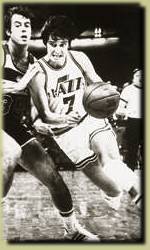 February 25, 1977. The Jazz were going up against the New York Knicks with their "defensive wizard" Walt Frazier. The Knicks were the favored team, but Pete fired a career-high sixty-eight points. Although that was definitely a high-flying career highlight, later that year knee injuries caused Pete to have to sit the sidelines for thirty-three games. In 1979, the New Orleans Jazz was moved to Utah, and new management was brought in. The coach and Pete did not have a very good relationship, and in the end Pete left the Jazz, and began his search for a team that would bring him that unobtainable championship ring.
Playing for the Boston Celtics had always been a fantasy of Pete Maravich. The Boston Celtics was a team that knew how to win championships, as the banners displayed in Boston Garden illustrated. In 1979-1980, Pete played alongside rookie Larry Bird, but not for as long as he would have liked. Pete received little playing time with the Celtics. His action during a game would range anywhere from ten to twenty minutes, but never an entire half. There were two occasions, however, when Pete was a starter, due to the fact that the regular start was absent. When the starter returned, Pete was placed on the bench again. After this disappointing season ended (the Celtics lost the World Championship that year to the Philadelphia 76ers, the other team Pete had considered joining), Jackie gave birth their first son, Jaeson (Pete and Jackie were married in 1976). Pete loved his son dearly, and was amazed by his purity.
Pete participated in the traditional preseason Green-White scrimmage in Boston Garden preceding the 1980-1981 season. Maravich played a terrific game, scoring thirty-eight points. His teammates congratulated him on his excellent performance, and Pete should have felt confident about his game. But serious thoughts flooded Maravich's mind, and after some long, hard thinking he decided to retire from the game that he loved.
The next two years of Maravich's life were spent isolated away from the world at his home at Lake Ponchartrain. He loved being with his family, and raising his two sons, Jaeson and Joshua, but soon his life without basketball became very depressing and empty. Maravich started searching for something to fill the loneliness in his life, and strange obsessions began to take form--nutrition, aliens, karate, transcendental meditation, etc. Pete felt empty, and he wasn't sure why--he should have been happy considering he had everything the world had to offer in happiness: money, fame, cars, and a family that loved him, but he wasn't.
The solitude, probing, and despair sustained until one late night on Lake Pontchantrain when the Pistol found it impossible to sleep. The thoughts of meaninglessness were overflowing his mind, and he fell to his knees in prayer. According to Pete, a voice answered his heart-felt prayer by saying, "Be strong. Lift thine own heart." Pete Maravich was never the same person again.
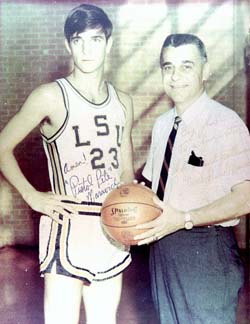 A fresh Pete emerged. He was now a devout Christian, a content husband and father, and above all, he was happy. He was a devoted father, dedicated to teaching his sons about Christ and helping them develop basketball skills. If they wanted to play basketball when they got older, great, but if not that would be all right, too.
Besides teaching his own children how to play basketball, Pete also spread his teachings at several camps and clinics. His approach of teaching basketball was "Homework Basketball", the same skills and techniques taught to him as a young child by Press. He would also integrate the love and message of Jesus Christ at these camps and clinics whenever possible.
Press Maravich was not left out in those who received the message of Christ. Pete shared his testimony and love of Jesus Christ with his father, and together they were "joint heirs of Christ", growing closer each day. 1986 brought Pete and Press closer than ever as Press battled cancer. On April 15, 1987, Press Maravich succumbed to cancer. Although Pete was sorrowful about his father's death, he knew that he would see his father again, whereas Pete in earlier years may have defied and cursed God for taking his father away from him.
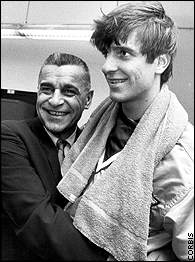
One of the greatest honors of Pistol's career came on May 5, 1987, when he became the youngest inductee to the Basketball Hall of Fame. His only regret about the occasion was that Press couldn't be there to hear his name announced. In earlier years, when asked what he would say if he were to be inducted into the Basketball Hall of Fame, he responded, "Give the award to my Dad, because there is no way in the world I deserve the award before he does."
A happier man than Pete Maravich couldn't have been found on earth during the last years of his life. He had finally found the inner peace and serenity he had been pondering to find all his life. He had found it, and wouldn't exchange it for a hundred NBA world championships.
Pete Maravich had said in 1974, "I don't want to play ten years [in the NBA] and then die of a heart attack when I'm 40."
Sadly, on January 5, 1988, that is exactly what happened. After coming off the court of a pickup game in Pasadena, California, Maravich collapsed and died of a heart attack. He died play the game he treasured at just forty years old. It was later discovered through an autopsy that Pete had lived with a defective heart his entire life. He had only one coronary artery instead of the normal two. It is amazing that Pete even lived as long as he did, as most patients live to be twenty years old. Putting all of his achievements into place, it's miraculous that he undertook all the remarkable and impeccable accomplishments he did.
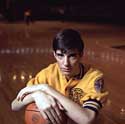 There will never be another athlete like "Pistol" Pete Maravich. He was one of a kind, and his moves and tricks can never be duplicated. His name will forever be engraved into basketball history not only because of all his phenomenal records (which have stood the test of time for almost forty years) and innovative style of play combined with his dazzling moves, but also because of his undying dedication to the game he loved. The game he loved so much that he spent his life dedicated to making himself the best basketball player he could possible be. The game that he loved so much that he would play it no matter what, no matter what injuries the doctor said he had. The game that he loved so much that he died playing it. That was the real dream Press Maravich had for his son--to inspire a love of the game in Pete so strong that not even words could describe it--not to watch his son be given a ring. That dream may be over, but the legend and legacy of "Pistol" Pete Maravich will forever live on.
| Pistol Pete Maravich |
|
|
Home Beyond the Brass Ring Quotes Pictures Pete's Teams Movies Statistics & Records Reviews Tributes & Memories Links |