In the eleventh grade, my Pre-Calculus teacher gave me the ridiculous task of measuring the radius, diameter, and circumference of several circles, using only a ruler and a piece of string!
Naturally it was an extremely difficult task. I couldn't do much, and I was not even close to being accurate. We were then asked to hand in the sheet with our results. Much to my bemusement and dismay, it seemed I had received a grade for the results of my circular adventures! Lacking in that finesse which some do have, I received a C for Average.
(Start sarcasm) Ah, yes! We have now accomplished our goal! (end sarcasm)
Would not reason assume that had I devised a proper, mathematical technique for measuring my circles and their diameters, radii, and circumference, that I would have the relation and the value which was so laboriously discovered by, ahem, previous mathematical thinkers?
Early, Early Days of Pi Pi in its early days was said to be 3, evidently those archaic mathematicians had neglected either decimals or had used the "rough" method described previously. One of these archaic mathematicians discovered a relationship in right angles which is crucial to our story: A^2 + B^2 = C^2. (It is called the Pythagorean theorem (of course) discovered by Pythagoras of Ancient Greece. A and B stand for the sides adjacent the 90 degree angle, and C stands for the hypotenuse, the biggest side.) This theorem is the link that my teacher failed to recognize. You see, a circle by definition is of course, all places a distance r away from a given point. These points are infinite in number and can be thought of as a polygon with an infinite number of sides. Now, on to the main problem: how to compute pi. I offer here two solutions, one utilizing a preset definition, and one more complex and yet more intuitive and refined one.
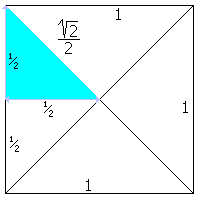
Preliminaries Starting from a triangle, the ratio of the circumference of a perfect polygon to the radius approaches 2pi, because a circle has the largest circumference to radius ratio, 2pi. Why is this so? Well, consider the following plain proof: The Method There is a method to find circumference / radius ratio of any perfect polygon, which involves the Pythagorean theorem. Let us first start with a square. The radius of a square is half of the length from any of its four points to the opposite point.
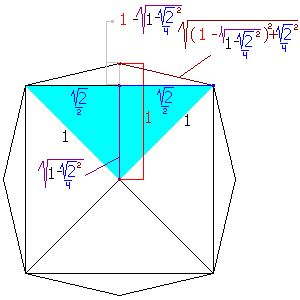
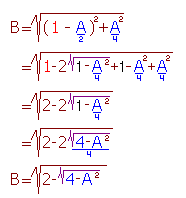
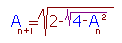
In a square with side lengths of 1, it is plain that the radius is [2(.5^2)]^.5, or sqrt(2)/2 The circumference to radius ratio of a square is then 4/(sqrt(2)/2), or 8/sqrt(2), which is about 5.658. A circle's, on the other hand, is 2pi, about 6.283. Let is now continue on by doubling the amount of sides out polygon has. This time we must find the ratio of one of the sides to the radius. This is not an idle exercise, as you shall soon see. This time the radius is one, but the ratios are still the same as in the previous figure. It's not a perfect octagon, but perfect for our example. The red coloring refers to the new radius line, the sqrt(2)/2 of the previous figure. The blue coloring refers to a side of figure perpendicular to a side of the figure, the "1" of the previous figure. The two new lines represent the doubling of the number of sides. The dark red line on the new right side of the polygon is what we are looking for. That side / radius ratio is now sqrt[(1-sqrt(2)/2)+1] Since there are 8 sides, C = sqrt[(1-sqrt(2/2))+1] * 8 Ideally, C = 2pi By increasing the amount of sides indefinitely to 16, then 32, then 64, we approach C = 2pi! By knowing the previous side / radius ratio, it is possible to find the next: By increasing the amount of sides to 16, then 32, then 64, then indefinetly onwards we approach C = 2pi! By knowing the previous side / radius ratio, it is possible to find the next: The equation therefore, of finding the next side is: By making A = B, one can find the side value once again after that. Doing this n iterations finds the side value n times after that. When A is sqrt(2/2), the amount of sides was 4, and n = 1, since this was the first iteration. Each successive iteration brings about a doubling of sides, so: # sides for n iterations =
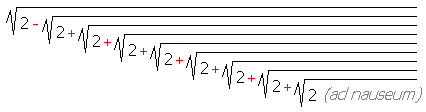
And therefore, C = #sides *B = 2^(n+2)*B In conclusion, pi can be approximated
to a greater and greater precision by using As n approaches infinity, B approaches pi. This can be neatly summed up using a simple equation: pi = email me: agamemnu at brandeis dot edu
You are a number. To be exact, number:

 *
,
*
,
*