
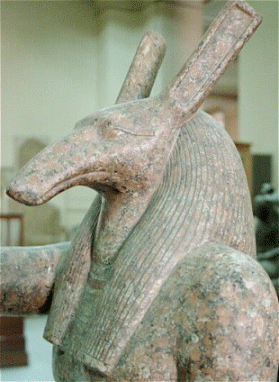
Set, Seth, Sutek, the second son of Geb and Nut, depicted as either an animal with four legs, a curving snout, long ears and an erect tail, or as a human with an animal´s head. Which kind of animal this was has been subject to much debate. His skin was white and his hair red, he was called the god of chaos, of thunder and storms, of destruction and of the desert.
Originally he was probably a desert deity symbolizing the forces of confusion and disturbance in the world. From these early periods, he maintained his place in the pantheon throughout Egyptian history, into the Late Period. He is depicted on standards on the "Scorpion Macehead". He is also attested on the serekhs of the 2nd Dynasty kings Peribsen and Khasekhemwy. It seems that at this time he was equal in power and importance to the falcon deity Heru The Elder (Gr: Horus).
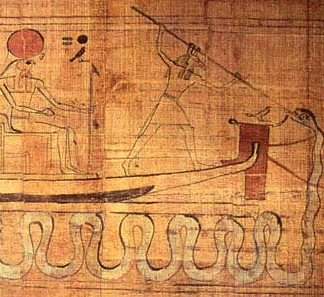
During the Old Kingdom his name appears in many of the Pyramid Texts and in the Middle Kingdom he became the god who stood in the prow of the Boat of Millions of Years (Solar Boat)where he repelled the evil, cosmic serpent Apep which threatend to kill Re. At this time Set was also incorporated into the RaHelipolitan Ennead where he was son of Nut and Geb together with his siblings Wesir, Aset and NebtHet.
During the Hyksos interval he was identified with their god Baal as their chief deity. Later, in the New Kingdom, his importance diminished, but in the 19th and 20th Dynsties he was elevated as a kind of patron deity for the Ramesside kings. After the 20th Dynasty however, his worship declined again and he became associated with the god of the Egyptians much hated emeny, the Assyrians. By the 25th Dynasty, his worship was more or less extinct. Nevertheless, his mythology includes both negative and positive sides.
He was the god of violence, chaos and confusion, ill-tempered and close to anger and rage. Thereby he was opposed to ma'at and could threaten existence.
On the other hand he was the god of protective power, strength and cunning. These traits were taken up by kings who called themselves "Beloved by Set" (Thutmose III, Ramses II).
He travelled with Ra in the sun-boat, standing in the prow, spearing the attacking Apep serpent of chaos. In that way he was both associated with Apep the chaos serpent and the protector of Re.
According to the most wellknown myth about Seth, he was jealous of his brother Wesir and betrayed and killed him, taking his throne. Through this action Wesir became ruler in the Underworld which meant that the deceased had a king and leader. Seth was later beaten by Horus, the son of Wesir and had to cede the throne to him.
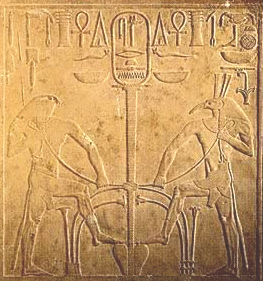
Set´s relationship to Horus is demonstrated in depictions where both are standing opposite each other, binding the symbols of Upper and Lower Egypt together to make one whole country. The ancient Egyptians never had any problems with incorporating both opposite sides of a concept, or, let us say instead of oppsites, complementary sides which make a whole, combined unit.
Main center of worship:
Nebyet/Ombos/Tukh, 5 th Nome, Upper Egypt.
Festivals: (exact dates not historically verified)
16th of July, the 3rd Epagomenal Day is the Birthday of Seth
30th August - 13th Paopi - Day of Satisfying the Hearts of the Ennead
29th October - 13th Koiak - Day of Going Forth of Het-Hert and the Ennead
15th November - 30th Koiak - The Ennead feast in the House of Ra, Heru and Wasir
18th December - 3rd Mechir - Seth Goes Forth
2nd March - 17th Parmutit - Going forth of Seth, Son of Nut Dictionary of Egyptian Gods and Goddesses - George Hart
Sources:
The Complete Gods and Goddesses of Ancient Egypt - Richard H. Wilkinson
The Ancient Egyptian Pyramid Texts - transl. R.O. Faulkner
Ancient Egyptian Religion - Stephen Quirke
Handbook of Egyptian Mythology - Geraldine Pinch
