Nut/Newet

General
Nut, belonging to the Heliopolitan Ennead and daughter of Shu and Tefnut, was the mother of all
heavenly bodies and was thought to be reaching across the sky from horizon to horizon, touching them with her hands and feet. Her laughter was the thunder and her tears were the rain and the heavenly bodies all were swallowed up each evening and born again next morning.
There are some astronomical indications of this. It has been shown that at the winter solstice before dawn, in Predynastic Egypt, the Milky Way would have looked very much like a stretched out body with arms and legs touching the horizons in the same manner as Nut was frequently shown in later times. Another thing which must have affected the way the Egyptians saw her, was the fact that at the winter solstice, the sun was rising at the exact place where it was thought that she was born, and nine months eariler at the spring equinox, it was seen to set at her head, so that it seemed to be swalloed up.
Myth
There is a myth about the birth of her children, written down by Plutharch, which states that the sun god feared her children as possible usurpers of his throne, so he laid a curse upon Nut so that she couldn´t give birth during any of the 360 days of the year. Then Djehuty (Gr: Thoth) came to her help, winning five extra days so that she could bear her children.
Funeral Deity
Nut was seen as the mother of Re, who swallowed him up every evening and gave birth to him
again every morning. It was said that the sun passed through her during the night, and the stars during the days. She was thus connected to resurrection and the tomb. The coffin, decorated with stars, was seen as the heavens, i.e. Nut herself in whose body the deceased rested until he awoke to new life.
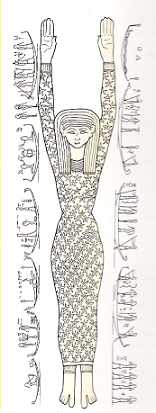 Many tombs are decorated with her image on the lid, so that the deceased could 'see' her. It was also believed that the deceased became stars in the sky. Nut was said to have united with Geb, and thus giving birth to Wesir (Gr: Osiris) and thereby associated with the other deitites which were involved with resurrection. Therefore, the priests of Heliopolis (Anc: Iunu), could incorporate the netherworld into their sun cult. Nut is an important figure in the Pyramid Text and is mentioned nearly 100 times. She appears there as a helper of the King´s resurrection, in the form of the Heavenly Cow, which in turns links her with HetHert (Gr: Hathor), and she is also mentioned as his "Mother Nut in her name of 'Sarcophagus'.... in her name of 'Coffin'....in her name of 'tomb'. Her association with HetHert became, by time, reason for their change of placement: sometimes Nut was seen as the sycamore tree which brings nurture to the deceased, while HetHert became the Heavenly Cow.
Depictions
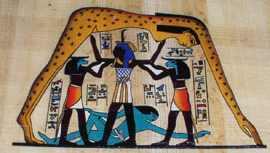
Mostly, Nut was depicted as a woman with a round water pot above her head, together with the hieroglyph for sky. Other times we see her starry body bending over Geb as the Earth deity. Her arms and legs touch the horizon. Sometimes there is Shu between them, holding her up. On the underside of coffin lids, she was depicted from her front, often with the sun showing it to be swallowed up by her. In this way, the coffin became a symbol of her body, which would enable the deceased to be reborn. In the Book of Going Forth By Day, she is seen coming from the trunk of a sycamore tree, to bring water and nourishment in the afterlife.
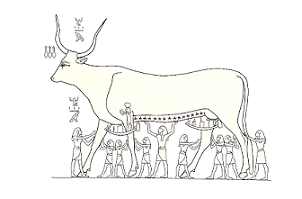
Sometimes she was shown as the Sky Cow. Her hooves were then the four cardinal points of the earth and stars and the sun were shown below her underside. In this form, she is often supported by Shu as well as the Heh gods, two of them supporting her four legs which are the 'Pillars of the Sky'.
Worship Dictionary of Egyptian Gods and Goddesses - George Hart
Although Nut was depicted in many temples and tombs, as well as in astronomical ceilings, she had no cult of her own like other deities. Probably she was not well observed in popular religion although amulets of her in sow aspect have been found in burials and there seemed to have been several festivals including her, though these events might have limited themselves to the temples.
Sources:
The Complete Gods and Goddesses of Ancient Egypt - Richard H. Wilkinson
The Ancient Egyptian Pyramid Texts - transl. R.O. Faulkner
Ancient Egyptian Religion - Stephen Quirke
Handbook of Egyptian Mythology - Geraldine Pinch
