Resource Page
Featured Deities Past Months
Back to Main
Nephtys -NebtHet - NeBet-Hewet
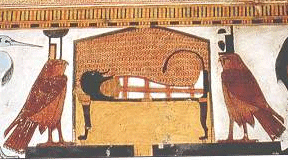
NebtHet is a shadowy lady who tends to slip away when you try to get a hold of her. But taking a closer look might reveal some unexpected features. The Name In the Heliopolitan Creation Myth Depictions NebtHet can appear in the form of either a female deity with the hieroglyphic sign of her name above her head, or in birdform; most frequently the kite, like Aset is, but sometimes also a hawk or a swallow. These depictions are seen guarding biers, sarcohphagi and shrines; either of them at each end of it, or both the deities together at the head end. In these situations they can be seen either in human form or in bird form. In later times NebtHet was said to be the mother of Inpew (Anubis) of which the father would be Wesir. No stories of jealousy on the part of either Aset or Set are found though. Another Late Period connection to NebtHet, although vague, is with Anuket of Abu (Elephantine) though the connection with Aset always takes precedence throughout NebtHet and other Deities Nit and NebtHet Seshat and NebtHet Cult Places 1. Already in the Early Dydnastic Period, Hiw, or Diospolis Parva, was the capital of the 7th Nome of Upper Egypt. The local deity at that time was Bat, who in the Middle Kingdom became merged with HetHert, who in turn in the Late Period was taken over - not with Aset but with NebtHet. At this time NebtHet had become the main deity here in Diospolis Parva, and her rôle was much the same as Aset in Behbet el-Hagar, i.e she was the protector and guardian of the rites of Wesir. So here we find the almost unlikely exception to the supremacy of Aset in her traditional position as caretaker and guardian of Wesir in every other cult place in Egypt. At this location, NebtHet was in charge. Here she has titles like: "The Lady of Hiw", "The Lady who Dwells in the Heart of Hiw" and "The Lady of the Mansion of the Sistrum", which all points at her being the main deity of this cult center. Although no temple remains have ben found here, other inscriptions in the 7th Sepat, talks about NebtHet as: "the domain of NebtHet". 2. From the 19th and 20th Dynasty, New Kingdom, there has been discovered at Seperemeru, near Oxhyrrunchus, 19th Sepat, Upper Egypt, two separate temple foundations, for NebtHet and for Set. They each had their own priesthood, were equal in size and were attested already in the Wilbur Papyrus, the famous listing of priesthood and taxes. It seems that from this time onward, NebtHet enjoyed an important and widespread worship which last into the Ptolemaic Period. 3. All the Ptolemaic temples Dendera, Philae, Edfu and Esna have inscriptions referring to "NebtHet, Mistress of Kom Mer" and when in 1978scant remains of a temple were discovered at Kom Mer, these ancient inscritions were confirmed. The temple was dedicated to NebtHet/Anuket, a combination developed in the Late Period. This was an important cult place as the tradition was that NebtHet had found one of the missing pieces of Wesir here, during the search for his body that she and Aset had made. 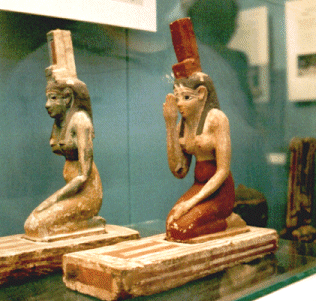 The "Two Sad Sisters" : Nepthys & Isis mourning. British Museum, photo: author Festivals: (these dates are just an estimate, compiled from several sources) 18th of July, the 5th Epagomenal Day is the Birthday of Nebet-Het
(Nephtys) 30th August - 13th Paopi - Day of Satisfying the Hearts of
the Ennead 3rd October - 17th Hethara - Lamentations of Aset (Isis)and
Nebet-Het (Nephthys) for Wasir (Osiris). 29th October - 13th Koiak - Day of Going Forth of Het-Hert
and the Ennead 15th November - 30th Koiak - The Ennead feast in the House of Ra, Heru and Wasir |

Dictionary of Egyptian Gods and Goddesses - George Hart
Ancient Egyptian Literature Vol I - Miriam Lichtheim
The Ancient Egyptian Pyramid Texts - transl. R.O. Faulkner
Nebt-Het: Lady of the House - Tamara L. Siuda
Handbook of Egyptian Mythology - Geraldine Pinch