Resource Page
Featured Deities Past Months
Back to Main
|
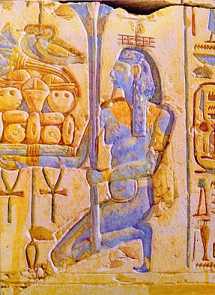
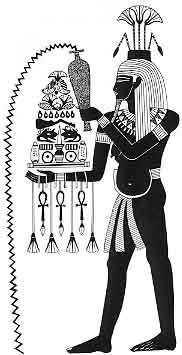
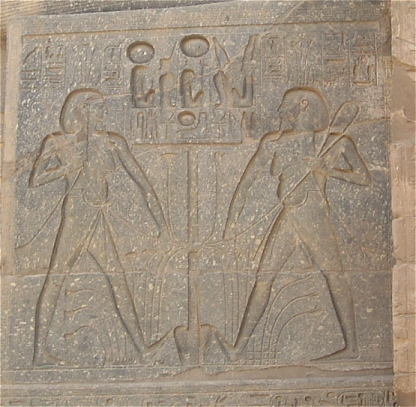
Hapi (Hep, Hap, Hapy) was probably the Predynastic name for the Nile. ('Nile' comes from the Greek word Neilos - which is a corruption of the Egyptian 'nwy' which means 'water'.) The Egyptians called the Nile Iterw. Hapi was more the personification of the Inundation of the Nile, than of the river itself. He was worshipped for two reasons; the actual waters of the Inundation which were bringing life to Egypt, and the fertility and sustainment made possible by the Nile silt left on its shores when the Inundation drew back again. It is not wrong to say that Hapi, together with the special geographical situation in the Nile valley, was what made Egypt into the civilization it was. But there were no guarantees for Hapi always giving an abundance; references have been found to a 'large' or 'small' Hapy. The Inundation could be either too high or too low, which meant threats as people could drown, or famine because of no growth. Hapi was depicted as a somewhat overweight man, to symbolize abundance, and with female breasts to symbolize the river’s fertile properties. In this aspect he is linked to several fecundity figures, or 'Nile gods' which personify abundance of various kinds, of which the Inundation is the most important and fundamental one. These fecundity figures can be seen bringing offerings to the King, or they can, together with the King bring offerings to deities in their temples. Double depictions of Hapi wearing either a crown of blue water liy or one of papyrus, like in the image at the bottom, where Hapi is tieing together the Two Lands, show that he was a god for both Upper and Lower Egypt. Hapi is an ancient god, mentioned already in the Pyramid Texts. In Utterance 581 it says: "...those who see the Nile when it surges, tremble, the meadows laugh, and the riverbanks are inundated." In the Middle Kingdom he is called 'Master of the river bringing vegetation'. It is also from this time that the great 'Hymn to the Flood' was written, though existing only as copies from the New Kingdom. It is along hymn and below is only a short sample. As Hapi was connected to water, he sometimes shared the epiteth 'father of the gods' with Nun and other deities connected with the process of creation, like Amun, Atum, Geb and Shu. Hapi was a god of both Upper Egypt, where he was called Hap-Meht and having Nekhbet for a wife. In Lower Egypt, his name was Hap-Reset and his wife here was Wadjet. Depictions show the two Hapis tieing together the two lands with their symbolical flowers; lotus for Upper Egypt and papyrus for Lower Egypt. They were often shown as twin deities with these plants as a crown on each of their head. From the Middle Kingdom and onwards we find Hapi depicted as a statue wearing the regent´s features, to point at the king´s importance to the regeneration of the land. The statue is standing behind an offering table which is decorated with flowers and fruits, denoting the rich vegetation, some of them are tied together to show the unification of the Two Lands. Other epithets for Hapi were "lord of the fishes and birds of the marshes", and he is followed by crocodile-gods and a company of frog-goddesses with braided tresses of hair. In the temple of Abydos Hapi is depicted with a double-goose head, perhaps alluding to his aforementioned epiteth. Often he carries a tray of offerings with the gifts of the Nile, the produce of the Nile silt. He wears a crown of either the lotus of Upper Egypt or the papyrus of Lower Egypt. Hapi influenced the whole stretch of the Nile, and is seen holding both papyrus and lotus plants, or two vases in his hands. In the Luxor Temple, Thebes, there is a relief showing two Hapi figures standing over respectively a lotus and a papyrus plant, tieing together Upper and Lower Egypt into the wind-pipe (sema) hieroglyph which denoted the Unification of the Two Lands. His home was thought to be in caverns near the First cataract of the Nile, which were in Khnum´s domain, and where his main center of worship als were. He was also worshipped at Gebel el-Silsileh, Aswan and Abu (Gr: Elephantine) where he was closely associated with the god Khnum. No temples or sanctuaries were built specifically in his honor, he was worshipped at annual festivals and with lavish offerings all over Egypt, but no temples have been found built to him epsecially. But his statues and reliefs are found in the temples of other deities. As early as the mortuary temple of Sahure in the 5th Dynasty to the Graeco-Roman temple for Heru at Kom Ombo, the lower register of temple walls are decorated with processions of fecundity figures in the shape of Hapy, carrying offerings. Such figures can also be seen in the temple of Ramesses II at Abydos.
From the Hymn to the Flood: Main center of worship: Abu, where he was worshipped in conjunction with other Netjeru; Khnum, Satet, Anuket. Festivals: (dates not historically verified) End September– 12th Hethara - Feast of Hapi: Creating of
the Nile Middle December– 30th Tybi - Day of Crossing before Nun in
the Temple of Hapi Dictionary of Egyptian Gods and Goddesses - George Hart |