

|
|
|
|
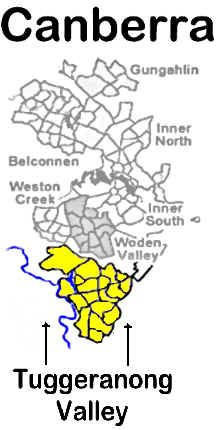
The issue of smoke pollution is an important and visable one for the Tuggeranong Valley. After a cold and still winter's night it is not uncommon to see, smell, and feel a thick haze of wood smoke lingering in the air. Due to Canberra's location and altitude we experience very cold winters and as you expect, people need to have some form of heat to keep them warm. Wood fires have always been a popular source of heat among Canberra's population due to the cost effectiveness as well as the amazing heat and charm that can be provided only by a wood heater. In a lot of Canberra’s older suburbs (over 10 years) it is a fact that nearly one out of every two houses has a wood heater. The Tuggeranong Valley in particular suffers from smoke pollution for the simple reason that it is surrounded by mountains. During winter the smoke gets trapped inside the valley so instead of being blown away by the wind, the smoke continually circulates around the valley. Wood remains a major heating material for the Canberra region, and certainly the older Tuggeranong Valley. However the amazing heat and charm that a wood heater provides comes at a cost, and not only a financial cost, but a cost to the Tuggeranong environment and to the people who live here. Now, in the 21st century, people are beginning to wake up
to themselves. The usage of other heating methods such as gas and electricity are becoming
more and more popular, and although wood fire sales are still going strong, the market has
shifted from suburban homes to more semi-rural houses. (source: home heating warehouse) Over the past few years the
ACT government has taken some very important steps in the protection of our air
quality from excessive wood burning. There have been campaigns such as the 'Don't
Light Tonight' campaign, which is a voluntry campaign to stop wood burnign on still nights, and now all fire wood sellers require a licence to sell wood.
There have been attempts to introduce a wood heater buy back scheme by numerous local
councils and to educate people of the risks involved with wood fires but so far the
results have been unsatisfying. In 1992 the national standards of wood heaters were changed and set higher due to the growing concern over the amount of damage that the smoke was inflicting on the surrounding environment and people. This started a national overhaul on wood heaters and from that year on all wood heaters had to comply to the Environment Australia (EA) standards. This particular step in reducing smoke pollution was very important because it has been proven that pre-1992 wood heaters produced 80 percent more smoke than those sold today. So effectively there is 80 percent less smoke pollution around today, but this is still enough to cause harm. Unfortunately, the problem still exists in the Tuggeranong Valley because nearly all of the houses were built before 1992 so the majority of wood heaters do not comply to the Environment Australia standards. There are numerous possible solutions to the wood smoke problem in the Tuggeranong Valley and the solution that we believe is most viable is for the ACT government to introduce a mandatory buy back scheme of pre-1992 wood heaters. Lets not forget that excessive wood smoke can not only harm the environment but it is a major contributor to breathing difficulties and asthma. One particular study found that the high levels of wood smoke in the Tuggeranong Valley is believed to be the direct cause of deaths for nine residents of the Tuggeranong Valley in the year 1999. (source: the chronicle) Constantly breathing smoke polluted air is also linked to allergies, headaches, sore eyes and throat, as well as increasing chances of cancer.
|