[return to p5 contents]
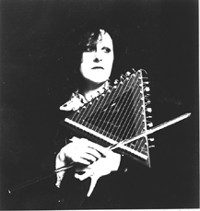 pipeline5.interview:Elodie Lauten
A Conversation with Elodie Lauten for pipeline by Scott Young
Elodie Lauten is a unique composer who has released recordings on many labels. Listening to the Studio 21 Limited Edition of Elodie Lauten 50th Year Retrospective: Selections from compositions from 1983-1999 brought back home to me the breadth of her work. Lauten has developed a complex compositional paradigm that is really all her own. But more extraordinary are what the New York Times calls her "elegiac melodies...pungent and intriguing," which "extract order from chaos." Parisian-born Lauten's experiences include studies with LaMonte Young and recording on Robbie Robertson's The Native Americans.
YOUNG:
�����Elodie, among your recent works is the chamber opera, Waking In New York--a musical portrait of Allen Ginsberg,1 which you premiered at Music Under Construction in New York. On June 2 and 3, 2001 you're going to have a second set of performances of Waking In New York at the 14th Street Y Theater in Manhattan. Tell me about your relationship with Ginsberg and about your composition.
LAUTEN:
�����This piece came about when, after spending two years in New Mexico, I came back home to New York. I lived in an apartment on a high floor that had a great view of the Hudson River and the buildings. I wanted to do a piece of work about New York, because New York meant so much to me, and because Allen Ginsberg had something to do with it. I contacted Allen, whom I had known since 1973, and asked him for a libretto. He replied very quickly in the summer of '96 with a set of poems about New York taken from his Collected Works, Cosmopolitan Greetings and White Shroud Poems. This was about six months before he died. When I started working on the poems I discovered that there was almost a secret message in them, an intimate self-portrait of the way he was living in the East Village neighborhood in his later years.
�����It took me a long time to write the piece and I did it independently. Ginsberg is still very controversial and in these conservative times not exactly a ticket to obtain funding--and it is probably best that the work developed over a period of 3 years at its own pace and without any interference. It is scored for a small orchestra comprised of string quartet, contrabass, two percussionists, and flute. The three singers are a baritone, with the role of Allen, and his two muses (I created the roles based on his writing) Freedom and Compassion, performed by a soprano and a Gospel singer.
�����This is a very karmic piece for me. Its composition coincided with the death of Allen [April, 1997,] and the death of my own father, jazz composer Errol Parker [July, 1998.] 2
�����The circumstances in which I met Allen Ginsberg were also extremely karmic. I am giving you the whole story here. In 1973, I was working on some music with actor Jean-Pierre Kalfon, which brought me to New York at Blue Rock Studio on Spring Street--I was 22 and it was my first recording session. The studio producer brought me back for another session with a group whose manager promptly "adopted" me, promising gigs, but his idea of management was to keep me locked up in his loft. (I guess [that he thought it was] to keep me out of trouble.) I looked at the Village Voice ads and noticed an interesting ad describing a women's band. I went to the audition and banged out a couple of songs on the out-of-tune upright, along with some of my wildest Ono-style vocal improvs and there I was, in a band with guitarist Denise Feliu, protege of Peter Orlovsky, living with Allen Ginsberg. She soon rescued me from my unwelcome management situation by offering me to stay with them.
�����This is where I met Allen. The first time I saw him he was coming back from a trip and had broken his leg. He sang a song he made up about it, Broken Bone. My contribution to the band included accompanying Allen in various appearances, and he extended his encouragement and kindness by providing me with a Farfisa organ he bought from Ed Sanders [poet, scholar and founder of the Fugs.] I was forever grateful to Allen to introduce me to electronics in this way--that was my first non-acoustic keyboard. Allen was travelling a lot of the time but when he was around I used to bake apple pie for him. There was a meat boycott we were all participating in and Peter was regularly bringing huge cases of tomatoes from Allen's farm upstate, and that's what we ate mostly--we were broke, living on 10th Street and Avenue C. Sometimes Denise and I went up there to help make preserves--natural and organic, of course.
�����At Allen's apartment I also met a young cellist, Arthur Russell, who turned out to be one of my best friends and collaborators for many years until he died of AIDS in 1992.
�����Somewhere along the way I learned mantras and got interested in meditation through Allen's example, and that was also very karmic for me, as I later on became a Buddhist. I learned a lot of things from being around Allen, in a non-traditional way but very effective nonetheless, the most important one being how to keep myself creative and unblocked, and also to appreciate New York and its diversity, its multiplicity--to embrace it.
�����Coming back to WAKING IN NEW YORK, the challenge of this piece was to use the texts in a non-narrative way. I did not want to duplicate what others (such as Philip Glass) have done with Allen's writing, which is mostly to keep it close to spoken text as a narrative over music. I wanted to actually create melodies based on the text--to set it in operatic style while maintaining the mood, which is more related to blues, rock and soul music rather than classical music. This is what made it very exciting for me. Some of the poems, such as The Charnel Ground, are incredibly hard-edged, describing junkies, winos on the street, in a very prosaic language with no rhymes whatsoever. But the wonder of it is that Allen's lyricism would burst out and take everything to another level, and that is what I can easily express musically. There are a number of "x-rated" words in the text and I didn't change anything whatsoever to the text. There are also many stream of consciousness monologues which are very appropriate for an Allen role.
�����So in this work, WAKING IN NEW YORK, we have a classical form, but a content that relates to blues (which was Allen's basic musical expression--he was quite a good singer himself.) We have vocals that go from operatic to rock to gospel according to the occasion. The most important thing in this work is that it expresses Allen's cosmic consciousness. It emphasizes the way Allen is feeling compassion for all human beings, always switching from talking about himself to talking about other people that he sees, about the city's whole and parts not in themselves but as they relate to people.
�����And this time around we have director Tom O'Horgan (original creator of the musical Hair) to work with.
YOUNG:
�����You've also been commissioned to compose an orchestral work, Symphony 2001, in celebration of the millennium, by the Bozeman Symphony Orchestra (to be premiered in Bozeman, Montana on April 7, 2001.)3 I know that you've long been concerned with new compositional structures, and that you've written about them at length. How is Symphony 2001 structured?
LAUTEN:
�����Symphony 2001 was commissioned by the Bozeman Symphony Society as a celebration of the Millennium. The uplifting aspect was essential and I was asked to do a happy piece, a rather unusual request for me.
�����As I started to meditate on the different aspect of the Millennium, I envisioned two directions: one is the fact that once the millennium has passed and everyone is still alive, it is wonderful to see the sun rise again. The light of the sun, the continuation of life. The other direction is all the emotions related to the occurrence of a millennium: fears, superstitions, prophecies; hopes for better times to come or [fears about] the apocalypse. So the symphony is expressing both sets of elements. Starting with the light of the sun, the light spectrum with its seven colors of the rainbow is what determines the structure of the symphony. There is a correspondence between the frequency of each pure color of the spectrum and musical frequencies, and so each movement is dedicated to a tonal center and corresponding color, as follows:
G - violet
A - indigo
B - blue
C - green
D - yellow
E - orange
F - red
�����Within these tonal centers, there are modulations and other elements relating to the emotional aspects of the millenium come into play. The general structure is ascending, corresponding to the sunrise theme. Also, within the movements there are different, recurrent ascending structures.
�����The first movement, Sundance, starts with an ancient celebrational Sioux song. The second movement, entitled The Fairy Bells, is also celebrational in its mood but in a more mysterious fashion, with unusual percussion textures. Third movement, Incantation, is more about the magic and superstitions surrounding the millennium, as is the fourth movement, Nostradamus, which, as suggested by the title, presents the character of Nostradamus and his predictions of doom in a light and playful manner. The fifth movement, entitled The Golden Age, one of Nostradamus' predictions about this wonderful age to come, is a complex rhythmic orchestral groove. The sixth movement, or The Eternal Return, explores the idea of universal time, as does the seventh movement, The Wheel of Time--a concept familiar to Buddhists.
�����The entire work is only 19 minutes--each of the movements is fairly short and there are seven of them as there are seven colors of the rainbow.
YOUNG:
�����You've received raves from Option Magazine, the Village Voice, the New York Times, the Chicago Reader and other publications. In Schirmer's 20th Century American Music, you're described as a "seminal figure, one of the leaders of the postminimalist movement." That's a wonderful tribute. For a time, you called yourself a microtonalist. But recently you've eschewed any categorization of your work. That's direct and more useful, since you live in your work rather than in some impersonal chronological relationship to a technique or an historic musical movement. I'd like to ask you a little bit about microtonality though. Did you begin your work in microtonality during your studies with LaMonte Young or with the Northern Indian composer Akhmal Parwez? What did you learn from those fellows?
LAUTEN:
�����I was introduced to alternative tunings by LaMonte Young. In the early eighties LaMonte and Marian [Zazeela] had a huge space and there was a room dedicated to LaMonte's masterpiece THE WELL-TUNED PIANO. In that room there was a sound system and one could sit and listen to the recording of this piece,which is 5 hours long in optimum conditions. I sat in the room alone and listened to the entire piece, which impressed me as the greatest masterpiece of 20th century music. At the time, I was playing the piano a lot and had never questioned the temperament and tuning of my piano. This was all new to me, hearing a piano tuned to natural invervals in just intonation. LaMonte's tuning of the piano was a creative work in itself, which he achieved with Bob Bielecki. They worked for months on achieving this tuning on a Bosendorfer piano. The sound of this piece is otherworldly; it takes your brain to places you never knew existed. This is how I learned that equal temperament is merely a convenience. From then on, I studied various alternative tunings and temperaments, and that is what drove me to want to build an instrument that I could easily tune and retune, and came up with the Trine. Most of all, I learned that finding the right tuning for a piece is key, the tuning being an element to be addressed each time, as opposed to being a given.
YOUNG:
�����You've written about the need for new instruments. But you've also gone right out and developed the Trine. When I listen to you play it I find it comfortable and compelling to listen to. How did you develop the instrument?
LAUTEN:�����The Trine is a triangular 21-string amplified lyre. I drew it up and a sculptor friend of mine built it for me. I put the strings on myself--it took a couple of months of handling for it to actually become a musical instrument and not a piece of wood with metal strings.
YOUNG:�����You have great hands and a wonderful facility to perform on keyboard instruments. You're known around the world for that--for instance, in having topped the Green Dolphin's Poll over many exceptional and well-known players. Did it take you some time to become proficient on the Trine?
LAUTEN:�����It took some practicing to develop techniques such as bowing with the glass bow, plucking and using a mallet, and to come up with amplified sound designs, using delay, reverb and overdrive effects appropriately for the instrument, but not very long.
It took me about 3 years to become proficient on the piano. It took me about year to become proficient on the guitar--that was shorter too. But I no longer play guitar because the calluses you develop on the tips of left hand fingers doing bar chords desensitizes my touch with the keyboards. With the new synthesizers, where you can brings out a different effect in the sound with a different amount of pressure on the key, that is something I like to play with.
YOUNG:
�����After learning about alternative tunings you gravitated to microtonality and polymicrotonality. How do you define them? Can you site examples in your recordings?
LAUTEN:
�����Microtonality is a generic term for music that offers alternatives to conventional tuning in equal temperament. Polymicrotonality means using several temperaments/tunings simultaneously in the same piece. For instance, in TRONIK INVOLUTIONS, the piece entitled Retreat has two simultanous keyboard melodies, one tuned in just intonation, one tuned in Vallotti, and you can hear the beating between the intervals.
YOUNG:
�����How does polymicrotonality fit into your improvisational style, Universal Mode Improvisation? Tell me about UMI.
LAUTEN:�����
Using alternative tunings can drastically change the character of a piece. It can affect the improvisation since the intervals sound different, so one may want to use different intervals and chords according to the tuning. Changing the tuning would drive the improvisation into different areas.
YOUNG:�����
Do some of your compositions move from scoring to improvisation and perhaps back again?
LAUTEN:
�����Yes. Going back and forth between a macro structure, such as the light spectrum matrix of Symphony 2001, and the micro structure--which is an improvisation in a certain framework--is a way to unblock the compositional process. Like looking at a painting from a totally different angle and seeing different things in it.
YOUNG:
�����To what degree are your compositions like Orange Cycle, Tronik Involutions, XX, and Inscapes From Exile improvised?
LAUTEN:
�����That is a very good question. In my garden, improvisation is very closely related to composition. This is helped by the fact that I am blessed with a musical memory, so I am able to retain elements of a piece in my head even though it is not written, and develop it in a seemingly spontaneous process from one version to the next until it is ripe and ready. It is more like composing on your feet. The Variations on the Orange Cycle were developed without a score. When I was approached by pianist Lois Svard who wanted to perform the piece after hearing the recording, the method I used was the following: immerse myself again in the piece (I had composed it several years before) and play it again for a long time. Then do midi inputs on the computer. And then look at the music. The first draft came out so incredibly complicated (it has a lot of fast chromatic parts) [that] I thought no one could read it and play it back. So I edited the input until it became legible and that was a huge job; but I tried to maintain everything as close to the improvisation as possible. And Lois Svard did a magnificent job of interpreting it and performing it. Actually, it is pretty close to the original recording I did myself in 1991. So here is a piece that is like a written improvisation.
�����Of course, it is easier to be more improvisational when I perform myself in my electronic pieces. However, if you repeat an improvisation a number of times, you begin to develop a set of "permanent" patterns that will come back every time you play the piece, even though some elements are new each time. This applies to TRONIK and INSCAPES.
YOUNG:
�����You're always composing new music, premiering, and giving repeat concerts; and you've often written against the cultural devaluation of the arts and about the concepts that inform your work. In addition to the new performances of Waking In New York, and the premier of Symphony 2001, what have you in mind for the coming year?
LAUTEN:
�����Whatever my karma brings. The best music-making opportunities that ever happened to me have come unexpectedly without my effort. Sometimes I make an effort and a plan and it is rewarded. Sometimes it seems wasted and useless. But the best things, they come on their own time somehow.
YOUNG:
�����Thanks for sharing your time with Pipeline's readers, Elodie.
LAUTEN:
�����My pleasure.
Elodie Lauten's CDs, discography, essays, reviews, scores, and links to labels are available online at her website: www.ElodieLauten.com
NOTES
1. WAKING IN NEW YORK - a musical portrait of Allen Ginsberg
Directed by Tom O'Horgan
Featuring: Mark Duer, baritone, in the role of Allen Ginsberg
with Laura Wolfe and Sherrita Duran, sopranos
Conducted by Mimi Stern-Wolfe
Produced by Downtown Music Productions
14th St Y Theater
Sol Goldman YM-YWHA of the Educational Alliance
344 East 14th St between 1st and 2nd Avenue
Saturday June 2 at 8PM
Sunday June 3 at 3PM
Reservations/information: 212-388-0202
Tickets: $15, seniors/students $8
2. Errol Parker's recordings and his autobiography are available from Cadence Jazz Books, Redwood, NY. www.cadencebuilding.com/Cadence/CJB.html
3. SYMPHONY 2001
April 7, 2001 at 7PM, "Gala Rachmaninoff" includes Debussy's La Mer and the Concerto for Piano #2 by Rachmaninoff performed by pianist Jeffrey Biegel, as well as Lauten's Symphony #1.
Tickets for Bozeman performance: call 406-585-9774.
Scott Young is a musician and writer who can be reached at: [email protected]
� 2001 by Scott Young
Elodie Lauten Discography
INSCAPES FROM EXILE - New Tone, 1998
OTHER PLACES CD - Pianist Lois Svard interprets Variations on the Orange Cycle, Lovely Music, 1998
TRONIK INVOLUTIONS CD - O.O. Discs, 1996
TRONIK INVOLUTIONS CD - Studio 21, 1994
COMPLETE WORKS COLLECTION 1983-1993 - Silenzio, Rome, 1993
THE AERIAL #4 CD, Nonsequitur, 1992 - Selection: "Music for the Trine"
BLUE RHYTHMS CD - Cat Collectors/NMDS, 1988
TELLUS #16 cassette, 1987 - Selection: "Tango"
THE DEATH OF DON JUAN Album - Cat Collectors/NMDS 1985
CONCERTO FOR PIANO AND ORCHESTRAL MEMORY Album - Cat Collectors/NMDS 1984
PIANO WORKS album - Cat Collectors/NMDS 1983
ORCHESTRE MODERN EP - Rocking Horse, 1981
As a guest artist:
ARTHUR RUSSELL - ANOTHER THOUGHT CD, Point/Polygram, 1994
ROBBIE ROBERTSON - THE NATIVE AMERICANS CD, Capitol, 1994