February 4, 2000
by: Pinoywatch Research
[Read: "Yasay's cure worse than the disease" by Amando Doronila, Philippine Daily Inquirer (March 3, 2000).]
[Also read the Philippine Star editorial (March 4, 2000), "Gagging the press."]
[Now read the Manila Times editorial (March 10, 2000), "Mr. Yasay and the national interest"]
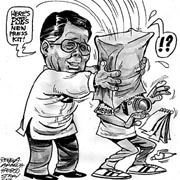 HE seems to be a straight guy. Perhaps it's his tame face, or the snappy suits? That permed hair and those shined pair. What about his saccharine tongue and that American twang? Almost perfect, to say the least. But is he? -- or is he not.
The foregoing article is a product of in-depth research that would take you to the chronology of events which led to the rise and fall of the "self-made" Security and Exchange Commission chairman Perfecto Yasay Jr.
Humble beginnings
First appointed as associate commissioner and the youngest, newest among the four associate commissioners of the Security Exchange Commission, Perfecto S. Yasay Jr. was appointed to the SEC in March 1993.
Born in Kidapawan, Cotabato on January 27, 1947, Yasay is married to the former Cecille Joaquin, Yasay received his bachelor of laws degree from the University of the Philippines and passed the bar in 1972. He also passed the New York State Bar Examinations in 1979 and made history as the first Filipino to make it in his first try.
Yasay, 53, is the "only outsider" in the commission. All other commissioners rose from the ranks, including commission chairman Rosario Lopez who served the agency for 34 years.
The New York educated lawyer was designated by FVR in 1993 to eventually replace Lopez who was politically at odds with the President.
He was designated on August 25, 1995 as acting chairman of the commission following the acceptance of FVR of the resignation of Lopez. Ramos appointed Yasay to a seven-year term as chairman of the SEC ending on March 11, 2004.
Inching up to the top
Now that calls for his immediate resignation is almost in every nook in Malacanang and the business sector, observers could not help but feel that this smart aleck is getting the same does of medicine that he helped administer on his predecessor, Rosario Lopez.
Before his appointment, the articulate Yasay practiced law extensively in New York and was later designated by Ramos to act as the spokesman of the associate commissioners in their fight to preserve the time-honored collegial approach in SEC operations which Lopez wanted to obliterate. (Today/Phil. Times Journal, 08/11/95)
Taking the cue from Ramos, Yasay finally hatched his plan to finally takeover Lopez's post. In such a beautifully executed script, Yasay, together with three other associate commissioners - Rodolfo Samarista, Fe Eloisa Gloria and Merle Manuel- collectively quit their posts and made a joint statement lamenting the ugly turn of events at the SEC which they all blamed on the alleged stubborn refusal of Lopez to implement reforms.
Yasay saw this as an opportunity to turn the events to his favor. In the view of many, Yasay and the other commissioners were only "collateral victims" of the reform-resistant policies vigorously pushed by Lopez and the image of inefficiency it painted.
On August 7, 1995, hours after filing their resignation to Malacanang, Yasay called for a press conference and stressed that their collective action was prompted by the necessity to change the leadership of the SEC and restore its image and carry out reforms. Industry leaders, however, appear to favor the stay in office of the four and the immediate ouster of Lopez. (Manila Chronicla, 08/08/95)
Lopez was ousted principally because she was a non-player of a bigger agenda - one of these is cornering a $13.5 million US grant. Lopez was under fire from the private sector for obstructing the government's capital market development program. The United States Agency for International Development (USAid) had threatened to withdraw its $13.5 million grant should Lopez fail to "reconsider" and "fix" the problems within the SEC.
Yasay finally succeeded.
Play the Yasay way
Upon his assumption to office, the promise of reforms in the securities industry never materialized. Dissatisfaction among businessmen and foreign investors were abound, not to mention his frequent brushes with members of media.
Yasay personally could not handle the doctrine of public scrutiny. In October 1997, in a clear disregard for the time honored principle of transparency in government service, Yasay has imposed a news blackout on petitions for payments suspension by troubled enterprises. (Philippine Star, 10/10/97)
Yasay, who has also restricted access to information about erring stock-brokerage firms, has ordered the records section of the Securities Investigation and Clearing Department (SICD) not to release documents about such petitions to anybody, particulary to nosey business reporters.
The SICD is the quasi-judicial department of the commission which hears intra-corporate disputes.
He instructed the custodians of SICD records not to release any petitions and similar documents pleadings, motions, etc.) to media in an apparent attempt to impose a silent "news blackout."
He claimed that reports about payments suspension were "one-sided" stressing that the side of creditors should be given equal opportunity to be heard. The reasoning itself implies that Yasay was trying to protect the interests or business reputation of his "friends'" distressed companies. (Philippine Star, Malaya, 10/10/97)
In June 1998, Yasay made an attempt to marginalize -- or even abolish -- the Prosecution and Enforcement Department of the SEC. PED is one of the litigation departments of the SEC which investigates erring companies defying SEC rules and regulations.
PED director Ruben C. Ladia cited the case of the precarious plight of the PED due to seemingly unabated issuances of special orders pirating PED dwindling staff. He warned that if the situation will continue, "it is not far fetched to imagine that the PED will vanish to oblivion. Should this happen, PED which is mandated to perform a task will be rendered inoperative, and the services which are to be delivered will be impaired." (Philippine Journal, 06/09/98)
In July 1998, a visiting team from the International Monetary Fund-World Bank has expressed apprehension over the way the SEC has been conducting petitions from companies seeking debt relief. The visiting officials were reported to have expressed their concern that SEC did not have clear parameters to determine which firms are qualified to avail themselves of temporary relief from debt payments.
Based on SEC's track record, even mismanaged companies are protected from their creditors. If the IMF-WB team were only serious to get the nitty-gritty of these details, it should have consulted with Yasay's lawyers: Medel Macam Tolentino and Larcia Law Offices.
Medel Macam have cornered the more ticklish debt suspension cases filed with the SEC and currently handles nine of the biggest debt relief cases being heard by Yasay before the latter went into a state of suspended animation. Up to now, Yasay would not disclose the parameters and arrangements SEC had entered into with the private lawyers with regard the debt relief cases.
The cases which Medel Macam handled include those filed by real estate developer Duvaz Corporation of the Duavit-Vasquez family, Duty-Free First Superstore, and Midas Diversified Export Corp. (Philippine Daily Inquirer, 08/07/98)
In the same month, Yasay had another snafu.
Ombudsman Aniano Desierto issued a 90-day suspension against Yasay for alleged "injurious acts not directly related to his job as the country's guardian of the corporate community. Desierto slapped Yasay of estafa and acts of graft and corruption which stemmed from the complaint filed by Donato B. Teodoro, president and chairman of Donsol Development and Commercial Corporation and DB Teodoro Securities Inc. on June 7, 1997.
Teodoro is the owner of two condominium units on the ground floor of the SEC building. One of the units "G-02" was leased to Emily Mendoza, who converted the area into a coffee shop.
Before the expiration of the lease to Mendoza, Yasay, acting for the SEC, intimated to Teodoro the intention of the SEC to lease the premises in question to be used as "display area." Mendoza, whose lease in the premises has not yet expired, later moved to other units (Unit 208) within the building in order to accommodate Yasay.
On the complaint of Teodoro, he said that despite the occupancy of the premises, Yasay did not only fail to execute the lease contract with Donsol and DB Securities, but he also miserably failed and refused to pay the monthly rentals of the premises without justifiable reason and despite verbal and written demands made by him. (PDI, 07/15/98)
The Ombudsman claimed that the unlawful demolition ordered by Yasay of the premises in question constitutes gross abuse of his authority as a public officer, causing undue injury not only to Teodoro but to third parties over their property rights. (Philippine Journal, 07/16/98)
One of the controversial issues that haunted Yasay was the Prudential insurance case.
In August 1998, Daniel Mercado Jr., president of Philippine Prudential Life Insurance Co., who at first did not want to directly tangle with Yasay, has sufficiently worked enough guts to criticize the SEC chief.
Mercado's argument is that Yasay allowed the giant American Prudential Insurance Co. a corporate registration despite the existence of a Philippine company with a similar name. The irony of Yasay's action is that, in 1995, he himself rejected a similar application filed by the British insurance company, Prudential Life Insurance Corp. of UK - to use the name "Prudential (UK) Philippines Life Insurance Corp. precisely to avoid confusion with Mercado's company. The British company eventually settled for the business name "Pru Life Insurance Corp. of UK." (PDI, 08/21/98)
Driving the bus
In 1998, Yasay was charged before the Ombudsman for criminal and administrative offenses involving the the Batangas Laguna Tayabas Bus Company (BLTB) case. Sportsman Mike Potenciano, one of the directors and shareholders of BLTB, filed graft charges against Yasay for allegedly influencing the SEC hearing panel to favor the group of businessman Benjamin Bitanga for control of the bus company.
The 4-1 decision of the SEC giving back control of BLTB to the Potencianos meant that the four commissioners - Danilo Concepcion, Fe Eloisa Gloria, Edijer Martinez and Rosalinda Casiguran -- chose to go against Yasay.
The SEC chairman made unfortunate, injudicious and widely publicized remarks that prejudged the BLTB case while it was being heard by a SEC panel. The SEC hearing panel decided, of course, in the direction hat their chairman steered them into, a course that the four other SEC commissioners now find to be legally untenable. Perhaps it is not yet too late for Yasay to spend more time with his law books rather than the golf course and taking out-of-town trips with Accra lawyers. (PDI, 07/24/98)
In reaction to the apparent intervention of Yasay, the Potencianos filed a motion to inhibit the SEC chief from participating in the case before the en banc, but Yasay refused to inhibit himself. Potenciano likewise underscored the fact that lawyer Augusto Macam, Yasay's lawyer, is also the lawyer of the Bitanga group in the case filed with the SEC.
"Atty. Macam's law firm is reputedly a most favored law firm of respondent and it behooves the Office of the Ombudsman to investigate and/or look into the past and pending business which said law firm handled/is handling before the SEC," Potenciano said in his petition. (Today, 08/08/98)
Travel itch
"The cat is always away," this was how SEC insiders describe Yasay who seem to have the knack of savoring the taste of junkets abroad courtesy of big foreign corporations who have pending applications with the commission.
Sometime in June 1997, SEC commissioner Edijer Martinez was robbed of his legitimate function to represent the commission to the Tokyo Management Seminar. Yasay was said to have took it from Martinez at the last minute simply because he wanted to visit Tokyo Disneyland. (Philippine Star, Philippine Journal, 06/11/97)
Market observers say Yasay's workstyle seems to betray a lack of interest in pursuing reforms to put the securities industry in order contrary to his repeated claims and promises.
Yasay has a number of ingratiating traits, discretion, unfortunately, is not one of them.
Last year, Yasay and two other lucky SEC officers toured Luxembourg in first-class luxury, courtesy of CitiSelect Sicav, a Citibank subsidiary, that has a pending application with the SEC.
According to highly-placed sources, the SEC chief had allegedly been sitting on the CitiSelect application for more than two years prompting CitiSelect lawyer, Eduardo de los Angeles (former stock exchange chief and a close friend of Yasay), to take the appropriate corrective measures.
The official explanation for the European trip is that Yasay, as a proper regulator, wanted to inspect the offices and capabilities of CitiSelect Sicav, a Luxembourg-based investment company that is waiting for SEC registration of its global securities.
The SEC approval would enable CitiSelect Sicav to sell the dollar-denominated pool of securities to local investors.
Apparently, Yasay, a former US immigration and physical injuries law associate of now Ambassador to Washington Ernesto Maceda, sees nothing wrong in accepting money and foreign trips from companies and groups that he directly supervises.
The SEC chief, for instance, also accepted a $1,000 travel allowance from the Philippine Association of Securities Brokers and Dealers Inc. (PASBDI) when he flew with PASBDI delegates Ramon T. Garcia and Alejandro de Castro to Taipei in June 1998.
PASBDI had also purchased a business-class ticket for Mr. Yasay, but the ticket was returned since, according to the SEC chief, he had already obtained first-class passage from the ailing Philippine Airlines.
The SEC chief had also wanted to tag along Commissioner Rosalinda Casiguran to Luxembourg but the lady commissioner, fearing that she could not defend the trip before the Ombudsman, declined. (PDI, 08/30/99)
Surprisingly though, Sen. Renato Cayetano has taken interest in the Luxembourg trip and other favors received by Yasay.
Briefly, Yasay admitted that he did take a ''study tour'' to Luxembourg, courtesy of Citibank, and claimed that Citibank subsidiary, Citiselect Sicav, ''has no pending application with the SEC for registration of its global securities.'' - but a copy of the Citibank letter proved otherwise.
The SEC chief also admitted, in writing, that he received $1,000 from the PASBDI which the SEC regulates, ''to pay for my food and lodging and other miscellaneous expenses'' during a three-day conference in Taipei in June.
And as a sidetrip from Europe, the SEC chief arrived in the afternoon of Aug. 31 from Spain, where he spent his one-week's leave after the one-day ''study tour'' in Luxembourg, and proceeded straight from the airport to a congressional budget hearing. (PDI, 09/03/99)
A few days after his arrival from the all-expense paid junket, Yasay was right away informed by SEC Commissioner Fe Gloria that Malaca�ang had objected to the Yasay plan of reinstating Adelaida Banaria, the SEC finance management director whom President Estrada himself ordered replaced in December for lack of civil service qualification, among others.
Banaria has since been replaced by Linda Daoang, who was brought along by Yasay to Luxembourg.
But unknown to Daoang, the SEC chief told Gloria that he had already reappointed Banaria, in effect replacing Daoang and preempting the phone call of Executive Secretary Ronaldo Zamora.
To prove it, Yasay the following day released Special Order No. 204-99 appointing the CESO-less Banaria. There is one small hitch, though.
The appointment was dated Aug. 30, which means that when Mr. Yasay drafted/signed it, he must be somewhere in between the plains of Spain and high up over the Middle East, being buffeted by the summer headwinds. (PDI, 09/03/99)
Living in style courtesy of the Filipino people
When the Commission on Audit made a check on the SEC's finances and assets sometime between September and October 1998, it found out that the commission has an unliquidated travel allowances worth $63,382.57 (roughly P2.54 million) and an unaccounted vehicles assigned to Yasay.
The COA on August 24, 1998, ruled that Yasay should return the cash, vehicles and other items issued to him in his capacity as SEC chairman before he was suspended by the Ombudsman.
Sought to be returned are a four-door 2-liter sedan Nissan Cefiro 482, a Nissan Maxima, a Toyota Corona Saloon, one pistol Beretta 92FS, one unit Motorola Mix 888 handheld radio, a pager and a state-of-the-art cellular phone.
According to SEC insiders, even during Yasay's suspension, the SEC chairman was seen to be moving around town with two bodyguards, virtually defying the suspension imposed on him by the Ombudsman.
Yasay likewise owns a three-bedroom condominium in Tagaytay Highlands courtesy of former First Lady Amelita Ramos and Solidbank chair Chito Madrigal Collantes. And whenever he feels to unwind, his Tagaytay becomes host as the watering hole of his billionaire friends.
Influence peddling
If one is to talk about influence peddling, Yasay is the experts' choice.
In May 1998, Yasay rang up a newspaper publisher to express his concern over the paper's coverage of the SEC dispute between Ramon RJ Jacinto and his erstwhile partner, Japanese-American Shig Katayama.
The paper's coverage, particularly the column items, had a decidedly anti-Jacinto slant. And Yasay expressed concern about the particularly damaging testimony against Mr. Jacinto in the hearings at the SEC.
But in trying to play the role of a press ombudsman, Yasay may have committed a graver error and opened himself to the accusations of using his office to lobby for Mr. Jacinto, who happened to be his former client.
Yasay was being retained by the Jacintos during the Marcos years when both the Jacintos and Yasay were in exile in the United States. Because of Yasay's indiscretion, the Katayama camp is going around town with the anecdote, with an added fillip that Katayama's lawyer, Eduardo delos Angeles (Luxembourg sponsor and former president of the Philippine Stock Exchange), is planning to call the publisher later to testify on the alleged bias of a certain SEC official.
In fairness to Yasay, he himself disclosed his Jacinto connection to Delos Angeles, with the qualification that he would inhibit himself when the Jacinto-Katayama case goes up to the commission for review or hearing. But with the unfortunate phone call to the publisher, that threatened inhibition may have to come sooner than later. (PDI, 05/01/98)
The motive?
At the start of the millennium, Yasay took extraordinary risks when he testified under oath at a Senate inquiry on that President Estrada had interfered in the SEC investigation into alleged stock market manipulation and insider trading on BW Resources Corp. shares.
Yasay told the Senate committee on banks and financial institutions that the President rang him up and ordered him to end the investigation and to clear Dante Tan of any wrongdoing. Yasay said Mr. Estrada told him Tan was ''a victim rather than an offender.''
If this is true, then the President was making a judgment ahead of the results of the SEC inquiry. Tan is a close friend of Mr. Estrada. He owns BW Resources, which has secured an exclusive license to operate on-line bingo nationwide, from the Estrada administration.
But despite the equivocation, Yasay stuck basically to what he told the Senate committee under oath. His ambiguity illustrates the risks facing any official testifying on presidential intervention in public transactions.
Senate President Blas Ople said Yasay gave the statement to ''blackmail'' the President, who has put pressure on Yasay to resign, so he can keep his job.
Liar, Liar
HE has not formally begun campaigning for a congressional seat but already, Yasay is sounding like a politician with a forked tongue rather than the chair of a financial regulatory agency clothed with quasi-judicial powers.
Hardly had the incredulous news agencies digested the importance of his Senate testimony last January 18, when who comes explaining in late night TV news to "clarify" what he, on a stack of Bibles, had earlier told a panel of senators.
Hearing his clarification, Channel 21's Tina Monson-Palma and Angelo Castro both concluded that Yasay had indeed "retracted" from his long-hinted, finally revealed disclosure.
The following morning, perhaps having woken up to his senses, the SEC chief burned the lines of the two most powerful radio stations to deny the impression given by his late night TV appearance that he had retracted, flip-flopped or otherwise recanted his position.
Yasay's spiel was: It is true that the President, my boss, had indeed called me up to clear his businessman-friend from the SEC investigation but never did I take the presidential interference as pressure nor was I bothered about it.
The highest official of the land treats you like an overstaying pest, asks for your head, calls you up to intercede for a respondent, publicly calls you a liar and that is not pressure? (PDI, 01/21/00)
