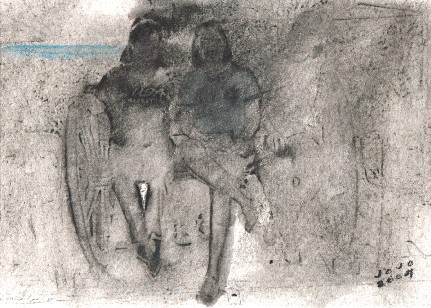
Looking Out to Sea (Her European Grey Shirt)
line photograph, watercolor pencils, at ink wash sa watercolor paper, 2004
Jojo de Veyra
Hunyo 23, 2004
Lungsod ng Takloban.
Mahal kong Miguel. Kahapon ay may natapos akong piyesa, isang line photograph itong naka-print sa watercolor paper, na ni-retouch ko ng itim at abuhin at puting watercolor pencils, tapos ni-rub ng eraser at daliri, tapos winash-over ng itim na tinta.
Nakapaloob sa komposisyon ang tatlong babaeng nakaupo sa isang upuang me gulong ng kalesa sa gilid. Ang pangatlong babae sa kanan ay halos kumpletong rubbed out. May isa pang pigura na nakatayo sa likod ng tatlong babae, at ito'y may dalang tila bouquet ng mga bulaklak o di kaya isang toddler na bata.
Pinamagatan ko ang digital art piece kong ito ng "European Grey Shirt" upang tumukoy sa kontekstong nakita ko sa pagtabi o juxtaposition ng upuang-gulong-kalesa na inuupuan ng girl subjects (mayaman sa pangkasaysayang Filipinong mga ibig sabihin) at ng mga t-shirts ng dalawang babae (buntis ito ng mas bagong mga pangkasaysayan o panglipunang mga konteksto = globalisasyon, halimbawa).
Ito ba'y isang pro- o contra-globalisasyon na art piece? Di ko alam. Ang alam ko lang ay di ko hinangad na gumawa ng isa pang virtuoso drawing-action na uri ng piyesa. Imbis na mag-drowing ay ginamit ko na lamang ang potograpiyang ito na nakita ko at minanipula upang makabuo ng dalawang pangunahing pigura sa isang portreyt. Hi-nighlight ko sila ng itim na watercolor pencil, ng retouching, ng reworking, tapos dine-highlight ng rubbing. Tapos inismudge ko ang ibang bahagi ng "drawing" area, kahit ang sirain ko pa ang papel ng kaunti sa pag-scrape at pag-wash na ginawa ko. At kahit pa ang line photograph na prinint sa watercolor paper ay nagmistulang isang ink work, nakuha pa rin nitong magaya ang epekto ng ulan sa isang lumang black and white na potograpiya. Inisip ko na dinala ng epektong ito ang buong view ng larawan sa isang huwad o faux na historical level.
Ang obsession ko ngayon sa itim na buhok (tingnan ang iba ko pang mga bagong pastel na drowing) ay narito rin. Pagmasdan ang babaeng may suot na USA-shirt -- ang kanyang itim na buhok ay fomoforeground sa itim na shirt ng nakatayong pigura sa likod niya.
At dun naman sa malabong baby, mmm . . . puwede itong tumayo bilang simbolo ng bagong henerasyon, kung nagtagumpay man ako rito sa pag-portrey ng isang henerasyon ng kasalukuyan, isang henerasyong nakaupo ngayon sa isang upuang nagmula sa isang nagdaang panahon, itong lahat sa pamamagitan ng emulasyong ginawa ko sa faux effect ng naulanang potograpiya.
At maaari bang ang nakatayong pigura ay lumabas din ditong simbolo ng isang taong tutulak pasulong sa gulong-ng-kalesang upuan? Kaya masasabi marahil nating ang piyesa'y naging depiksyon ("portreyt") din ng ating mga popular na ideya ng kaunlaran o progreso!
At bakit ko ba in-abstract ang mga mukha? -- itatanong mo naman ngayon. Well, Miguel, iyon ay dahil hindi ito maaaring maging portreyt ng mga taong nasa potograpiya. Ito'y isang portreyt ng isang henerasyon, isang pagpoportrey na drinamatays ng mabuti ng potograpiya na mismo, nang di sinasadya siyempre.
Teka. Paumanhin. Gawin nating ang pamagat ay maging "Her European Gray Shirt", na sa palagay ko'y mag-i-individualize sa Europeanization sa isang tao (upang i-defocus ang Americanization na nasa isang babae): sa ganito, ililimita ang lahat sa pagtukoy sa babaeng nakasuot ng Adidas na shirt lamang, isang paglimitang gayunpaman ay sa kahulihuliang epekto nito'y magtutulak din sa ating tumingin pa, tumingin sa indibidwalidad ng iba (sa isa pang babae at ng kaniyang "USA" shirt), lahat kaugnay ng mga isyung pandaigdig, mga isyung sa kahulihuliha'y naging atin na rin.Papa
June 23, 2004
Tacloban City.
Dear Miguel. Yesterday I finished a piece, a line photograph printed on watercolor paper, retouched with black and gray and white watercolor pencils, rubbed by eraser and finger, then washed over.
It features three girls sitting on a calesa-wheels chair, the third girl almost rubbed out. Another figure stands behind the three, carrying what may be a bouquet of flowers or a toddler baby.
I call this digital art piece "European Grey Shirt" to point to the context I saw in the juxtaposition involving the calesa chair the girl subjects were sitting on (rich in Filipino historical meaning) and the shirts two of the girls were wearing (pregnant with more recent historical contexts = globalization, for one).
Is this a pro- or contra-globalization art piece? I don't know. All I know is that I didn't want to produce another virtuoso's drawing-action kind of piece. So instead of drawing I just used this photograph I saw and then worked to create two leading figures for a portrait, highlighting them with black watercolor pencil, retouching, reworking, de-highlighting them by rubbing, and then I smudged the rest of the "drawing" area, even ruining the paper a bit through the scraping and the washing. And though the line photograph printed on the watercolor paper now looked like an ink work, still it seems to mimic the effect of rain that washed over an old black and white photograph. I thought this carries the whole picture view into a faux historical level.
My obsession with black hair (see my new pastel drawings) is here too. Notice the girl wearing the USA-shirt, whose black hair foregrounds the black shirt of the standing figure behind her.
As for the vague baby, well . . . that could stand as a symbol for the future generation, if I succeeded in portraying a present generation sitting on a chair from the past, this via the emulation of a faux rained-on-photograph effect.
And might the standing figure also come out as pushing the calesa wheel-chair forward? So that the piece might in this light become a depiction ("portrait") likewise of our popular ideas of progress!
Why did I abstract the faces? -- you now ask. Well, Miguel, that's because this cannot be a portrait of the people in the photograph. It is a portrait of a generation, already dramatized well by the photograph itself, unintentionally of course.
Sorry, make the title "Her European Gray Shirt", which I think individualizes the Europeanization on a person (defocusing the Americanization on the other girl), limiting the view to the Adidas shirt-wearing girl, but in effect perhaps making us look further, at others' individualities (the other girl's with her "USA" shirt) in relation to global issues, issues that have ultimately become ours.Papa
Karapatang-ari © 2004 Vicente-Ignacio de Veyra. Reserbado lahat ng karapatan. Ang mga mambabasa/browsers ay maaaring tumingin, mag- save, mag- file at mag- print out ng tig-iisang kopya ng mga webpages sa website na ito, kasama ang mga artwork images na nakapaloob sa nasabing pages, para sa kanilang personal na gamit lamang. Walang reproduksyon, display, maramihang pagkopya, transmission, o distribusyon ng mga webpages na ito't ang indibidwal na mga artwork images na nakapaloob rito, o anumang bahagi, adaptation, abridgment o pagsalin ng mga textual o artwork na laman ng mga ito, ang maaaring gawin nang walang kasulatang pahintulot mula sa artist. Ang sinumang persona na gagawa ng anumang di-awtorisadong aksyon kaugnay sa mga trabahong ito ang liyable sa prosekusyong kriminal at civil claims for damages.
(Copyright © 2004 Vicente-Ignacio de Veyra. All rights reserved. Readers/browsers are welcome to view, save, file and print out single copies of the webpages in this website, inclusive of the artwork images contained therein, for their personal use only. No reproduction, display, multiple copy, transmission, or distribution of the webpages and the individual artwork images contained therein, or any excerpt, adaptation, abridgment or translation of the textual or artwork content herein, may be made without written permission from the artist. Any person who does any unauthorized act in relation to these works will be liable to criminal prosecution and civil claims for damages.)
BALIK
SA INDEX NG MGA BAGONG PORTREYT
(BACK TO NEW PORTRAIT WORKS INDEX)