
SOLD
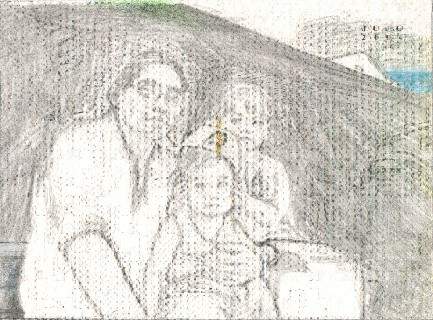
Ribbon sa Puting Barong Tagalog ni Miguel
[Ribbon on Miguel's White Barong Tagalog]
line photograph, graphite, at watercolor pencil sa watercolor paper, 2004
Jojo de Veyra
Hunyo 24, 2004
Lungsod ng Takluban.
Kahapon, Gabo, sinimulan ko at natapos ang isang portreyt natin ni Miguel na nasa upuan sa park. Bilang isang digital art na portreyt, masasabi mong tinapos na 'to para sa akin ng line photograph mismo na ni-retouch ko na lamang ng graphite. Ngunit hindi lang simpleng retouching ang ginawa rito. Diyata't ang graphite ang gumawa nung upuan sa park na wala ro'n sa litrato, at ito rin ang gumawa nung burol sa background. Tapos, gumawa naman ng dagat at pahiwatig na damo ang mga watercolor pencils.
Pero, okey, talakayin natin ang retouching bilang tracing. Ano ang kabuluhan nito bilang isang pahayag, kung hindi natin ito ituturing na isang kahihiyan?
Una, gusto kong itanong kung ang pag-drowing ba sa ating panahon ngayon (ng mga computer-tweaked na potograpiya na nakakagaya ng mga sketch) ay mahalaga pa rin labas sa on-the-spot virtuoso-in-action na value nito? Hindi nga ba't napakadaling magsuspetsa sa mga reyalista at kahit man mga ekspresyonistang pintor ngayon bilang mga artisanong gumagamit ng overhead projectors sa kanilang mga studios upang gawin ang kanilang mga sketches sa luna? Ito, sa konsiderasyong may mga muralista nga noong araw pa na gumagawa ng butas sa papel na kanilang pinag-sketchan upang mapadali ang kanilang pagpinta sa mga plaster sa dingding. At wala pa akong sinasabi tungkol sa camera obscura na tinalakay ang dating gamit nito ni Ginoong David Hockney ng Britanya.
Tunay na ang art ay nangyayari na sa isang konsepto, bago pa man ang craft, kung major man ang ginagampanan ng craft. Ilang porsyento ba ang inuukopa ng craft sa sining ng collage, halimbawa, o sa abstract expressionism o installation art?
Ngunit ang pag-retouch ng mga potograpiya ay makakagawa ng isang sining mula sa akto ng pag-retouch mismo, sa pagsunod lamang sa basic tenet ng art-making na may pagyakap sa mga desisyon ng pagsama at di-pagsama ng mga elemento. Sa kaso ng Ribbon, ang pag-retouch ng isang potograpiya, tulad ng collage, ay di-nagsasama sa pangangailangang mag-drowing. Tapos, nagdesisyon din akong palambutin ang lahat sa di-pagsama sa dilim ng dating itim ng nagigitnang shirt sa pamamagitan ng option na outline sketch, gayundin sa pagdesisyon kong gumamit ng graphite imbis na charcoal. Ang retouching sa piyesang ito ay nagpasya ring burahin ang photograph look ng print, at pinalitan ito ng isang sketch look sa pamamagitan ng graphite, at ang epekto nito'y ang alisin ang accuracy o exactness ng isang potograpiya upang mapalitan ng mala-sketch na kalabuan o pagkamailap (na sadya pang ginawang mas mailap ng mga pattern ng watercolor paper) -- ang malabong "ribbon" sa pamagat ay nagpapahiwatig na sa pagkamailap na ito.
Ngayon, ano pa ang pinapahayag ng lahat ng ito sa isang mas mataas na lebel? Una, ang nauna nang hakbang sa pagbago sa litrato upang maging isang line photo na lamang ay isa nang pagbubunyag ng isang mekanikal na proseso. Ito nama'y magtatanong din ng isang patagilid na tanong, kung ang drowing ba mismo'y isa ring mekanikal na proseso. Sapat ang pagtulak ng Amerikanong si Chuck Close ng mekanikal na pagdrowing sa kanyang mga higanteng portreyt, gamit ang grid at ang kanyang tipong mathematical na pointillism. Ang mekanikal kong proseso sa Ribbon ay tumulak ng isa pang isyu, sa akto ng pag-print nito na nakabuo -- nang walang paggamit ng isang Chuck Close na grid -- ng mga vertical na patterns sa papel nung tumakbo ito sa printer roller. Ang isa pang mekanikal na proseso ay nangyari sa graphite tracing kung saan kinailangan kong gumamit ng magnifying lens upang mai-apply ang graphite sa bawat tuldok ng tinta sa naka-emboss na mga vertical patterns. Tulad ng tradisyonal na pag-drowing, malaki rin -- marahil mas malaki -- ang ginampanan dito ng paglimot muna sa buong larawan at pag-focus muna sa mga formal na anino't mga tuldok.
Subalit, . . . sa likod nitong mga prosesong mekanikal, tulad ng prosesong mekanikal ng tradisyonal na pag-drowing, makikita natin ang ginagampanan ng puso. Ang pagpili ng subjects, halimbawa. Hindi nga ba't ito'y isang self-portrait at kasama ko ang aking mga anak sa komposisyon? Bahagi ng puso ang gumawa nung upuan sa park upang makabuo ng isang quality-time mood. Bahagi ng puso (at konting katamaran?) ang nag-udyok sa akin na burahin ang lahat na nasa background ng litrato, at gawin na lamang itong isang abstract na puwang upang makapagbigay ng pribasiya sa tatlo. Bahagi ng puso ang naglagay ng isang halatang-halatang dagat sa kanang itaas ng larawan at nagbigay niyaring dampi ng kulay berde sa puwang ng "burol".
Ngunit nasaan ang paghihirap ng kamay bilang pagpapakita ng pagmamahal sa subject na "dinodrowing"? Dito papasok ang aking corollary na mga tanong: kung ang paghihirap ba ay sukatan ng tindi ng pagmamahal, kung ang "shortcuts" ba (tulad ng sa sining ng collage) ay nakababawas ng pagmamahal sa subject, at kung ang tracing ba (o anumang cheating sa pag-drowing) ay hindi nakababawas sa megalomania na nasa bawat "self-portraitist".
Ang mailap at impressionistic na look ng buong piyesa ay maaari ring masabi nating responsable sa pagbawas ng megalomania sa nag-co-congratulate sa sariling virtuoso. Isang paglipat ng focus ang nangyayari: ang isang nagmamasid ay di na nagtatanong "paano ba narating ng artist ang drowing?" at nagsisimulang magtanong ng mga tanong na tulad ng "ang nakatayong bata ba ay nasa akto ng pagtatakip ng mga mata ng mas maliit na bata?"
Ang tabinging sumbrero ng nakaupong batang ito sa harap ang tila may sagot sa lahat ng tanong sa itaas. Ang sayang dulot ng pagmamahal sa mga subjects ng drowing ay hindi nasa proseso ng pag-drowing sa kanila, ito'y nasa end-drawing. Hindi ito nasa artistic na pagsalsal, ito'y nasa mga portreyt ng mga taong nakapalibot sa portreyt ng sarili, sa kanilang pagiging mailap bilang mga biswal na imahe.
Gayunpaman, hindi rin ba ako dumaan sa isang prosesong bagamat sarili ko ay nagdulot din sa akin ng kasiyahan? Hindi sing-nakakapagod, totoo, ngunit mentally taxing! Kaya proseso ring hindi mas mababa ang pagmamalaki! Kahit ang mekanikal kong pirma rito ay may astang pagmamalaki. Samakatuwid, maaari kang magtanong ngayon dito kung ako nga ba'y naniniwala sa mga pahayag ng dinaanan nating talata ko sa taas.Papa
June 24, 2004
Tacloban City.
Yesterday, Gabo, I started and finished a portrait of you, Miguel, and myself, together in a park bench. As a digital art portrait, you could say it was finished for me by the line photograph itself which I only retouched with graphite. But there was more than simple retouching here. After all, it was the graphite that created the park bench that wasn't in the photo, created the hill in the background. Then watercolor pencils created a sea and a grass hint.
But, okay, let's tackle the retouching as an act of tracing. How significant is this as a statement, if it is not to be accepted as a simple embarrassment.
For one, I wanted to ask the question as to whether drawing in this day and age of computer-tweaked photography able to mimic sketches is still relevant beyond the on-the-spot virtuoso-in-action value. After all, it is easy to suspect realist and even expressionist painters today of using the overhead projector to do their canvas sketches. This, considering that muralists of long ago already punched tiny holes on the paper they made their sketches on to facilitate painting on the plaster walls. And I haven't even mentioned yet the camera obscura's use in the past that has been amply discussed by the controversial painter David Hockney of Britain.
True, art already happens in a concept, before the craft, if the craft part was even major. What percentage does craft occupy in the art of collage, for example, or in abstract expressionism or installation art?
But retouching photographs can make art out of the very act, simply by referencing the basic tenet of art-making to do with decisions of inclusion and exclusion. In Ribbon's case, retouching a photograph, like collage, excludes the necessity of drawing. Then, I also decided to soften things by removing the blackness of the central shirt via an outline sketch option, likewise by deciding on graphite instead of charcoal. The retouching in this piece also erased the photograph look, replacing it with the sketch look via the graphite, in effect excluding the accuracy of a photograph, replacing it with a sketch's vagueness or elusivity (made even more elusive by the patterns of the watercolor paper) -- the vague "ribbon" in the title hints at this elusivity.
Well, what else does all this signify, on a higher plane perhaps? Already, the first step of tweaking the photo to become a mere line photo signaled a mechanical process. In turn asking the elliptical question whether drawing itself is not a mechanical process. Chuck Close amply pushed the mechanical in his gigantic portraits, using the grid and his type of mathematical pointillism. My mechanical process in Ribbon moved a step further with the printing act which created, in lieu of a Closean grid, the vertical patterns of the paper as it ran through the printer roller. The next mechanical process happened in the graphite tracing wherein I had to use a magnifying lens to be able to apply the graphite on each ink dot within the embossed vertical patterns. Like traditional drawing, this too involved to a larger extent the necessity of forgetting the bigger picture of the object, focusing on its formal shadows and dots.
Yet through all this mechanical processes, as with traditional drawing's own mechanical processes, one can find a heart part. The choice of subjects, for one. This is after all a self-portrait including my sons in the composition. It was the heart part that created the park bench to create in turn the quality-time mood. It was a heart part (and a bit of laziness?) that prompted me to erase everything in the background, turn this background into an abstract plane, to create that privacy among the three. It was a heart part that put an obvious sea at the top right of the picture and gave that green touch on the "hill" plane.
But what about the labor factor as a demonstration of love for the subject? Herein comes the corollary questions as to whether labor is synonymous to love, whether shortcuts (like collage art's) decrease the love, whether tracing (or cheating the drawing) decreases in fact the megalomania in the "self-portraitist".
The elusive, impressionistic look of the whole piece may also be responsible for lessening the megalomania of the virtuoso's self-congratulation. A focal shift happens: a spectator ceases to ask "how did the artist achieve the drawing?" and begins to ask questions like "is the standing child supposed to be in the act of covering the eyes of the toddler child?"
The sitting kid's askew cap says it all. The joy of love for one's subjects is not in the process of drawing them, it is in the end-drawing. It is not in artistic masturbation, it is in the portraits of those beside oneself in a self-portrait, in their elusivity.
Then again, didn't I just go through a process of my own and find joy therein? Less laborious, yes, but mentally taxing! So a process no less proud! Even the mechanical signature looks proud. Therefore, you might here begin to ask if I really believe the statements of that preceding paragraph.Papa