 "Our Lives, Our Fortunes, Our Sacred Honor"
How many of you can recognize what to me is the greatest exit line in history?
Every year it amazes me how many don't even know WHAT it is that we celebrate this day. And the fact that it seems to be a growing number every year. Where has the teaching of history in our schools gone?
Well, OK, I know where it's gone... but that's a whole 'nuther sermon.
I watched in amazement the other day as someone with a microphone & a camera in the streets of New York City asked the simple question... "What do we celebrate on the 4th of July?"
Answers ranged from the close-but-no-cigar, "Revolution"... to "discovering America" (guess that clown never heard of "Columbus Day" - Oh, nevermind, he was an evil European white guy & oppressor)... to " The Bill of Rights"... to the utterly ridiculous.
A conservative guess would be that fully 75% of those asked got it wrong, and I'm being generous and giving credit to those that said "American Independence" or "independence from England" (two responses were "France" & "Europe" - believe it or not).
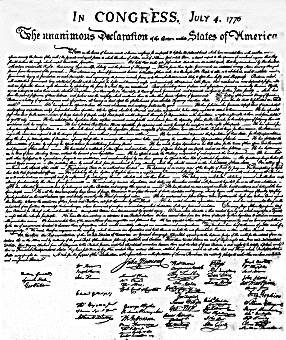
Only about 10% got the true correct answer... The signing of the Declaration of Independence.
Although, technically, it is the day of the adoption of the Declaration... the day the document was voted on.
Though the resolution was formally adopted July 4, it was not until July 8 that two of the states authorized their delegates to sign, and it was not until August 2 that the signers met in Philadelphia (the original national capital - not Washington) to actually put their names to the Declaration.
{It wasn't until May 15, 1800, Congress having adjourned, then President John Adams directed his Cabinet so to arrange their departmental affairs "that the public offices may be opened in the city of Washington... by the 15th of June." This was done, and Philadelphia ceased to be the seat of national government on June 11, 1800.}
One answer would have been truly amusing if it wasn't so sad and ominous... from a "law student" no less... "The signing of the Constitution" .
That folks, is likely a future president of the ACLU.
There's an ignorant fool who will no doubt be arguing Constitutional Law in the future without ever having READ the actual document.
Some say ignorance is bliss... I'd say it's dangerous.
There's a saying... "Those who choose to ignore history are doomed to repeat it."
Truer words were never spoken. Far too many pointy-headed elitist intellectual pinheads would have us go back to being subservient... not to England mind you... but worse... to the United Nations. An organization about which I could make the argument that it's likely the most corrupt institution on the planet... as we are learning in the wake of "Oil for Food".
As a side note I found it fitting that at the "Live 8" concerts, an event designed to raise money to give to Africa -- which ends up in the hands of corruppt African dictators and feeds damn few -- that they had the UN's Kofi Annan appear on stage.
When raising cash for the corrupt I guess you should have the guru of corruption make a curtain call.
Like I said... Ignorance is dangerous not bliss... but, of course, Bob Geldof & rest of the lot think they are actually DOING something for hunger in Africa.
Folks... in the last 30 years we've given enough money to Africa to feed every person on the continent for 30 years 5 times over... you do the math & tell me where that money is really going?
Want to bet it's similar to where the "Oil for Food" cash went? I'll even give you odds.
But I digress...
We fought a war for our National Sovereignty... why in Hades would we want to surrender it?
Of course this is fueled by the "Old Guard" of Western Europe... most notably the French & Germans. Petty jealousy maybe?
In a mere 200 years (a blink of an eye in historical terms) we have surpassed every other nation on this pebble we call planet Earth by any way you want to measure it. Make no mistake about it folks... we ARE the most powerful nation on the planet... and there are those, even in this own country, who would have us surrender that position and take orders from not only those who want our power and influence... but also those who would see us destroyed.
Of course I'm talking about our leading pathetic apologists currently lead by the Michael Moore & Ward Churchill crowds.
This lot thinks you can "gain understanding" and "get along" with those who are bent on nothing but your ultimate destruction... like radical Islam and its terrorists are today.
To that lot I say to dig up Neville Chamberlain & Joseph Stalin & ask them how well "getting along" with Hitler worked out.
Like Hitler had no interest in "getting along" with Jews... Militant Islamic fascists have no interest in "getting along" with us... it's history repeating itself folks.
To the Islamo-fascists you are an "infidel" and are worth nothing more than a bullet in the head... or shrapnel from the bomb blast as the case may be. And it doesn't matter to them that you would never be a "threat" to them in any way, shape, or form... you should die.
Unlike idiots like Ward Churchill, Michael Moore, Barbara Streisand, Sean Penn, Rosie O'Donnell & most of the mainstream media, I refuse to apologize for America, or feel guilty about being an American.
It's more important than ever these days to remember what kind of sacrifice was laid down to form this nation and there is no better day to do just that than today, to recall just who WERE those men who risked it all...
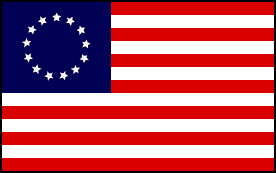
The
Betsy Ross Flag
Since there was no official flag
during the first year of the United States, there were a great number
of homespun flag designs. This flag is without question the most well
known of those. Although it is not, this flag is confused with the first
official U.S. flag |
Ben Franklin was one of only three really old men. Eighteen were under 40, three were in their 20s. Of the 56, almost half--24--were judges and lawyers. Eleven were merchants, 9 were land-owners and farmers, and the remaining 12 were doctors, ministers, and politicians.
With only a few exceptions, such as Samuel Adams of Massachusetts, these were men of substantial property. All but two had families. The vast majority were men of education and standing in their communities. They had economic security as few men had in the 18th century.
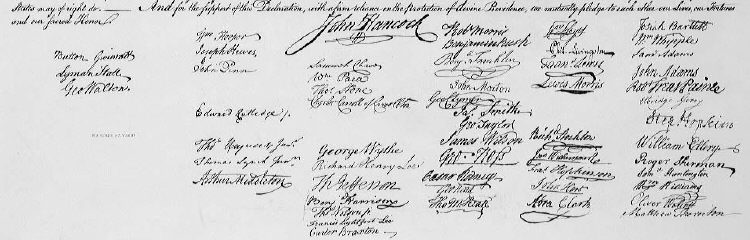
Each had more to lose from revolution than he had to gain by it. John Hancock, one of the richest men in America, already had a price of 500 pounds on his head. He signed in enormous letter so "that his Majesty could now read his name without glasses and could now double the reward."
Ben Franklin wryly noted: "Indeed we must all hang together, otherwise we shall most assuredly hang separately."
Fat Benjamin Harrison of Virginia told tiny Elbridge Gerry of Massachusetts: "With me it will all be over in a minute, but you, you will be dancing on air an hour after I am gone."
These men knew what they risked. The penalty for treason was death by hanging. And remember: a great British fleet was already at anchor in New York Harbor.
They were sober men. There were no dreamy-eyed intellectuals or draft card burners here. They were far from hot-eyed fanatics, yammering for an explosion. They simply asked for the status quo. It was change they resisted. It was equality with the mother country they desired. It was taxation with representation they sought. They were all conservatives, yet they rebelled.
It was principle, not property, that had brought these men to Philadelphia. Two of them became presidents of the United States. Seven of them became state governors. One died in office as vice president of the United States. Several would go on to be U.S. Senators. One, the richest man in America, in 1828 helped establish the Baltimore and Ohio Railroad. One, a delegate from Philadelphia, was the only real poet, musician and philosopher of the signers (it was he, Francis Hopkinson--not Betsy Ross--who designed the United States flag).
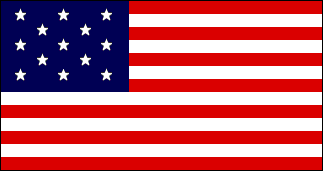
The
First Official United States Flag
This 13-Star
Flag became the Official United States Flag on June14th, 1777 and is the
result of the congressional action that took place on that date. Much evidence
exists pointing to Congressman Francis Hopkinson as the person responsible
for its design.The only President to serve under this flag was George Washington
(1789-1797). This Flag was to last for a period of 18 years.
Each star and stripe represented a Colony of which there were thirteen, united nearly one year earlier by the Declaration of Independence. |
William Ellery, delegate from Rhode Island, was curious to see the signers' faces as they committed this supreme act of personal courage. He saw some men sign quickly, "but in no face was he able to discern real fear." Stephen Hopkins, Ellery's colleague from Rhode Island, was a man past 60. As he signed with a shaking pen, he declared: "My hand trembles, but my heart does not."
They signed and they pledged their lives, their fortunes, and their sacred honor.
Carter Braxton of Virginia, a wealthy planter and trader, saw his ships swept from the seas by the British navy. He sold his home and properties to pay his debts, and died in rags.
Thomas McKeam was so hounded by the British that he was forced to move his family almost constantly. He served in the Congress without pay, and his family was kept in hiding. His possessions were taken from him, and poverty was his reward.
John Morton, a Tory in his views previous to the debate, lived in a strongly loyalist area of Pennsylvania. When he came out for independence, most of his neighbors and even some of his relatives ostracized him. He was a sensitive and troubled man, and many believed this action killed him. When he died in 1777, his last words to his tormentors were: "Tell them that they will live to see the hour when they shall acknowledge it [the signing] to have been the most glorious service that I rendered to my country."
Vandals or soldiers or both, looted the properties of William Ellery, Lyman Hall, George Walton, & Button Gwinnett,
Robert Morris, merchant prince of Philadelphia, delegate and signer, met Washington's appeals and pleas for money year after year. He made and raised arms and provisions which made it possible for Washington to cross the Delaware at Trenton. In the process he lost 150 ships at sea, bleeding his own fortune and credit almost dry.
George Clymer, Pennsylvania signer, escaped with his family from their home, but their property was completely destroyed by the British in the Germantown and Brandywine campaigns.
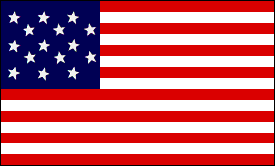
The Star Spangled Banner
This Flag became
the Official United States Flag on May 1st,1795. Two stripes and two stars
were added for the admission of Vermont (the 14th State on March 4th, 1791)
and Kentucky (the 15th State on June 1st, 1792, and was to last for 23
years.
The 15-star, 15-stripe flag was authorized by the Flag Act of January 13, 1794, adding 2 stripes and 2 Stars. The regulation went into effect on May 1, 1795. This flag was the only U.S. Flag to have more than 13 stripes. It was immortalized by Francis Scott Key during the bombardment of Fort McHenry, Sept 13, 1814. The image above is representative of the actual flag that flew over Fort McHenry on that day and which is now preserved in the Smithsonian Museum. You can notice the "tilt" in some of the stars just as in the original Star Spangled Banner. |
Edward Rutledge, Arthur Middleton, and Thomas Heyward, Jr., the other three South Carolina signers, were taken by the British in the siege of Charleston. They were carried as prisoners of war to St. Augustine, Florida, where they were singled out for indignities. They were exchanged at the end of the war, the British in the meantime having completely devastated their large land holdings and estates
At the Battle of Yorktown, fire from 70 heavy American guns began to destroy Yorktown piece by piece. Thomas Nelson Jr., noted that the British General Cornwallis, had taken over the Nelson home for his headquarters. The owner quietly urged General George Washington to open fire, which was done. The home was destroyed, smashing it to bits. But Nelson's sacrifice was not quite over. He had raised $2 million for the Revolutionary cause by pledging his own estates. When the loans came due, a newer peacetime Congress refused to honor them, and Nelson's property was forfeited. He was never reimbursed. He died, impoverished, a few years later at the age of 50.
Francis Lewis, New York delegate, saw his home plundered and his estates, in what is now Harlem, completely destroyed by British soldiers. Mrs. Lewis was captured and treated with great brutality. Though she was later exchanged for two British prisoners through the efforts of Congress, she died from the effects of her abuse.
William Floyd, another New York delegate, was able to escape with his wife and children across Long Island Sound to Connecticut, where they lived as refugees without income for seven years. When they came home, they found a devastated ruin.
Phillip Livingston had all his great holdings in New York confiscated and his family driven out of their home. Livingston died in 1778 still working in Congress for the cause.
Louis Morris, the fourth New York delegate, saw all his timber, crops, and livestock taken. For seven years he was barred from his home and family.
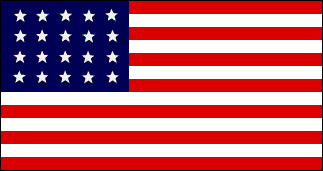
The
1818 20 Star Flag
Realizing
that the addition of a new star and new stripe for each new State was impractical,
Congress passed the Flag Act of 1818 which returned the flag design to 13
stripes and specified 20 stars for the 20 states.
This Flag became the Official United States Flag on April 13th, 1818. Five stars were added for the admission of Tennessee (the 16th State on June 1st, 1796), Ohio (the 17th State on March 1st, 1803), Louisiana (the 18th State on April 30th, 1812), Indiana (the 19th State on December 11th, 1816), and Mississippi (the 20th State on December 10, 1817), and was to last for just one year. The only President to serve under this flag was James Monroe (1817-1825). |
|
More US Flag
history at:
USflag.org
|
John Hart of Trenton, New Jersey, risked his life to return home to see his dying wife. Hessian soldiers rode after him, and he escaped in the woods. While his wife lay on her deathbed, the soldiers ruined his farm and wrecked his Homestead. Hart, 65, slept in caves and woods as he was hunted across the countryside. When at long last, emaciated by hardship, he was able to sneak home, he found his wife had already been buried, and his 13 children taken away. He never saw them again. He died a broken man in 1779, without ever finding his family.
Dr. John Witherspoon, signer, was president of the College of New Jersey, later called Princeton. The British occupied the town of Princeton, and billeted troops in the college. They trampled and burned the finest college library in the country.
Judge Richard Stockton, another New Jersey delegate signer, had rushed back to his estate in an effort to evacuate his wife and children. The family found refuge with friends, but a sympathizer betrayed them. Judge Stockton was pulled from bed in the night and brutally beaten by the arresting soldiers. Thrown into a common jail, he was deliberately starved. Congress finally arranged for Stockton's parole, but his health was ruined. The judge was released as an invalid, when he could no longer harm the British cause. He returned home to find his estate looted and did not live to see the triumph of the revolution. His family was forced to live off charity.
And, finally, there is the New Jersey signer, Abraham Clark.
He gave two sons to the officer corps in the Revolutionary Army. They were captured and sent to the infamous British prison hulk afloat in New York harbor known as the hell ship "Jersey," where 11,000 American captives were to die. The younger Clarks were treated with a special brutality because of their father. One was put in solitary and given no food. With the end almost in sight, with the war almost won, no one could have blamed Abraham Clark for acceding to the British request when they offered him his sons' lives if he would recant and come out for the King and parliament. The utter despair in this man's heart, the anguish in his very soul, must reach out to each one of us down through over 200 years with his answer... "No"
Such were the stories and sacrifices of the American Revolution. These were not wild-eyed, rabble-rousing ruffians. There were soft-spoken men of means and education. They had security, but they valued liberty more. Standing tall, straight, and unwavering, they pledged:
"And for the support of this declaration, with a firm reliance on the protection of the Divine Providence, we mutually pledge to each other, our lives, our fortunes, and our sacred honor."
They gave us an independent America. Can we keep it?
 ....
....
..
......