| Welcome to Charles, BJ, and Malakeh's epilepsy site!! |
| Why this site is being built: We have a Science Enrichment class and have to research a disease and create a poster (or something else creative). This is the "poster" that my group is making. We are researching epilepsy and this website will contain a lot of information about the condition and other helpful information. |
| What is epilepsy? Epilepsy is a condition/brain disorder involving recurrent seizures, meaning that it is a problem with the nervous system that causes you to have seizures repeatedly. There are two categories of seizures, which will be explained later. Epilepsy affects one in about 180 Americans and about one in 200 people in the world have epilepsy. EPILEPSY IS NOT A DISEASE (it's a "condition" or "disorder", but it isn't a disease)!!! |
| Helpful links Ask Jeeves result www.cdc.gov Yahoo! Health Directory The EpiCentre www.ninds.gov www.epilepsy.org The Glass Ceiling-epilepsy section |

|
| What types of seizures are there? First off, there are two different types of seizures: partial and generalized. In these two categories, there are even more different types of seizures. In all, there are over 30 different types of seizures, all with different severities, from the harmless, unnoticable one to the one that makes you go unconscious and then make it look like you went crazy because you were throttling yourself. |
| What is there to know about partial seizures? Well, there are two types of partial seizures: simple partial seizures and complex partial seizures. Also, partial seizures are less severe than generalized seizures. A simple partial seizure is when the epileptic activity in one part of the brain (most likely damaged) doesn't interfere with consciousness, causing the part of the body that that part of the brain controls to either go limp or start jerking. Complex partial seizures occur when the person partially loses consciousness or their consciousness is impaired, and they do strange and random things, such as turning their head, mumbling, walking around randomly, and pulling at their clothing. Later, they usually can't remember doing these random things. |
| What is a seizure? If you're too lazy to look in a dictionary, here's a definition from a dictionary: sei�zure n. A sudden attack, spasm, or convulsion, as in epilepsy or another disorder. ...meaning that seizures happen suddenly and that they are sudden, "involuntary contractions of a muscle ro group of muscles" or "the episode or onset of a disease". |
| What is there to know about generalized seizures? First of all, there are also two common types of generalized seizures, and a few other uncommon types, and they are more severe than partial seizures. Common types of generalized seizures include abscence seizures (also called "petit mal", from French meaning "little sickness") and tonic-clonic seizures (also called "grand mal", from French meaning "big sickness"). Absence seizures start to occur when a child is 5-10 years old and are not easy to find. The child will look like he/she is daydreaming when the seizure is taking place, and just stares off into space for a few seconds, and then the child will be back to normal. This can happen many times in a day and gets in the way of life. Tonic-clonic seizures are far more severe, and have two phases to them. The person might get a feeling of rising or sinking in the pit of the stomach and the person may cry out or groan before going unconscious. After losing consciousness, the person�s limbs will become stiff and rigid and breathing will stop. After the "tonic" phase, which was just described, the "clonic" phase will happen, 30-60 seconds after the person had lost consciousness and will start to shake violently. This will last for a few minutes and then that person will regain consciousness, and might be confused for a minute or two. That person might want to sellp for a few hours afterwards, and will have headaches and the muscles that had contracted during the attack will be sore for a few days after the attack. There are also other kinds of generalized seizures, and are less common. A few examples are myclonic, atonic, and tonic seizures. These are caused by injury to the brain, and during these seizures, sometimes the people won't go unconscious. These seizures are have the usual seizure effects: muscles contract, sudden motions, etc. |
| Who can get a seizure, and who can have epilepsy? Anybody can have a seizure, and anybody can have epilepsy. Epilepsy is caused by many things, the most common of which is brain damage. Other causes include genetics (epilepsy runs through some peoples' families) and sometimes, you just develop it. Other strange causes include lack of sleep and alcohol and coffee intake. |
| What is the history of epilepsy and what are some interesting facts about the condition? Epilepsy is the oldest brain problem in the world, and was discovered over 4000 years ago and is also mentioned in the Bible and ancient Greek writings. In fact, epilepsy comes from a Greek word meaning "a condition of being overcome, seized, or attacked." Surprisingly, despite the fact that it had been known about for so long, serious reasearch only started on the condition in the mid-1800s. Also, epilepsy occurs more in some cultures than others, for example, as many as 4% of the population of Tanzania has epilepsy, while only 1-2% of the people in the U.S. and Canada have epilepsy. There isn't much research done on it now, but people know enough about the condition and people who have it are living better lives. |
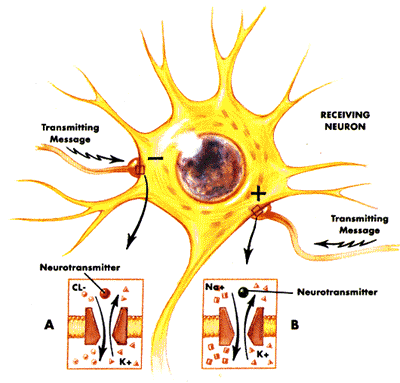 |
| Epilepsy is a neurological disorder. |
