MICROSOFT
Flight Simulator 2002
RETURN TO HOME PAGE
[email protected]
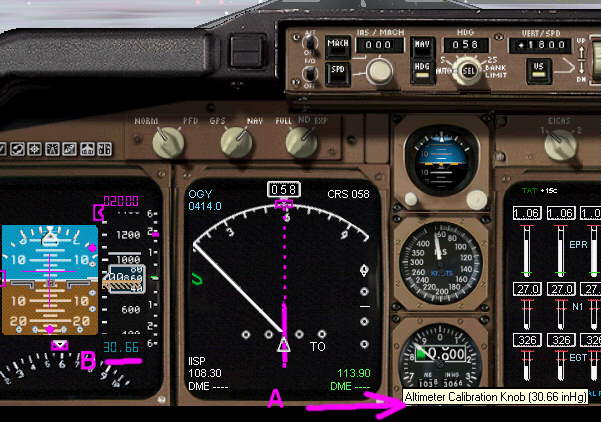
First raise the instrument panel, it seems to be cut off. See attached .jpg. The following is for the non-pilots. The "Barometric pressure set knob A" must be set at the airports pressure, that will be displayed in the Kollsman window of the standard altimeter. Doing this will change the pressure and altitude in the digital "Primary flight display B" of the Boeing 747. If the barometric pressure is not known, the field elevation could be set, and that will give you the current pressure.
The standard "Pressure altimeter" installed in an airplane is far from satisfactory as an accurate instrument for measuring height, though the information it provides is essential for aircraft control and for maintaining terrain clearance under instrument conditions. The limitations of the instrument are due primarily to the fact that its design and operation are based upon its response to conditions that rarely exist.
Notwithstanding the limitations, you can use the altimeter as a satisfactory height-measuring instrument if you understand how it responds to non-standard conditions.
Even if the conditions are standard the altimeter rarely presents you with accurate information. The misinformation due to altimeter construction and atmospheric changes must be first understood and compensated for before you could understand and altimeter. Some inherent characteristics of an altimeter are (1) Scale Error, (2) Friction Error, and (3) Hysteresis. It is also impossible for the pressure and temperature to be the same at the departing airport and the airport that you are arriving at. The pressure also changes en-route, and at different altitudes. Effects of nonstandard conditions can result in a difference of as much as 2,000 feet between true and indicted altitude. If you are flying and the pressure should drop, then you are actually flying lower then what is indicated. The saying is "If the pressure goes from high to low, then look out below", a good way to remember this. The location in the airplane of the altimeter in relationship to the ground could also create a difference of up to 30 feet, if you compare a Cessna 150 that sets 36" above ground and a MD-11 that already is elevated 25’ above ground.
It is important that you monitor the pressure as you are flying so that you can maintain a somewhat accurate reading of altitude. After understanding the components that make up an altimeter, such as the aneroid wafer, you must then understand the types of altitudes. The types of altitudes are "Pressure Altitudes", "True Altitudes", "Indicated Altitudes", and "Absolute Altitude". I hope I helped answer your question.
Gary
Aeronautical Engineer/Pilot
Boeing Defense