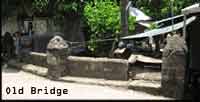
 After severe flooding from Laguna
lakewaters perenially submerged its streets and agricultural lands. Pila's
populace moved out of Pagalangan late in the 18th Century to
settle at its present site in Barangay Sta. Clara, then a part of the
hacienda owned by Don Felizardo de Rivera and his brothers. The Pagalangan
church was relocated stone by stone (remnants of the dismantled church are
still visible in present-day Victoria, a town adjacent to Pila) through
a bridge and its
transfer was eventually completed in 1803.
After severe flooding from Laguna
lakewaters perenially submerged its streets and agricultural lands. Pila's
populace moved out of Pagalangan late in the 18th Century to
settle at its present site in Barangay Sta. Clara, then a part of the
hacienda owned by Don Felizardo de Rivera and his brothers. The Pagalangan
church was relocated stone by stone (remnants of the dismantled church are
still visible in present-day Victoria, a town adjacent to Pila) through
a bridge and its
transfer was eventually completed in 1803.
The land of which the church, town
hall and plaza now stand was donated by Don Felizardo de Rivera who
consequently became widely regarded as the founder of Nueva Pila.
Pila is a small town in Laguna with a
population of about 35,000. It is an hour and a half drive or more from
Manila, depending on the traffic. What makes Pila unique from other towns
in the Philippines is that it still has the Church, Plaza and Municipal
hall intact in an aesthetic, Spanish Colonial setting. Pila is a prime
example of Spanish Colonial urban planning at the turn-of-the-century.
Pila is known
as "Bayang Pinagpala" (Blessed Town) because it was the only town in
Laguna that survived the Japanese bombings of World War II.
It is by far the most charming and beautiful town in Laguna today. The
town of Pila, has maintained it's old colonial heritage amidst the vastly
changing landscapes and rapid rush towards industralization by other
neighboring towns. It is also strategically located away from the main
highway, there's no heavy traffic going through, maintaining its peaceful
serenity. Pila is one of the best kept secrets in the Philippines, the
beauty of the town usually surprises those who see it for the first time.
Through the guidance of the Pila Historical Society, the help of the
Church and local govt. Pila has now been declared a National Landmark,
assuring its preservation for future generations
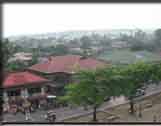
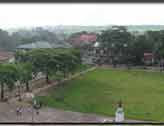
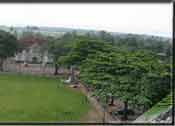
Panoramic view of Pila taken on top of the San Antonio
Parish Church
 Long
before the era of the Spanish colonization, Pila was already an important
center of culture and trade, as evidenced by findings from archaeological
excavations at Pinagbayanan where clay potteries of handsome design and
make were discovered in 1967.
Long
before the era of the Spanish colonization, Pila was already an important
center of culture and trade, as evidenced by findings from archaeological
excavations at Pinagbayanan where clay potteries of handsome design and
make were discovered in 1967.
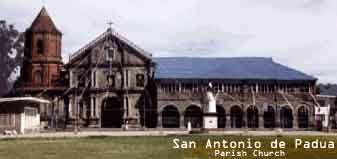 The
town of Pila first saw mention in Spanish records as early as 1575. It was
conferred the distinctive title La Noble Villa de Pila in recognition of
its peoples' refined manners and customs. Its parish church was dedicated
to its patron San Antonio de Padua on June 13, 1581, which date has since
been annually celebrated as Pila's "fiesta" day.
The
town of Pila first saw mention in Spanish records as early as 1575. It was
conferred the distinctive title La Noble Villa de Pila in recognition of
its peoples' refined manners and customs. Its parish church was dedicated
to its patron San Antonio de Padua on June 13, 1581, which date has since
been annually celebrated as Pila's "fiesta" day. 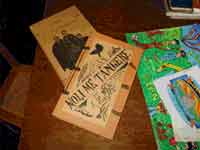 It
is noteworthy that it was in Pila that the second printing press in the
Philippines was set up by the Franciscan fathers who engaged the renowned
Tomas Pinpin to supervise its operation. As a matter of fact, it was in
this Pila printing press that the first Tagalog-Spanish dictionary was
published.
It
is noteworthy that it was in Pila that the second printing press in the
Philippines was set up by the Franciscan fathers who engaged the renowned
Tomas Pinpin to supervise its operation. As a matter of fact, it was in
this Pila printing press that the first Tagalog-Spanish dictionary was
published. 