| How to build a house in one day |
| Ok, granted, it�s not the kind of house that you are used to. In fact, it is more akin to the shed in your back yard, although a bit larger at about 400 square feet. But to many of the people in Piura, this is a home and they are thankful to have a roof over thier heads and a place to call home. Each house costs a family $315, that may be 3 months wages for a man working full time, or a year or more wages for most Piurrans who can only find temporary employment. Nearly all of that money goes into buying the materials for the house: bamboo products, corrugated aluminum and wire. The church has a crew of about six guys who build the houses. |
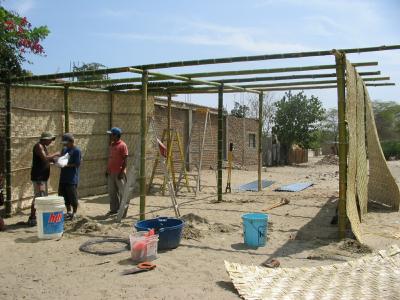 |
| Once a site is chosen, usually in one of the many large tracts of land that are set aside by the city for this type of housing, a frame of the house is built using large bamboo poles. These houses are usually built on sand or sandy dirt. They usually have to use a lot of water to wet the sand where they want to dig the holes for the posts. Building the frame takes all morning and is usually finished about lunch time. |
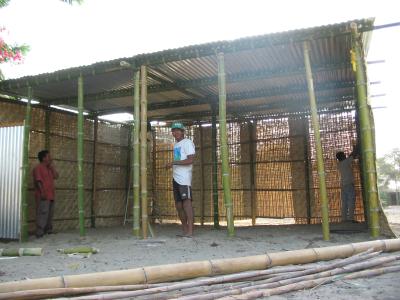 |
| Next, large sheets of woven bamboo are tied to the frame to make the exterior walls and sheets of corrugated aluminum are nailed to the top for the roof. |
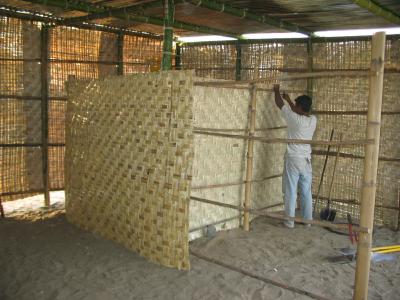 |
| Interior walls are constructed using the same materials and techniques as the exterior walls, to make two bedrooms. The rest of the house serves as the kitchen and living room. |
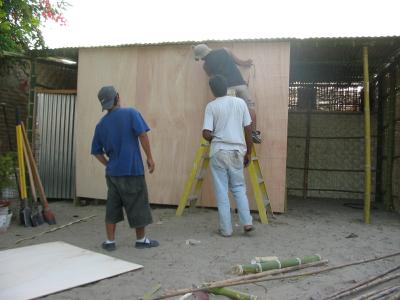 |
| The front door is installed and the front of the house is covered with plywood. |
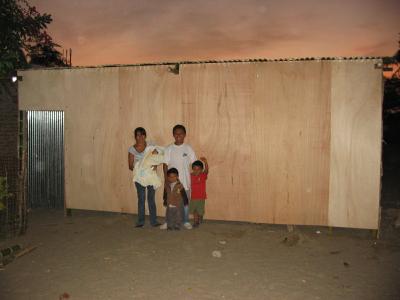 |
| And just as the sun sets, the house is completed and the family can start decoriating inside and our. It will last for about 5 years. In that time, the family might make improvments to the house, adding mud to the outside, adding more house to the back, or using bricks or tiles to create a hard floor over the sand. |
| Most of these houses still retain a sand or dirt floor. They are decorated with pictures of the family, nearly all have pictures of Jesus and Mary and other religious decorations. They usually have a dining table and chairs, beds, shelf units, a propane stove and an electric light bulb in each room. Bathroom facilities are located outside and they usually have to get their water from a city water tap in the neighborhood. All water must be boiled before it is consumed. Electricity is provided by the city and in some neighborhoods, the city pays the unemployed inhabitants to install water lines to each house. The residnets get paid about $3 a day for their work. |