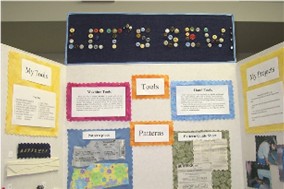
| We often receive questions as to what is expected of a project for the Fair. Much has to be left up to the individual teacher, but there are some things that are generally expected. In GENERAL terms, 3 things are usually desired: a stand-up posterboard with a title, a written paper/report, and some items to sit on the table. Examples: Bats of Pennsylvania: A posterboard naming the different kinds of bats in PA, with pictures and facts. A written paper telling more detail about bats. And sitting on the table is a bathouse (real or out of cardboard) with labels and explanation about the parts of the bathouse. Lewis and Clark: A posterboard telling who they were and what they did, perhaps with a map or a timeline. A written paper with more detail. And on the table, a salt map of the journey (labeled)... or some tools the student made that resemble Lewis and Clark's...or some items Lewis and Clark would have found on their journey....or an electronic quiz board for fair-goers to be quizzed with about Lewis and Clark...or a quiz board made of little flaps you lift up. Some fairs require that a student follow the scientific method of presentation, where the student identifies a problem, formulates a hypothesis, and conducts an experiment to test the hypothesis. Some teachers may want their student to do this type of project, which is quite fine, but our Fair does not require this kind. Written reports would vary as to the age of the child. A preschooler might write one paragraph, and put it right on their posterboard. A second grader might write a page or two, with a list of the 2 books he used for info. And then the info in that two-page report might be repeated on the posterboard. It depends--I know that my 2nd grader wrote five pages about his topic and only put some of it on the posterboard, but when he was in 3rd grade the topic of electromagnets only gave him enough info for a two page report, and so most all of his paper was repeated on the posterboard. At any rate, as the child grows older, so his paper should become more detailed. Certainly a student in 3rd grade should write down what books/resources he used. Abbreviated bibiliography form (Bartram, Brent. Wild Frontier) is fine. 7th and 8th graders should start having a more detailed and proper bibiliography (Bartram, Brent. Wild Frontier. New York: Collier, 1974.), along with having more than 1 or 2 sources of information. In grades 9-12, we EXPECT the written paper to have footnotes (or in-text citations) and a bibliography, double-spaced, following all the accepted rules of term paper writing. Length is up to the teacher. Some good resources are ABeka's Handbook of Grammar & Composition or How to Write Term Papers and Reports by L. Sue Baugh. One common resource used by high schools and colleges is the paperback MLA Handbook for Writers of Research Papers by Joseph Gibaldi. Teach the student about plagiarism: all writing should be in the student's own words. Words straight from the book (or internet) should be used sparingly, and should always tell where they came from. Try to make the project well-labeled and easy to understand. The paper is for in-depth discussion on the topic, and the posterboard is for main points. Imagine an adult explaining the display to a 2nd grade child, telling him, "Now this one is about...." Is there a title? Are there large subtitles to catch the eye, with a few important facts? What exactly IS that thing sitting on the table? In many ways, presenting a project at a fair is all about explaining what the student has learned. We are always impressed with so many of the students because they can talk and talk and tell us so many absolutely fascinating and detailed ideas about their topic! The students KNOW about their topic and can TALK about their topic. Now at the Fair, they must also explain their topic in WRITTEN and VISUAL form. |

|
| SUGGESTIONS For Your Project |
 |