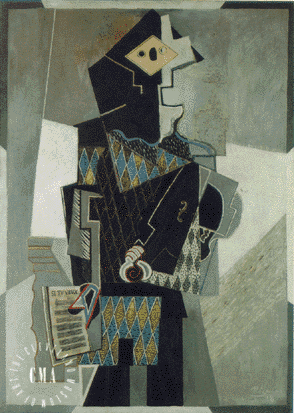
FIG. 1 Harlequin with Violin by Pablo Picasso is an example of when the brain uses bottom-up processing.
(Image from http://www.clemusart.com/museum/collect/highlights/high07.html)
| Bottom-up processing is when the brain uses its low-level information to decipher an image. It is quick and efficient because it is a method which makes assumptions about what we see, like a built in detector that tells the brain "whenever you see this, it means this; no questions asked". So, a person may be misled if they are viewing an image which can be made up in more than one way; there may be more than one way to create an image, and the brain will be fooled if it makes assumptions. |
FIG. 1 Harlequin with Violin by Pablo Picasso is an example of when the brain uses bottom-up processing. |
| An example of when the brain uses bottom-up processing is when looking at Picasso's synthetic, cubist painting entitled Harlequin with Violin (FIG. 1). To understand to image, the brain will read each geometric shape and then add all the shapes together to understand the entire image. In fact, the style of this painting is referred to as synthetic cubism (as opposed to analytical) because the image is constructed using shapes (as opposed to deconstructed into shapes) |
| Top-down processing uses high-level information to decipher the parts in an image to understand the image as a whole. Knowledge about the "big picture" help the brain analyze the details that make it up. |
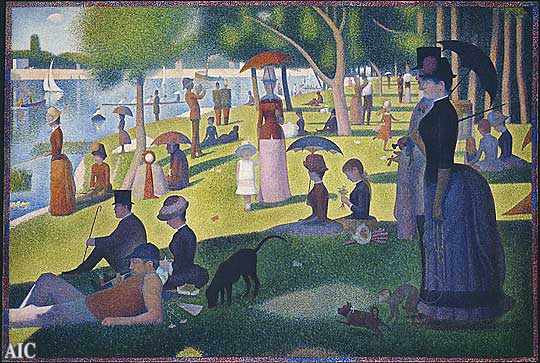 FIG. 2 A Sunday on La Grande Jatte-1884 by Georges Seurat is an example of top-down processing. |
| An example of top-down processing is the painting by Georges Seurat, done in 1884, entitled A Sunday on La Grande Jatte (FIG. 2). This is one of many paintings by Seurat in which he uses the method he developed called pointillism. The method renders the image by placing small dots of pure pigment next to each other so that the eye mixes them. The focus of Seurat's paintings where on the nature of light and colour. By understanding what the objects in the painting are (IE- A dog, a hat, the water), the brain can then understand that the colours refer to the certain object in a specific lighting situation. For example, the patches of blue grass are recognized to be shadows cast on the green grass. The brain uses top-down processing in that it understand what the image is as a whole and can therefore understand the details. The brain uses knowledge acquired from previous experiences about the nature of light and colours to understand what is being shown in Seurat's painting. |
| How colourfast a pigment is refers to how resistant to change or loss of colour it is. Light is a form of energy. Pigment will absorb light energy and convert it into heat. Through this absorption of energy, a chemical reaction may occur. The chemical reaction can break up chemical bonds so that the pigments will become bleached. |
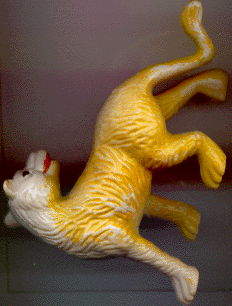 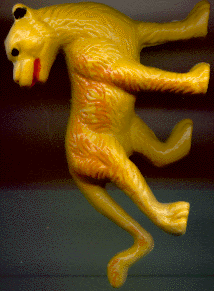 FIG. 3 Plastic statuette of cougar/hyena that is half bleached by the sun. |
| I keep a little plastic statuette of a yellow cougar (FIG. 3), or perhaps it's a hyena, on my window sill. It is a very cheaply made statuette. This is not only apparent by the fact that I cannot tell exactly the animal it is, but because the pigment used in painting it is very low quality-it is not colourfast. For less than half a year, I left it on the sill without repositioning it. The window faces south, and is thus in direct sunlight throughout most of the day. The cougar/hyena is currently half yellow and half white due to its low colourfast quality. |
| Reflection is when light bounces off a material, while refraction is when light passes through a material and changes direction. The refractive index number is calculated by dividing the speed of light in a vacuum by the speed of light through the material in question. Therefore, the higher the number the slower light will pass through the material. The amount of the change in direction of the light depends on the difference between the refractive index of the material from which the light exits and the refractive index of the material that the light enters. |
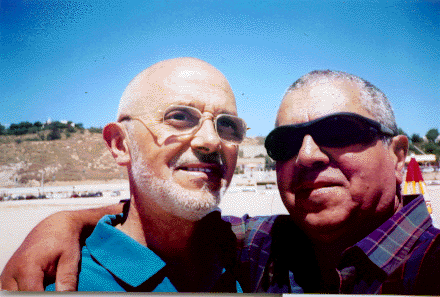 FIG. 4 Refraction through my uncle's glasses (on left) distort the light bouncing off the edge of his face. |
| My father showed me a picture (FIG. 4) of his recent vacation in Italy. The picture is of him and his brother at a beach. My uncle (his brother) wears rather thick glasses. I noticed in the picture that the portion of the edge of his face that can be seen through his glasses is not aligned with the rest of the edge of his face. This is because of refraction; the light that bounces of his face and passes through the glasses changes direction, not only because the lens is curved, but because of refraction. |
| Mirrors work because they are smooth and glossy enough to reflect most of the light, and they do so at the same angles the rays are received, keeping the rays parallel. The image in the mirror seems real because it looks very accurate, but in fact it is a virtual image-the objects in the mirror are behind the mirror and not on its surface. |
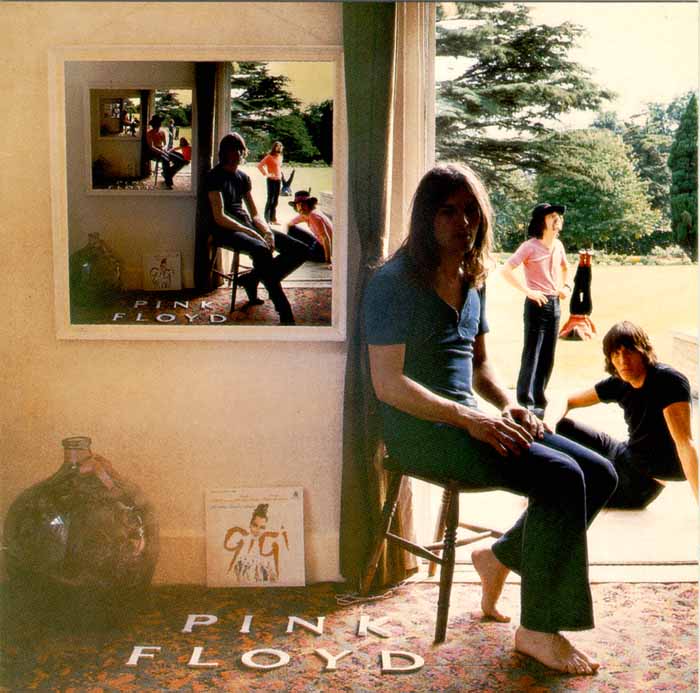 FIG. 5 For the album cover of Ummagumma, Pink Floyd plays with the reality inside a mirror. |
| Pink Floyd played with the mirror as reality for the cover of their album Ummagumma (Fig. 5). Which image is the real one? Perhaps they all are. Where are the sources for each mirror's image coming from? And each mirror is inside the next. Oh, but then they are all on the same surface, that being the first mirror's surface-there is no real depth. Or is there? Perhaps the biggest image, the first one, is a mirror as well. I find this image intriguing. |
| The word specular is derivative of the Latin word speculum, which means "mirror". Specular reflection is when light reflects off a surface that is so smooth that I does not disrupt or scatter the light in different directions, but rather, keeps them parallel to each other as they were before reflecting. Therefore the image of whatever is emitting it's rays onto the smooth surface can be seen perfectly. The more matte the surface (meaning the rougher it is) the more the light is scattered, and thus, the image is less clear. You can tell if a surface is matte (rough) or glossy (smooth) by how well/clearly an image is reflected off of it. |
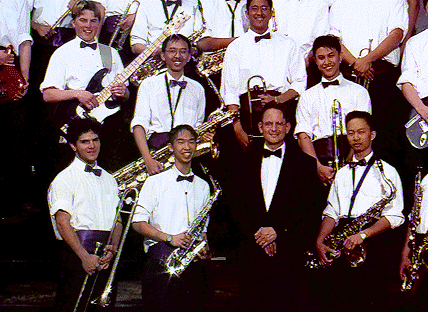 FIG. 6 Ouch! My eyes! Look at all that specular reflection! |
| I played trombone for the senior jazz band in high school. The photograph (FIG. 6) that I have of our trip to a festival in Banff is funny because of all the specular reflection in it. The light rays from the sun are reflected very well of our instruments because they are made of smooth metal, wood, or plastic, and coated with a sealant. |
| Specular reflection takes places on a smooth surface. But when the surface is rough, light bounces off of it in different directions, instead of in parallel. The surface will appear matte. One may polish a rough surface to make it glossy. By polishing the matte surface, the roughness is levelled or filled with polish so that the surface is smooth. |
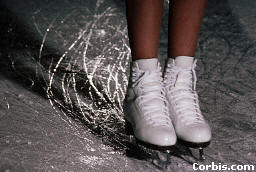 FIG. 7
The more surface is skated upon, the more matte it becomes.
|
| An ice surface is smooth until it is used. After ice skaters have cut into the ice by skating (FIG. 7), the surface becomes rough/uneven. Light then will bounce off of it in different directions. The ice will appear more matte than it was. A Zamboni polishes the ice surface-it fills the cuts in the ice and flattens it all out. After this operation the ice's surface will look shiny again. |
| We tend to perceive a specific colour under different lighting conditions as the same colour, though it may in fact be a different shade under the certain lighting condition. The colour our brain sees depends on the conditions under which we see it. |
 FIG. 8
TV's use colour bars as the standard for adjusting colour.
|
| However, the camera doesn't have this tendency to adapt its perception. As a result, filming the same object under different lighting conditions will most likely affect the colour it appears to be on film. The colour bars (FIG. 8) are thus used as a standard-the camera's colour values are adjusted to match the standard shown by the colour bars. |
| Lines that are grouped together form the different areas in an image, which can then be named the foreground and background. Deciding which area is the foreground and which is background can sometimes be a bit tricky. Usually you can force yourself to look at the situation both ways. However a few things can influence your decision about which is the foreground: [1] the smaller area is usually seen as the foreground, [2] a convex shape is usually seen as the foreground, [3] a symmetrical shape is seen as the foreground. |
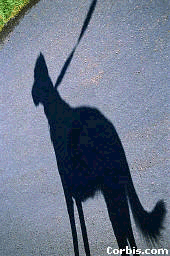 FIG. 9
Is the shadow the foreground?
|
| In this picture (FIG. 9), the shadow of the dog is smaller than the rest of the area. It's rather convex. And it's familiarity I think does help seeing it as foreground. But the interesting thing is that, conceptually, I think it's strange that I call a shadow (which is the absence of light) the foreground. |
| The visual cortex is mainly in charge of detecting the edges we see. Ganglion cells are lined up to create the line detectors (edges detectors) that make up the visual cortex. It is important that we be able to detect the edges of objects around us because, well, objects are the things are us. To distinguish between them we need to know where one ends and the other begins. |
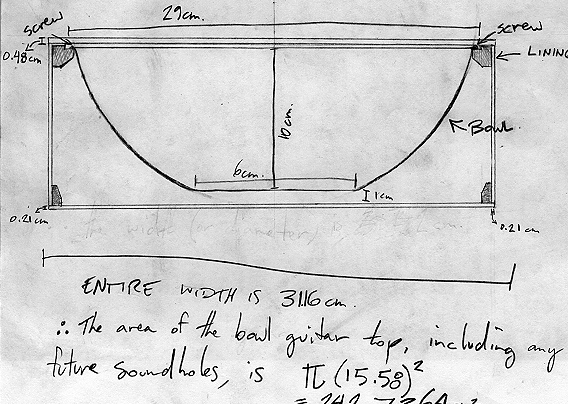 FIG. 10
In the schematic for measuring the proportions of the guitar, I used only the contour lines.
|
| This summer I was drawing plans (FIG. 10) for an acoustic guitar. In the schematics, I rendered the objects that I was measuring only in contour-line drawings. I was only interested in the edges of the guitar-where the edges began and ended. This is what the visual cortex is all about. It just needs edges to measure the objects we see around us. |
| The Law of Good Continuation is a Gestalt law that states that lines that are visually broken but that create a smooth curve overall are seen as being the same line. As with all assumptions our brain makes about visual information, the image may be constructed in more than one way-in this case the apparently single line may in fact be several lines. |
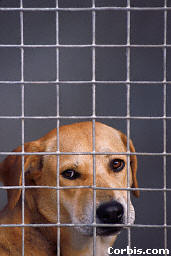 FIG. 11
Is this one dog? Or nineteen square portions that just look like one dog when placed behind this cage?
|
| In the example of Fig. 11, the lines that make up the dog are cut into sections by the grid of the cage that is in front of it. Even though the lines that make up the dog are interrupted by the grid, the Law of Good Continuation helps us to see the lines as continuous, and so we see one dog. But it is plausible for the image to be made up of 19 cubed sections of lines, placed behind the grid, so that the seams between the cubes are covered up by the wires of the grid. However, my brain makes the assumption that the lines are continuous. The fact that I recognize the image as a dog probably helps me to connect the lines, and if I saw the dog move behind the grid, it would be even easier to see the lines as continuous. |
| The Gestalt Laws of Grouping describe how it is decided that objects in an image are separated into groups. The deciding factors are proximity, similarity in shape, symmetry, enclosure, and apparent continuity. Obviously, if more of these factors are covered, the separation or grouping becomes apparently stronger. |
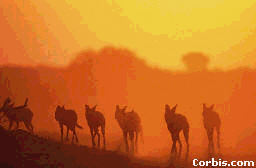 FIG. 12
The animals are grouped as different from the landscape, and, within that group, are separated into three groups.
|
| The silhouettes of the animals in Fig. 12 are grouped as separate from the landscape. This is because of their enclosed shapes and their contrast against the background. The unison between them as a group is also enhanced by the similarity in shape between the six of them. Within the group of "animal shapes" another separation occurs. They are grouped into three groups because of proximity-the two on the right, the three in the middle, and one on the left. The shapes are not equally spaced from each other, and so they are grouped into three. |
| Size constancy is our tendency to see objects as their actual size in relation to each other, despite their sizes on the retina. Size constancy, therefore, helps us to see objects as being in a depth of field. Without size constancy, all objects would seem to be the same distance and out of proportion in relation to each other. |
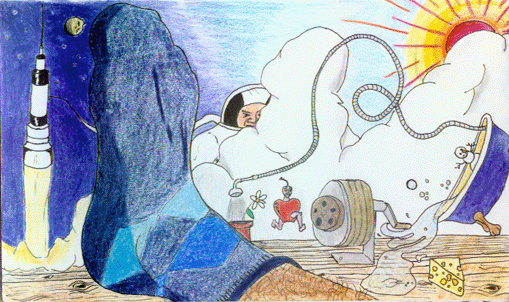 FIG. 13
Is that an enormous foot? A small rocket ship? Or are they at different distances?
|
| I played with size constancy in this picture I drew a few years ago (Fig. 13). The objects are different sizes on the two-dimensional surface of the page. Normally size constancy would make me see the foot as being closer, and the other objects as being farther away. But all the objects in the picture are on the same wood floor which puts them in the same space, or at the same distance. This makes the foot seem very big, and the other objects very small. |
| Shading helps us to see shapes as three-dimensional in a two-dimensional image. We normally see light in a two-dimensional image as coming from above, being a singular source, and being diffuse. These assumptions change the way we interpret the "three-dimensional" shapes in the image. |
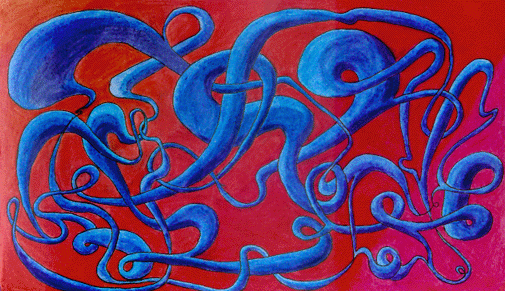 FIG. 14
These could be seen as tubes or slides.
|
| So, for example, this picture (Fig. 14) is usually seen as convex-shaped tubes. This is helped by the fact that the background may be suggesting where the light source is coming from-the lighter orange in the top left corner becomes dark red in the bottom right corner. However, if that clue is ignored, you can see these tubes as concave shapes, like a crazy set of slides. |
| Visual pop-out refers to an object that stands out in contrast to other objects in an image. When looking for that specific object among the other objects in the image, it appears to "pop-out" from the group because it is different. It takes little time to pick out that object from the group because of this pop-out effect. |
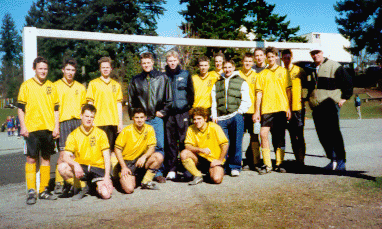 FIG. 15
We should have been called the Kerrisdale Visual Pop-outs.
|
| My soccer team is a good example of visual pop-out (Fig. 15). We depended on visual pop-out to locate where we were on the field. I always thought our jerseys were the best because the yellow stands out, or pops out, so vividly against the surrounding grey and brown and dark colours of the soccer pitch. In fact, I never understood why some teams had jerseys that were dark colours. When using my peripheral vision, it was always easy to spot my team mates because the yellow jerseys popped out. |
| With atmospheric perspective, the colour, the sharpness of the edges, and the brightness and contrast of objects change as they get further away. The light that bounces off distant objects travels a longer distance to reach the viewer's eye. In travelling this longer distance, the light has more chance to be blocked by dust in the air, reducing the objects brightness. Also, this light will be more scattered, making the object (its edges) more blurred, and also affecting the colour. |
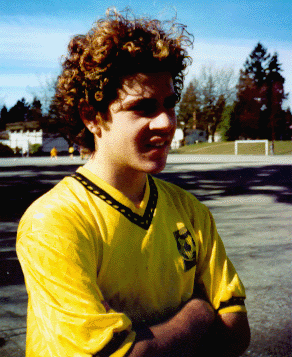 FIG. 16
Atmospheric perspective is a clue to depth.
|
| This photo (Fig. 16) demonstrates atmospheric perspective. The foreground (my shirt) is more in focus, has more saturated colour, and has greater contrast than the background-the trees look almost black, all the edges are blurry, and the contrast is more uniform. This is because (at least, partly) the light coming from the objects in the background is farther away and passes through more dust and fog in the air. If the air were to be dustier and foggier the reduction of the colour saturation, edge definition, and contrast would be greater. |
| When light passes through a prism, the white light is broken into the spectrum of colours. This is because colours refract at different degrees when passing through the prism. Newton showed that white light is a mixture of all the colours in the spectrum by dispersing white light into the spectrum with one prism and then recombining them into white light again by using a second prism. |
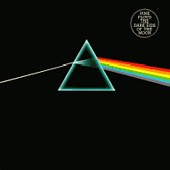 FIG. 17
A fitting album design for this concept album by Pink Floyd.
|
| The musical group Pink Floyd used this diagram (Fig. 17) as part of the design for their album Dark Side of the Moon. The front cover shows the light being bent through a prism. The spectrum can be followed into the inside of the cover when the LP gatefold is opened. The spectrum continues all the way around, and eventually connects again with the front. Part of the concept behind the album is the cyclical patterns in life that can make you crazy. The album begins and ends with a heart beating. In this way, the album design is indicative of the cyclical themes. It begins as one, is divided into many, and returns to being one again eventually. |
| Regarding pattern recognition, there is a theory about an object's orientation affecting our perception of it. It seems that we store key positions of an objects possible orientations, and then, when we are presented with a slightly varied image of that object, we are able to rotate it to the key position which then enables us to recognize what it is. There are, in other words, canons for the recognition of objects; when you think of a truck, in your mind, its image is from the "idealized perspective", or the position that describes the truck best. The question then is, what are these key positions (or "idealized perspectives") in which we remember an object? |
 FIG. 18
30 bucks for a blue box?! No, 30 bucks for a blue box with a 140 watt power inverter inside it�
|
| Advertisements always try to present the item for sale in the position that describes the object best. When you look through an advertisement catalogue, you are supposed to be able to understand what each item is at first glance. I was recently looking through the Jameco Electronics catalogue (Fig. 18). The images of the items try to show as much as they can about each of them. However, I do need the descriptions to describe what I cannot see, or else the 140 Watt Power Inverter may only be a pretty blue box. The image doesn't tell me what is inside the box-the electronic components. |
| Different materials absorb different wavelengths of light. The colour an object appears to be is the colour that is not absorbed by the material, and is therefore allowed to travel back to the eye. So, when you see something blue, it is because the blue wavelength was not absorbed by the material off which the light bounced. |
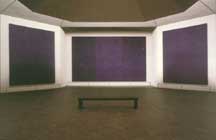 FIG. 19
All colours are absorbed by these paintings by Rothko in the chapel named after him.
|
| Mark Rothko painted a series of paintings which are entirely black (Fig. 19) for a chapel in Houston. In this case, all colour wavelengths are absorbed, and none are left free to reach the viewers eye. This is a very strong concept, one which reflect the nature of meditation which takes place in the chapel. I haven't seen these particular Rothko painting, but I've seen other ones. You become totally engulfed by their presence. The ones I saw were reds and oranges and greens� I wonder what affect black would have, seeing as it absorbs all colour. |
| Internal reflection occurs on a surface that is covered by a transparent coating, such as water, oil, varnish, or wax. Light enters and passes through the coating and is reflected off of the surface. However, not all of the light that enters the coating to reflect off of the surface will exit at its first attempt. Some of the rays of light will try to exit the coating but will make contact at a shallow angle which is beyond the critical angle-the shallowest angle that a ray must hit the coating in order for it to be refracted and not reflected. So, some rays of light will keep reflecting back and forth until they hit the coating at an angle that is steep enough to refract through. What happens, then, is that a material with a transparent coating looks darker (because less light exits after contacting the surface) and more saturated (because the light that does exit will have hit the surface a number of times). |
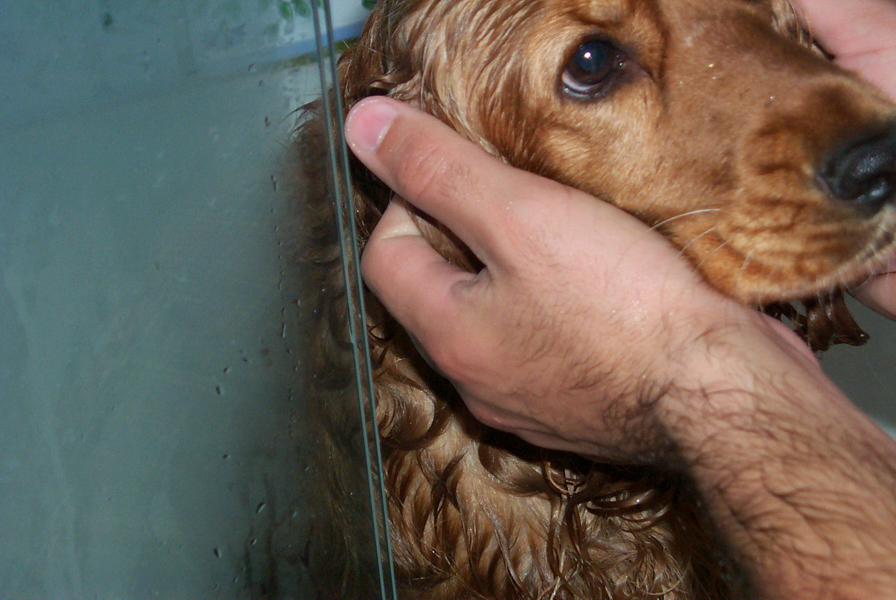 FIG. 20
The colour of this dog's red coat is intensified because it is wet.
|
| That's why when a dog with a nice red coat (Fig. 20) gets wet, the coat becomes a darker intense red than when it is dry. The water traps the light that enters it. The coat looks darker because less light is immediately reflected to the eye of the viewer. The red is more saturated because the light has hit the surface of the dog's hair again and again, which is more light than the coat receives when it is dry. |
