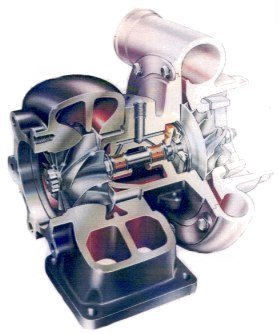
 Picture shows insides of a turbocharger.
Turbochargers Explained
The turbocharger uses waste energy from the escaping exhaust gas to drive a turbine.
If you cut a turbo in half. You would find a turbine wheel and a compressor wheel, connected by a shaft. The exhaust gas causes the turbine to spin up very fast, driving the compressor wheel in excess of 300,000 rpm. Which then sucks in massive amounts of air, and instead of the engine just sucking its own air. It is literally forced in under pressure.
The delay it takes the turbocharger to spin up to full speed, is known as the 'lag'. The turbo has a distinctive whistle when up to full speed. When the accelerator pedal is pressed, the turbo will spin up to the above speed, in less than a few seconds ( when exhaust pressure manifold pressure is high enough ), no bearing could ever stand this sort of pressure, so the shaft floats on a film of oil. This also has an advantage, of removing some of the excess heat generated from the exhaust side of the turbo. In hard to medium driving the turbo can glow red!. This is why you should always, leave the car ticking over at ideal for about 8 - 20 seconds ( depending on how hard driven ), so the oil passing through the turbo can remove some of the excess heat.
A greater advantage of getting even more power out is to intercool. When the air from the turbo is compressed it generates heat in excess of 350'c.
If you have ever pumped up a tire with a foot pump, you may have noticed that the cylinders of the pump. And also the valve get hot. This is due to the friction of the air being compressed. An intercooler, is a device that sits between the turbocharger. And the inlet of the engine ( plenum ). Its purpose is to remove some of the heat generated. It looks simulur to a water radiator and has the same purpose, except it cools air, not water.
Picture shows insides of a turbocharger.