SAINT ORLAND'S STONE
The stone is nearly rectangular, having
a slight taper from bottom towards the top.
It is carved on the front and back, but not the sides.
At some point it has broken, or been broken, about one third of
the way down, and originally it had been pinned back and front
with iron straps. It has since had the back straps moved to the
sides, and the holes plugged with mortar.
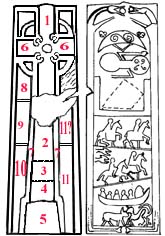
The dotted area on the drawing, below the double-disc and z-rod,
is a missing slab. There are clear signs of chisel marks, which
raises the question, was the section chiselled out, or do the
marks represent someone's attempts to provide a key for mortar to
cement the piece back in?
One possibility is that the stone fell, split in two, the piece
sprung loose, and was not found when the stone was repaired.
A large section of the lacework on the cross side is still lost.
Another possibility is that someone found whatever was in the
mini-frame offensive, and had it chiselled out, much in the way
that people deface the relics of other people's religions by
gouging out eyes, or chipping off faces etc. A mis-strike by the
mason caused the stone to split right across.
Perhaps the "missing" bit is still lying at the top of
the mound?
[Key to Diagram.]
- Indistinct. (Interlace?)
- Indistinct. (Interlace?)
- Spiral Type A interlocking (3 rows)
- Indistinct. (Interlace?)
- Knotwork Type A.
- Spiral Type B.
- Spiral Type A (Mainly - slightly
erratic in places).
- Assorted knotwork.
- Indistinct.
- Interlocking beasts?
- From bottom - Eel-like creature
with knotted tail (with human head?) takes up about 1/3
of height. It is difficult to say whether the the other 2/3
are all one design. It appears to be a fish with a body
made up of knotwork, ending in what looks like a human
head, with arms raised above it, hands resting on the
head. Above this again a carved semi-circle giving way to
knotwork which seems to include a disc with a leg over it.
Unfortunately, this knotwork disappears into the broken
segment.
The Cross:-
- It gives the appearance of a cross
overlaid on a larger wheeled cross, but both are carved
in relief on a solid slab.
- It is richly ornamented with relief
carving, all abstract except from a curious tangle at the
bottom RH corner, which may include a human head. Other
people see a face there, but it is difficult to decide
whether it is a head, or just an accident of
weathering. The carving is not of the best quality to
begin with.
- Due to the breakage, a substantial
chunk of carving is missing from the RH side, and the
shaft of the cross, but the LH side is intact.
- The "squareness" of the
wheel is apparently caused by using the lobes of the
upper cross as centres to define the arcs of the lower
cross. The asymetry of my drawing faithfully reflects the
actual carving. It wasn't obvious at first, because our
human mind tidies these things up, but an examination of
the stone, or a good photo of it, shows up the
discrepancies.
- The middle true circle is empty,
although deeply cut, as if to receive a metal boss, or a
stone of some other type.
On the other hand, this area of plainness may have some
symbolic value of its own.
I don't know if this makes it unique, but I haven't heard
of it before. Centres of crosses are usually decorated.
The Pictorial Side:-
- The other side of the slab is
framed by knotwork patterns that end at the top with a
pair of animal heads facing each other. These heads each
appear to be biting a disc in their long jaws. They both
have one outstretched leg which may or may not have been
holding something. The area is too defaced to make out.
At the bottom of the slab, the interlace ends in two
fishtails facing one another.
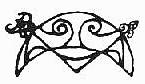
- Immediately below this is a
crescent-and-V-rod. The crescent has the two-spiral
decoration.
- Below this, a double-disc-and-Z-rod.
The top of the Z cuts into the bottom of the V. Each disc
carries the 4-spiral decoration.
- Next comes the mini-framed missing
section.
Whether you talk about 4 or 5 panels depends on whether
you regard this topless frame as a panel in its own right,
or merely part of the crescent and double-disc section.
N.B. The frame was only ever 3-sided. The carving
indicates this. The fourth side was not lost when
the stone broke.
- The next part is distinctly
separated and different.
Two horsemen ride from Left to Right, here. The LH
horseman has long hair and appears to be cleanshaven,
with either a collar or ponytail. The RH rider has long
hair and a beard. Both appear to have saddlecloths which
cover their bottom legs. Both horses have bobbed tails.
The downward sloping ridge between them and the panel
below acts as the ground their horses walk on.
- The next panel has two hounds
stretched out in pursuit, up in the LH corner, filling
the gap above the LH horseman, who appears to be short-haired
and cleanshaven. The RH horseman appears to be bearded,
with long wavy hair. Both horses have long tails, and
both riders have distinctly visible forelegs and feet, so
no saddlecloths. The divider here slopes upwards.
- The bottom-most panel has five
definite people sitting in a boat with upcurved ends. The
sixth, larger shape is indistinct, but judging by photos
taken about 1900, it might represent an important person
(made larger than lesser mortals) with long hair, looking
back at the others in the boat.
There is no sign of sails or oars, although it has been
suggested that the now indistinct shape is a sail.
I thought it might be a wicker "cabin".
At any rate, it lacks the detail that often gives Pictish
art its character. Either the carver didn't know exactly
how to depict it, or the bald statement 'He came in a
boat' was sufficient. Who knows?
Boats are rare on Pictish carving, so its inclusion must
be significant.
- Beneath the boat there is the
bizarre scene of a horned cow or bull being gripped by
the head, by a strange beast looking like an 'S' turned
through 90 degrees. At first glance, the beast looks like
a camel, but its spindly legs end in vicious claws, with
prominent hackles on the back of the lower legs.
Is the weird animal attacking the ox a reference to a
successful conversion of bull-cultists? Or is it about a
folk-tale of some kind?
The stone stands on a sandy outcrop in a
marshy area. Before it was drained, it must have represented the
classic hermit's retreat - an island in inhospitable bogland.
So far so good.
The stone is easily described, but then the
questions start:-
- Who was St Orland?
- Why is the farm that surrounds it
called Cossins?
- Why the boat? Boats are extremely
rare in Pictish carving.
- Why is what appears to be a
freestanding cross on a plinth, portrayed in shallow
relief, overlying another cross?
- Is he a lost saint? I have found no reference to St
Orland.
Was there a confusion with some other saint? Say St Orwin's
Land? Or St Oran?
Margaret Gelling, in her "Place-names in the
Landscape", gives the word 'alor' and its various
pronunciations as Old English for Alder tree. Alor-land
would have been appropriate for a boggy morass because
alders prefer wet surroundings.
The same book gives the word 'gore', as meaning a wedge
of dry ground, again appropriate to the site, and also
because the word comes from N. Yorkshire, a source of
missionaries to Pictland.
Kenneth Cameron's "English Placenames" gives 'or'
as a prefix from Old English 'ora' which means border,
bank, or riverbank.
These are English derivations, but 'land' would not have
been in use in Pictish times, unless Pictish had a Nordic
or Germanic element in it. Apparently the Scots Gaelic
for 'land' is 'tir', although what it was a thousand
years ago, I don't know.
It might derive from the Doric 'orra' (pronounced with a
flat 'oh' as opposed to the English 'aw') meaning dirty/undesirable
land, in the same way as the lowest labourer on a farm
was called the 'orraman', the one who did all the
filthiest, most unpleasant tasks.
For a last speculation, see item 3 (b).
- (a) Cossans/ Cossins might derive
from the Gaelic 'coissin' - to win- which would be
appropriate to land that has had to be drained to be
usable.
Indeed, the day we went to examine the stone, there was
evidence that a combine harvester had become bogged down
in the peat. Either it had broken the field drains in its
struggle to get out, or the drains had blocked or broken
and caused the quagmire the machine had sunk into. Some
of the surrounding fields are still full of reeds.
(b) Might 'cossins' refer to a battle, or the conversion
or 'winning-over' of the local tribe?
- (a) Did the person who caused the
stone to be erected come by boat originally? Was he an
evangelical from Iona, or did he sail up the coast from
Northumbria?
(b) One of the derivations of Orland might be 'Irish land'
Apparently there is a word 'or' which means 'West' or 'Irish'
, as in Orford - Irishmen's Ford, and given the Irish
tendency to talk about 'Oireland', I don't find it too
far-fetched. Modern Scots Gaelic has 'an iar' for 'westerly'.
- This question might be answered by
studying the stylistic differences between sculptors. Did
the free-standing 'Celtic' crosses from Iona, with
separate bases not appeal to the Picts of North-East
Scotland? It certainly resembles a free-standing wheeled
cross, but as said, it is all carved on the flat.
When we come to the so-called Aberlemno No2 Cross-slab,
we shall see what appears to be someone beginning to make
the cross more similar to the free-standing variety by
cutting through the 'eyes' in the cross.