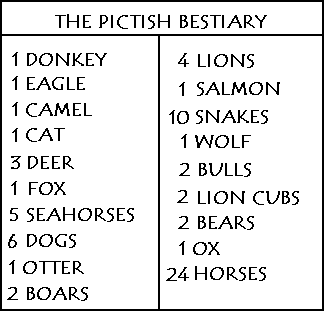
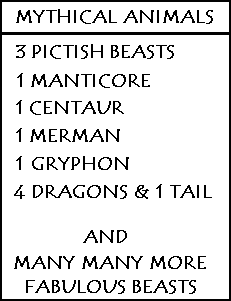
Meigle Museum has the best collection of Pictish sculpture in Scotland. There are twenty-odd stones here, from the massive Vanora Monument to smaller broken slabs. Most of them have carvings of at least one animal on them, others have many more.
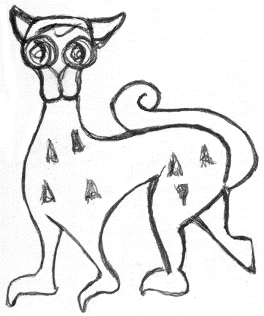
So what creatures would you expect to find on late Pictish stones? Horses? There are a whole herd of them. Snakes? At least ten, some knotted in pairs, others curled around each other. And what about the famous Pictish Beast, aka the 'Swimming Elephant'? There are three of them here.
But at Meigle you also meet with the unexpected - a camel kneeling on its front legs; a sleeping otter; two pairs of seahorses dancing with each other; four friendly lions licking the praying Daniel.
Not all the creatures portrayed here are good-natured, though.Some of them are downright aggressive - two bulls face up to each other, eyeball to eyeball; a wolf brings down a mature stag; a manticore stalks a frightened man; two mythical beasts devour a human body; a hound chases a fox; a dragon grasps the muzzle of an ox in its powerful jaws; a bear chases two people up a tree. And everywhere, there are biting beasts, gripping and being gripped.
Some of the creatures are realistically portrayed, like the horses. Others are shape-shifters, like the birds that edge one recumbent stone whose bodies develop into knotwork and end as fierce animals, with jaws gaping and fangs extended.
On another stone, a quadruped weaves in and out of its own body, and a creature with deeply chiselled claws stalks off a slab that might once have been a lintel.
Another massive gravestone, the only hogback in the collection, is shaped like the severed tail of a dragon, complete with scales. And last but not least, could that long sinuous fish monster with five pairs of fins be a coelacanth, or an early representation of the Loch Ness Monster? St Columba met Nessie on his travels, so just maybe.....