| Back to Homepage |
Labyrinths
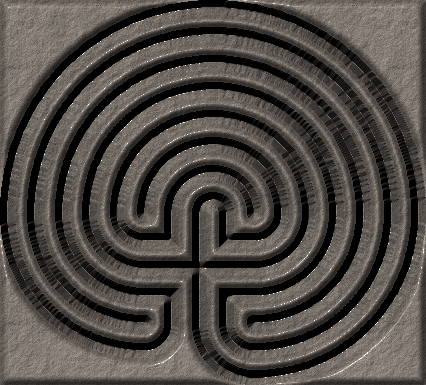
Possibly one of the oldest abstract designs to be found replicated around the world, with a particularly high concentration of surviving examples in N.W. Europe.
The oldest known example, found carved into mammoth ivory has been dated to 30 000 bc, this same meandering design, known in ice-age Siberia, can be found carved into Neolithic tombs in Sardinia, is well known in the Tamil Nadu district of India, where it occurs not only on ancient dolmens, but also carved on Hindu temples and in early manuscripts.
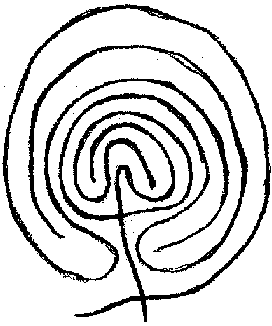
Luzzanas Sardinia
These miniature representations undoubtably attempt to reproduce the greater labyrinths which were designed for ritual progress. The 100+ turf and 500 or so stone examples found in N.W. Europe are of a size large enough to be walked (or run) by either a single walker or a single file of walkers.
Pampa Ingenio Peru
Recent theories ( more credible than those of Von Danichen) regarding the Nasca lines in Peru suggest that the lines were created for a single file of people to walk in ritual progress. Interestingly, it is believed that the following devotees followed the lines cut into the desert, whereas European labyrinth design created walls for walkers to walk between. The design of the labyrinth at Pampa Ingenio in Peru (dated to c.500a.d.) is correspondingly a map of a line to be followed rather than walls to be channelled by.
Ballygowan Argyll
Although there is a passing similarity between the classical labyrinth design and the cup and ring marks found throughout the British Isles; (see examples below) ; I have yet to find a site that reproduces the labyrinth pattern in miniature alongside the similar cup and ring marks.
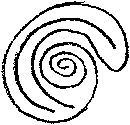
Newgrange Ireland
However, the geometric relationship between key patterns and labyrinths is rather surprising; the labyrinth design can be found repeated four times on the X of the Christ name-page of the book of Kells.
If you can find a space (you will need c. 35x35 feet) it is well worth the bother to lay out a labyrinth of your own. I used canes laid out on a lawn to make a temporary one, but lines drawn on sand would be just as good. Walking (or better, running) the labyrinth is surprisingly good fun and (in my experience) provoked a strange euphoria in all who tried it.
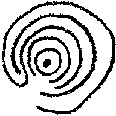
Seskilgreen
If you are lucky you may be near to an existing labyrinth, these are often called 'the walls of troy' or 'mizmaze'. For a comprehensive gazetteer of sites and a wealth of information on this fascinating subject I would reccommend contacting Caerdroia.
Padugula Southern India
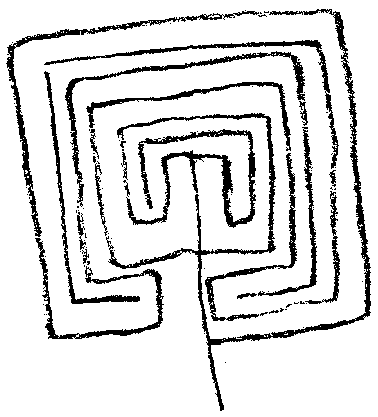
Oraibi Arizona