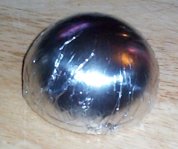
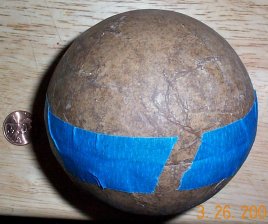
This is my 4" shell form Here is a completed shell with the hemi's taped together
Shells are the most impressive display of fireworks I believe. These are what compromise the majority of devices seen at professional displays.
First you need to figure out what size and shape of a shell you want. Usually this is determined by what size of a mortar you can get or have on hand. For firing your shells safely you either needs a HDPE or steel mortar. You CAN use PVC or ABS pipe like I do. But I have built a brick wall to fire the mortars behind to protect me and the audience from shrapnel if they were to rupture. Make sure if you use ABS or PVC to make it safe. Barricade it behind something. Your mortar needs to be 6-7 times as long as its internal diameter. I use 7 times for good measure. I like to use 4" spherical shells for my main display. I get a good symmetrical break with these, and they give a good display. I also use 2" canister shells for salute inserts and non-symmetrical breaking shells. These perform well. I always use American visco for my time fuse. I cut it at an angle then prime it with BP slurry, then roll it in corning dust. Also, you can make a multiple shot mortar system, a cake. Just by making tubes, and securing them together, then fusing them together.
For making spherical shells I found a 3-3/4" diameter form I use to make my hemispheres. I put a layer of aluminum foil over it, then 3 pieces of Kraft paper soaked in my wood glue solution. I cut V's into the paper to keep the folding over to a minimum. I work this paper over the form until I am satisfied with it. Then I let it dry, cut off the excess paper around the bottom and sand it a bit. I then rotate the hemi on a piece of sandpaper to even out the edges.
This is my 4" shell form
Here is a completed shell with the hemi's taped together
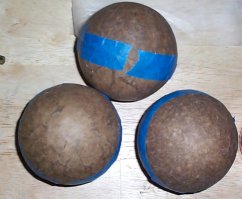
Here are three of my shells waiting to be fused and filled.
For making cylindrical shells I use a piece of toilet paper tube, 4 inches long. I then paste a 30 inch length of Kraft paper over it to make it a bit stronger. This gives it about 6-7 wraps. I let it dry then cut the edges 3/4" in in little strips so I can fold them over the end discs. This gives me a finished shell of 2-1/2" long. Put in one end disc, glue and fold the edges over and put another disc on top with glue. Compress this and hold until glue dries. I have found it easier to insert the fuse first, and glue it in, then add the shell contents and close with another disc, fold edges down and seal with top disc. Clamp this until it dries. Next you can spike the shell and add a few layers of pasting.
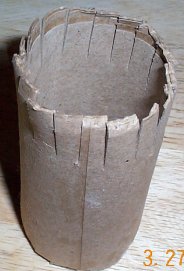
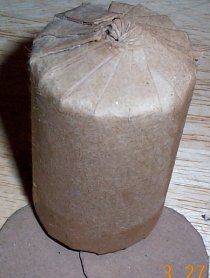
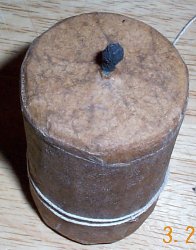
Here is the shell with
slits
The shells folded
over
Completed shell
To make a cake is easy enough. You roll as many tubes as you want shots, these will be your mortars. Let the tubes dry then ram a clay plug as thick as the tube is wide. Arrange the tubes next to each other, however many you want, and glue them together. After that's done, drill two holes 1/8" wide just above the top of the plug into the tube. One hole at the side next to a tube, and the other hole next to the next tube. Insert your fuse about 1-1/2" long into the hole, then put the other end of the fuse into the hole in the next tube. Repeat until they are all fused. Make another row of tubes, and glue them to the first row, then ram the plug and fuse these ones. Make as many rows as you want. Now after it is all glued and fused you need to make some shells. Roll some tubes around a dowel that will fit into the mortar tubes. Cut them to length and let them dry. Make endplugs, add fuse, stars and bursting powder and glue on the other plug. Insert your measured amount of lift, drop in the shell and repeat for all tubes.
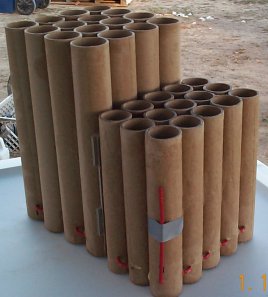
This is my 31 shot cake