
This page is particularly for those who could never be satisfied with the explanations they found in regular material regarding the twin paradox. You just needed to search the right place! Forget about all the complicated mathematics, that's not what physics is about. Even those who've just heard all of it somewhere - Einstein, relativity, and the works - and are interested in it, would find this page quite amusing!
Physics has the beauty of explaining the most damned confusing shit in a way so simple that you'd wonder why it didn't occur to you earlier! And that's the quality I've utilized here to elucidate the causes, effects, reasons, and clarification of the most intriguing result of Einstein's Special Theory of Relativity.
The twin paradox uses the symmetry of time dilation to produce a situation that's seemingly paradoxical. However, before we go into the details, there are a few things you should know beforehand. Below are the list of topics which are - very concisely - touched upon in the following paragraphs.
Click here to skip these if you're already familiar.
Well, the most special fact is that it's Einstein's theory after all! That apart, it's prefixed with "special" because it's applicable to inertial frames of reference. The concept that's applicable everywhere, in all frames, is rightly named The General Theory of Relativity. Albert dude made two basic and really simple postulates in this theory:
The first postulate is quite simple to understand, and there's no hidden controversy in it either. The only thing you've to keep in mind is that everything is "relative" to your observation point (~ reference frame). Nothing is absolute. If you say you're standing on the road, you're stationary only with respect to the road, roughly with respect to the earth too. but say, with respect to the sun, you're revolving around it, at the same time undergoing a periodic motion due to the earth's rotation. Similarly, a car on road seems to be in motion to you, but to the person inside, it seems that you, the other people, trees, the road, houses, everything, is moving backwards, and they are stationary. We are just so accustomed to the phenomenon that when we see such a sight, we immediately realize it's us that's moving forward. Taking advantage of that, lets say you're standing at a place, where there's a black cylindrical wall with helical white paint on it surrounding you. If that cylinder is made to revolve about its axis, you'll feel that you're moving ahead/back depending on the orientation of the paint "screw". A somewhat similar effect - though hardly effective - can be seen in the image below:
Now when you ponder a bit over the second postulate you realize there's
either been an error in writing or there's something seriously wrong with your
concept of the laws of physics! For the slightly slow graspers, here's why:
Assuming you're a (straight) guy, imagine you having a mean-machine that travels
at half the speed of light, i.e. c/2. And you manage to snatch away the girl
you've been eyeing since weeks right from under the nose of her geek boyfriend!
Then you drive away at top speed, not knowing the geek chap has a superb laser
gun, and he fires off a beam of photons at you, but misses! Now, from the frame
of the geek you're moving at a speed of c/2, and the photon beam's moving at
speed c. So? Problem happens when you look at things from your machine: you're
going away from the geek at a speed of c/2 (which means to you he's moving with
a velocity of -c/2), BUT the photon jet is still moving away from you at a speed
of c! Well, yes, according to Einstein (and experiments conducted by a load of
scientists before and after him), the speed of light will ALWAYS be c, no matter
where you're measuring it from (in vacuum, of course). That's where and why the
concepts of length contraction and time dilation come in the picture.
When a body moves along its length at a speed comparable to that of light, a shortening in length is noticeable. but there is no change in the breadth: i.e., the part of the body that is perpendicular to the motion. For example, if a pencil is somehow made to move perfectly straight, its tip pointing forward, at a speed, say 1/10th of that of light. It's length will reduce from 100mm to 99.498 mm. Below is the Lorentz factor:
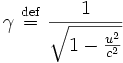
u = speed at which object is traveling
c = speed of light
gamma = Lorentz factor
The relation between "rest" length and "moving" length is given by : L0 = γL where L0 is the rest length, L is the moving length. Note that if you try to measure the length of the pencil when in motion with a ruler, it'll turn out to be 100mm, not 99.5mm. Guess why? Because the ruler has undergone length contraction too, and by the same factor. All objects that are going at that speed will experience length contraction. Another thing: there isn't necessarily an object required to experience length contraction: say an astronaut travels from earth to mars at such impossible speeds: the distance traveled for him is lesser than the distance we'd calculate. As mentioned since the beginning: this is all relative.
For a detailed account on why it happens (like how that gamma thing appeared), there will be some math involved, so I'm omitting it here. Lets just assume its true.
Similar to length contraction, there is a phenomenon called time dilation: and the effect is quite clear from the name itself: the rate of flow of time slows down for a person who's moving at high speed. Now this is quite confusing: I'd said earlier that if two objects have relative motion between them (i.e., they're either going apart or coming closer), then we can't say that it is that object which is at rest and the other in motion, it's all relative. So, you might ask: if there are two people, say Jack and Jill. Both of them are wearing synchronized watches and have a telescope to look at the other's watch too. Jack starts moving (in an inertial manner) away from Jill, and they record the time seen by each person in both watches for sometime, then Jack returns. Question: who is the one whose watch will seem slower to the other? Answer: both. To Jack, it'll be Jill's watch that's slower, and for Jill, it'll be Jack's. This is an inconceivable situation, but it's true. Why we cannot imagine it is because we have never experienced motion at such high speeds. But I suppose you're smart enough to realize how length contraction and time dilation occur in harmony so as to keep the ratio of length/time for the speed of light constant! This is where it all comes from, actually, not the other way round. As postulated by Einstein, the speed of light measured in any frame should be "c". Hence if measured from a frame that's in motion, it should appear to be less/more depending on our relative velocity with respect to light, but it is always "c". This adjustment is done by the two phenomena: length contracts and the flow of time slows down, so as to always maintain the experimentally calculated value of the speed of light at a fixed value: c.
So what is this twin paradox then? What happens is: if there are two twins, lets take Jack and Jill again, and Jack travels at light-comparable speeds to some destination, turns around and returns home, he'll find Jill to have aged more than him. As Einstein had once said:
“ If we placed a living organism in a box ... one could arrange that the organism, after any arbitrary lengthy flight, could be returned to its original spot in a scarcely altered condition, while corresponding organisms which had remained in their original positions had already long since given way to new generations. For the moving organism the lengthy time of the journey was a mere instant, provided the motion took place with approximately the speed of light. (in Resnick and Halliday, 1992) ”Now, according to Jill, Jack's onboard clocks (mechanical and biological) will run slower, hence this is quite expected. But according to Jack, Jill's the one who's moving, and she's the one who'll experience time dilation and length contraction and all that shit, so she should be one who's younger. Who, then, is correct? According to the proponents of the paradox, there is a symmetry between the two observers, so, just plugging in the equations of relativity, each will predict that the other is younger. This cannot be simultaneously true for both so, if the argument is correct, relativity is wrong.
A naive interpretation would be to assume that the situations of both Jack and Jill are symmetrical. Whether we look at it from Jack or Jill's point of view, that doesn't change the picture, Einstein said the frame of reference doesn't make any difference, didn't he? And hence, if a situation is identical from both points of view, the results should also be identical, right?
Although it appears so, when you think a bit, you'll realize there's a difference. There is a special something that happened to only ONE of them, and hence the asymmetry appears, and the paradox vanishes. What is it?
Only ONE of them ACTUALLY had to stop, turn around, and start again. Hence,
ONE of them experienced acceleration. Who was it? Quite obviously, the person in
the spacecraft.
Although Jill was throughout in a single inertial frame of reference, that case
is not true for Jack. There are THREE different frames in which Jack was: one
while going, another while coming, and the third while turning around. The third
frame is non-inertial, and special relativity cannot be applied there. But this
"paradox" can be explained without having any knowledge of general relativity.
As you've understood, Jack has an asymmetry with respect to Jill, that alone makes all the difference. You might not understand why. Let me explain it in a very crude way: firstly, Jill and the point of destination of Jack (say Mars) are a constant distance apart. Hence there is no relative motion between Jill and Mars, so there is no relativistic effect either. For Jack, there IS relative motion between him and Mars. Now, a little off the mark: some people might say that since it is that point of acceleration that causes all this trouble, if we minimize it, and extend the journey infinitely, then the effects should be negligible? The reasons below also explain why the exact opposite will happen:
Here's the first reason why he'll return younger: for him the distance between Earth and Mars will contract. It will appear to him that he's traveling a smaller distance (say 9999 kms) than what will appear to Jill (10000 kms). And it obviously takes less time to travel 9999 kms than 10000 kms. So, although for Jill, the time passed is equivalent to Jack having traveled 10000 kms, for Jack, the time elapsed is the time taken for him travel 9999 kms.
The second reason. Lets assume they both sent each other a beacon at regular intervals. Note here: what seem as regular intervals for Jill will not be the same for Jack; and vice versa. But for that, we'll need space-time graphs to elucidate. Lets not get into all that complications. Just a simple reason is that Jack will experience the acceleration and its effects immediately, as soon as it takes place. Whereas Jill will be able to notice a change in Jack's behavior only after the first signal he sent after accelerating reaches her, which is obviously going to take some time, depending on how far away he is.
Now, as I'd mentioned earlier: on extending the journey and minimizing the duration of acceleration we will not get a negligible relativistic effect, but an ever more increased one. Because, firstly, the more the length of travel is, the more contraction will take place, Jack will be traveling lesser, hence will be younger. And, the farther apart the point of turning around is, the more time it'll take for the first signal sent after accelerating to reach Jill.
Well, I hope that cleared everything then! For more references try these out: